Anyone who has run qualitative user discovery or in-depth interviews (IDIs) knows the paradox of the craft:
One-on-one customer interviews yield the sharpest commercial breakthroughs, yet they are among the most exhausting, calendar-heavy grunts in business.
In a traditional research cycle, a seasoned interviewer can realistically conduct three or four quality sessions a day. Between scheduling cancellations, compensating participants, transcribing hours of audio, and tagging qualitative themes, a small team caps out at twenty to thirty interviews per month.^1
This reality forces teams into an uncomfortable compromise:
- If you want statistical volume, you send out a rigid multiple-choice survey—but surveys rarely uncover the unscripted motivations that shape buying decisions.
- If you want nuanced depth, you interview a small handful of buyers—only to have leadership question whether twenty conversations truly represent your entire addressable market.
Now, multimodal voice agents—such as Listen Labs (acquired by Salesforce for a reported $2B) and Outset—have shattered that constraint.^2 An autonomous agent can conduct five hundred adaptive, conversational voice calls in forty-eight hours, asking follow-up questions tailored to each participant's answers.
This does not mean human researchers are obsolete. It means qualitative research is entering an era of practical division of labor.
Below is a calm, neutral breakdown of the distinct strengths of both approaches, followed by a three-stage relay framework that modern teams use to combine them.
1. Where Each Approach Holds a Distinct Advantage
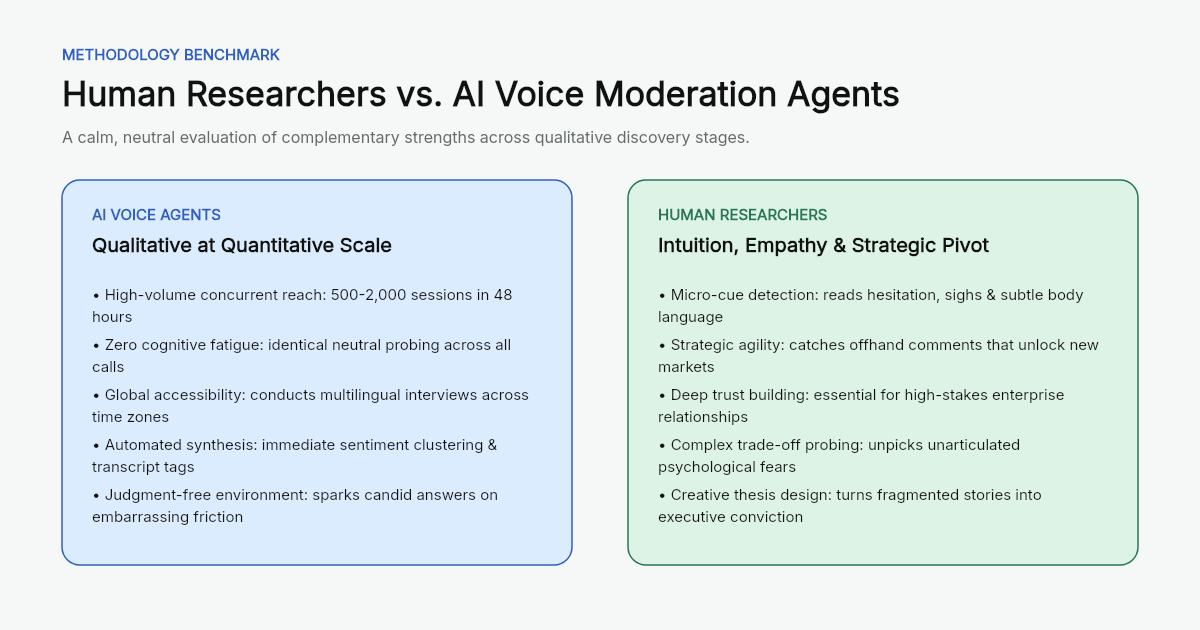 Figure 1: Objective benchmark comparing the distinct structural strengths of AI voice moderation agents and experienced human researchers.
The Unique Strengths of AI Voice Moderation Agents
AI interviewers are not mechanical forms read aloud by a robotic text-to-speech engine; they listen, interpret context, and probe vague replies. They provide three massive structural advantages:
- Qualitative Depth at Quantitative Scale: The single greatest shift is volume. A team can launch a qualitative study on Friday evening and review synthesized, thematic takeaways from eight hundred participants across five continents by Monday morning.
- Eliminating Cognitive Fatigue and Moderator Bias: Even veteran researchers experience mental fog after their fourth interview of the day, inadvertently steering questions to confirm internal biases (confirmation bias). An AI agent listens with identical patience, neutrality, and adherence to the study guide during call #1 and call #800.
- The "Judgment-Free" Confession Effect: When speaking to a live human, participants frequently succumb to social desirability bias—softening their complaints or pretending they use features they actually ignore. Talking to an impartial AI interface often prompts candid, unfiltered admissions about daily workarounds and product frustrations.
The Unique Strengths of Seasoned Human Researchers
When gathering high-stakes competitive intelligence or conducting granular competitor research against incumbents, breakthroughs still depend on human intuition:
- Micro-Cue and Body Language Interpretation: When a buyer claims an onboarding flow was "fine," but takes a sharp breath, pauses for three seconds, and glances away, a skilled human interviewer immediately catches the friction. A gentle, instinctive follow-up ("You sounded a little hesitant just now—what felt awkward?") regularly unlocks the actual product flaw.
- Capitalizing on Unscripted Tangents: Major product pivots often emerge from a casual, offhand remark that had nothing to do with the original interview guide. An AI agent is bound by its programmed scope; an experienced researcher recognizes a potential multi-million-dollar opportunity and intentionally derails the agenda to explore it.
- Building Psychological Safety in Sensitive Scenarios: When interviewing enterprise executives about proprietary tech stacks, compliance anxieties, or multi-million-dollar budget allocations, human trust is paramount. High-stakes enterprise discovery requires peer-level rapport that automated software cannot replicate.^3
2. A Side-by-Side Comparison
| Operational Dimension | AI Voice Moderation Agents | Experienced Human Researchers |
|---|---|---|
| Participant Volume & Velocity | 500–2,000 interviews in 48 hours | Typically 15–30 interviews over 3–4 weeks |
| Consistency & Moderator Bias | 100% consistent across all cohorts | Subject to interviewer fatigue and personal confirmation bias |
| Geographic & Linguistic Reach | Native multilingual interviews across global time zones | Limited by the team's spoken languages and travel budgets |
| Non-Verbal & Emotional Intuition | Limited to vocal tone and cadence analysis | Deep detection of micro-expressions, posture, and hesitations |
| Strategic Agility on Tangents | Probes within pre-defined thematic guardrails | Instinctively pivots the conversation to explore unexpected goldmines |
| Enterprise Rapport & Confidentiality | Ideal for consumer feedback and end-user UX | Essential for C-suite negotiations, sensitive security & M&A discovery |
3. The Modern Three-Stage Hybrid Relay
Instead of debating whether to automate everything or conduct every call by hand, forward-thinking market research analyst teams and commercial strategists combine both methods into a three-stage relay:
[Stage 1: AI Broad-Beam Discovery]  -->  [Stage 2: Semantic Theme Clustering]  -->  [Stage 3: Human Precision Probing]
        500 AI Voice Interviews                     Algorithmic Contradiction Tagging                 8-10 Executive Depth Calls
  • Global time-zone coverage                 • Filter out one-off noise                       • Pressure-test commercial models
  • Automatic transcription & tags            • Surface top 3 polarities                       • Deep rapport with key buyers
- Stage 1: AI Broad-Beam Discovery (The Wide Net): Deploy an autonomous agent to interview three hundred to five hundred target users. Within forty-eight hours, you establish a statistically solid baseline of baseline behaviors, terminology, and widespread product frustrations.
- Stage 2: Algorithmic Theme Clustering (Finding the Friction): Use language models to group the hundreds of transcripts into core thematic clusters, specifically flagging contradictory feedback or emerging patterns that warrant executive attention.
- Stage 3: Human Precision Probing (The Strategic Strike): Arm your senior researchers with those AI-identified friction clusters. Schedule eight to ten deep, one-on-one interviews with key account executives or outlier users to unpick the strategic why behind the numbers.
Summary: Automate the Volume, Elevate the Human
Voice AI agents have not diminished the value of qualitative research; they have elevated it.
Whether you lead in-house marketing research, run an agile startup, or evaluate outside market research companies and market research services, the strategic lesson is simple:
Delegate high-volume listening, transcription, and thematic tagging to autonomous agents. Save your human curiosity, empathy, and strategic judgment for the high-leverage conversations that define your product's future.
Sources and date notes
- QRCA Industry Research Whitepaper (2026):
- Publication: "Augmenting Qualitative Discovery: The Role of Automated Voice Agents in Consumer Research"
- Key Empirical Context: Benchmarks 1,200 participants across human-moderated and AI-moderated focus environments, analyzing sample scalability, interviewer fatigue, and contextual probing depth.
- SiliconANGLE Enterprise Cloud & AI Analysis (October 2026):
- In-Depth Study: "The Evolution of Agentic Customer Research: Inside the $2B Consolidation of Voice AI and CRM"
- Market Evidence: Tracks the commercial adoption of automated customer discovery agents and the enterprise shift toward autonomous qualitative feedback loops.
- ESOMAR Professional Standards Committee (2026):
- Official Guideline: "Guideline on the Application of Artificial Intelligence in Qualitative Market Research and Automated User Discovery"
- Professional Methodology: Establishes global standards for participant consent, synthetic probing ethics, and human oversight in automated research.
Notice and fair use statement: Research methodologies, industry survey statistics, and organizational frameworks cited in this review reflect established professional association guidelines and public technology evaluations. All trademarks, logos, and registered marks belong to their respective corporate entities.
Disclaimer
This article is intended for qualitative research methodology evaluation, organizational workflow planning, and educational reference only. Research outcomes vary based on target audience demographics, prompt design, and data compliance standards.
CTA
Looking to scale your qualitative research and synthesize verified customer evidence without cognitive burnout? Explore how ResearchMaster AI empowers modern strategy teams with auditable, multi-source intelligence.