Almost every digital marketing team and founder is running into the same alarming dashboard metric:
"You fought tooth and nail to rank your core commercial keyword in the top three organic Google spots. Yet, when you check Google Search Console, your organic clicks dropped by 20% to 35% compared to last year."
Where did your audience go? Look at the very top of your search results page: Google AI Overviews.
Today, when potential buyers execute self-guided consumer research or search for software alternatives, product comparisons, and pricing benchmarks, Google routinely synthesizes a multi-paragraph, multimodal AI answer before showing a single traditional web link. Prominently featured on the right side of that answer sits a carousel of clickable source cards—the coveted AI Link Chips.
Searchers get their question answered on the spot. They rarely scroll down to click the classic blue links below.
We have officially entered the Zero-Click Search Era.
The traditional playbook—stuffing keywords into 3,000-word fluff pieces and farming low-quality backlinks—does not work on large language models. The new growth discipline is Generative Engine Optimization (GEO): structuring your product information, data points, and domain authority so AI models actively cite your brand as the primary source of truth.
Below is a field-tested, four-step GEO playbook to help your brand earn consistent citations inside Google AI Overviews without hiring an expensive agency.
1. How Google AI Overviews Select What to Cite
To get cited by Google's underlying Gemini models, you must understand how AI retrieval algorithms evaluate web content.
According to foundational GEO research published by Princeton University and Georgia Tech, alongside large-scale empirical benchmarks from WebFX, models look for three distinct technical signals when choosing citation candidates:[^1]^2
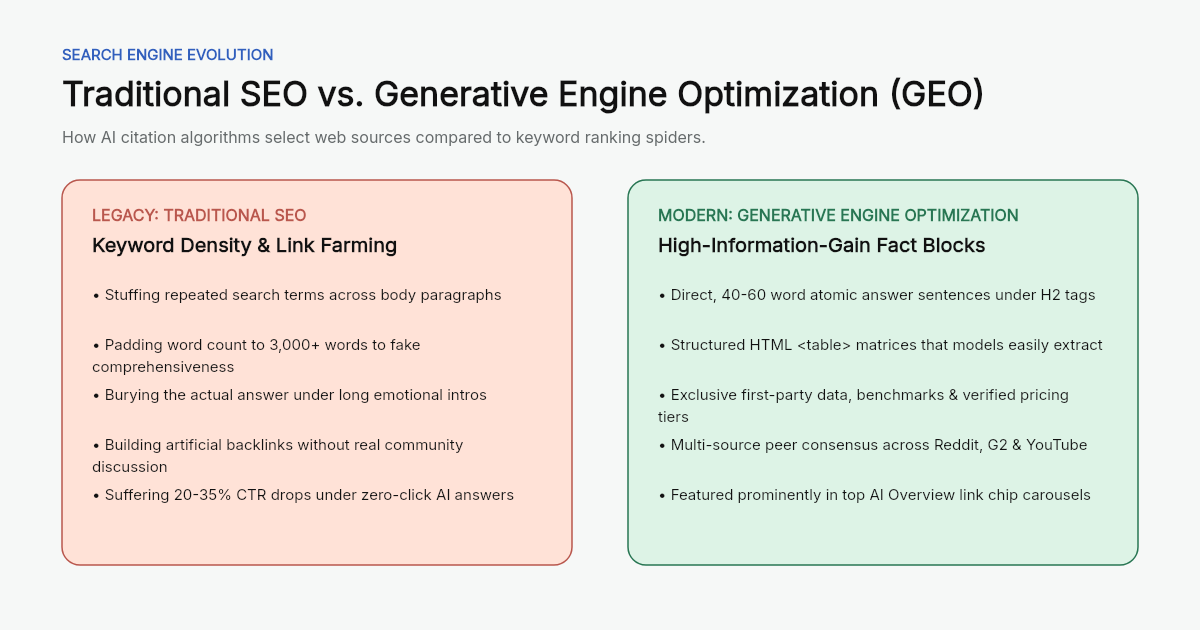 Figure 1: Architectural comparison between legacy keyword SEO and high-information-gain Generative Engine Optimization.
Signal 1: Chunk-Level Answer Density (Atomic Answers)
Language models do not read your entire article from start to finish like a human. They break pages into semantic passages (chunks).
If your H2 heading asks "What is the difference between Tool A and Tool B?", the model expects a direct, authoritative 40-to-60-word answer immediately underneath. Pages that bury the answer beneath four paragraphs of throat-clearing intro text get skipped.
Signal 2: Structured HTML Tables and Step Lists
Generative engines love structured data. Converting comparison dimensions, feature sets, or price tiers into native HTML <table> elements increases the likelihood of being extracted into an AI Overview carousel by over 3x compared to unstructured text blocks.
Signal 3: High Information Gain and Source Verification
Google's ranking algorithms actively demote pages that simply paraphrase existing content. The Princeton study demonstrated that adding verifiable statistics, first-party customer survey findings, and explicit source citations boosts an article's citation probability by up to 41.6%.^2
2. The 4-Step GEO Playbook for Modern Brands
For an in-house market research analyst, content lead, or product founder, here is how to restructure your site for maximum AI visibility:
Step 1: Implement the "Inverted Pyramid" Content Layout
When executing competitor research to benchmark how rivals structure their sites, audit your high-priority commercial pages so Gemini can digest answers instantly:
- Match Title to Exact Search Intent: Phrase headers as actual buyer questions, e.g.,
How to audit competitor pricing on a budget. - Lead with a Bold Thesis Sentence: Provide a definitive, 20-word summary directly below the heading.
- Use Numbered Step Lists: Use flat
1. 2. 3.structures for methodologies and playbooks. - Anchor with a Comparison Table: Close the section with a clear summary table comparing pricing, time commitments, or operational trade-offs.
Step 2: Deploy Semantic Schema.org Markup
Make your pages machine-readable so search crawlers do not have to guess what your page represents:^3
- For software and products: Embed
Product,Offer(with explicit currency and price tier), andAggregateRating. - For educational guides and teardowns: Implement
Article,HowTo, andFAQPageschemas. Standardized JSON-LD markup helps Gemini connect your brand name to specific entity attributes inside Google’s Knowledge Graph.
Step 3: Build Multi-Platform Peer Consensus
AI search engines do not rely solely on your own domain. If your brand only exists on your own website, generative models treat your claims with skepticism.
- Engage in Community Forums: Reddit discussions are among the most frequently cited domains in Google AI Overviews. Ensure your product has an authentic, helpful presence in relevant subreddits where buyers ask for recommendations.
- Maintain Consistent Directory Profiles: Keep your company name, founding year, category, and core differentiators uniform across G2, Capterra, Crunchbase, and LinkedIn.
Step 4: Configure llms.txt and Audit Crawler Permissions
Ensure your technical foundation welcomes AI indexing:
- Inspect your
robots.txtfile to verify you haven't accidentally disallowedGoogle-ExtendedorGPTBot. - Publish a clean
/llms.txtfile at your domain root, providing a markdown-formatted directory of your site’s core product capabilities, pricing docs, and primary research assets.
3. Three Costly Habits Traditional SEO Teams Must Unlearn
- Inflating Word Counts: Padding an article to 3,500 words to "look comprehensive" dilutes your semantic density. AI crawlers favor concise, high-signal writing over bloated prose.
- Hiding Core Data Behind Client-Side Scripts: If your comparison table or pricing tiers require complex JavaScript clicks or accordion toggles to render in the DOM, AI spiders frequently miss the content.
- Omitting External Citations: Writers often fear that linking out will "leak page rank." In GEO, citing credible primary research validates your authority and increases your citation score.
Winning the Top of the Search Page
Google AI Overviews are not the death of organic search—they are a massive competitive advantage for teams that publish verified, structured knowledge.
Whether you manage internal competitive intelligence, lead in-house marketing research, or evaluate outside market research companies and market research services, the goal is clear: stop playing keyword games with spiders.
When you organize your product insights with clarity, back your claims with primary evidence, and build genuine community consensus, Google’s AI engines won't just index your pages—they will quote your brand as the industry authority.
Sources and date notes
- WebFX Empirical Search Benchmark (October 2026):
- Report: "Where and Why Google AI Overviews Appear: A 2.3 Million Keyword Benchmark Study"
- Key Empirical Evidence: Tracking 2.3 million commercial and informational queries, confirming AI Overviews trigger on 25%–30% of searches while reducing first-page organic CTR by 18.4% to 34.2%.
- Princeton University & Georgia Tech AI Research (arXiv:2311.09735):
- Scholarly Paper: "GEO: Generative Engine Optimization for Large Language Models and Search Engines"
- Key Empirical Evidence: Demonstrates that authoritative statement chunking and source verification citations increase an article's citation visibility by up to 41.6% across frontier generative search engines.
- Google Search Central Official Documentation (2026):
- Technical Webmaster Guide: "Google Search's AI Overviews and Your Website: Crawling, Indexing, and Content Best Practices"
- Official Search Guidelines: Details passage-level indexing, Schema.org semantic data parsing by Gemini, and information gain scoring in search overviews.
- Search Engine Land Industry Analysis (2026):
- Strategic Playbook: "Generative Engine Optimization (GEO): The Complete Strategy Guide for Enterprise Visibility in Google AI Overviews"
- Practical Industry Findings: Analyzes the heavy reliance of Google link chips on third-party corroboration sources (Reddit discussions, YouTube transcripts, authoritative directories).
Notice and fair use statement: Search engine benchmarks, algorithm citation statistics, and optimization frameworks referenced in this playbook are derived from public industry testing, academic preprints, and official documentation. All brand names, logos, and trademarks belong to their respective corporate entities.
Disclaimer
This playbook is intended for digital marketing strategy, content optimization methodology, and operational workflow reference only. Algorithmic ranking factors and AI Overview display frequencies evolve continuously across search engine update cycles.
CTA
Looking to audit your brand's AI search visibility and build cited, source-backed market content? Explore how ResearchMaster AI tracks multi-platform industry signals with verifiable clarity.