Open X (formerly Twitter) on any given morning, and you will notice a stark difference in how the developer community talks about artificial intelligence.
When new iterations of ChatGPT, Claude, or Gemini drop, the broader industry buzzes for three to five days before settling back down.
With xAI's Grok, the conversation never seems to stop.
Part of that perpetual spotlight is undeniably driven by Elon Musk's cultural megaphone and Grok's irreverent conversational persona. But look beneath the viral memes and Twitter banter from the perspective of competitive intelligence and strategic marketing research, and you will find an unprecedented architectural shift:
Grok is the first frontier AI model wired directly into the live, nervous-system firehose of a 500-million-user global town square.^1
While traditional search-augmented models rely on periodic web crawlers or third-party search APIs to summarize yesterday's articles, Grok ingests breaking developer complaints, sudden brand crises, and emergent consumer trends in sub-second timeframes.
Yet, raw social data is a double-edged sword. Unfiltered social streams offer pure, unvarnished buyer sentiment—but they also contain viral rumors, sarcastic distortion, and polarizing echo chambers.
Below is an objective, investigative breakdown of where Grok's real-time engine delivers an unmatched research radar, the three blind spots that can derail an analyst's report, and how top strategy teams tame the noise.
1. The Three Structural Advantages of Social-Native Intelligence
Why are brand strategists, growth operators, and corporate researchers increasingly keeping Grok open alongside their financial terminals? The answer lies in architectural capabilities other models cannot match:
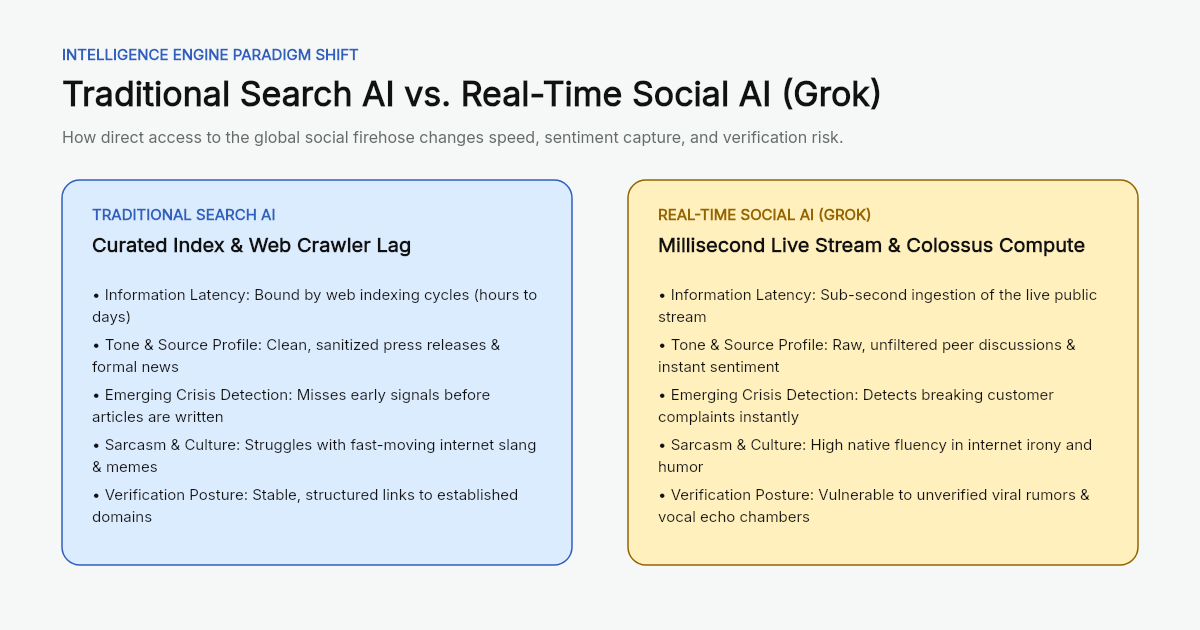 Figure 1: Comparison between web-crawler-based search assistants and xAI's live social stream architecture across latency, sentiment depth, and verification risks.
1. The True "Zero-Hour" Early Warning Radar
When a competing software provider stealthily raises its API pricing or suffers an unannounced regional outage, traditional search engines come up empty because journalists haven't written articles yet.
Grok, however, analyzes the live stream. A developer in Seattle venting about broken endpoints thirty seconds ago, cross-referenced with a founder in London asking for alternatives, forms an immediate, synthesized trendline hours before official post-mortems appear.
2. Unsanitized "Raw Meat" Customer Sentiment
Corporate press releases and polished customer case studies are heavily curated by PR departments. Real users, especially late at night on social media, share unfiltered truths.
Grok allows a market research analyst to bypass corporate talking points and capture the raw emotional friction real people feel when interacting with an incumbent brand.
3. The Brute-Force Inference of the Colossus Cluster
Behind the scenes, xAI deployed the massive "Colossus" supercomputing cluster in Memphis, powered by over 100,000 Nvidia H100 GPUs.^2 This massive infrastructure provides high-throughput processing for long conversational threads, multimodal screen parsing, and real-time sentiment extraction at scale.
2. The Three Blind Spots Every Analyst Must Navigate
As any experienced researcher knows, social media volume does not equal objective market reality.^3 Relying exclusively on Grok to brief your executive team can lead you straight into three dangerous traps:
Trap 1: The Sarcasm and Meme Distortion Filter
X is the global capital of digital irony, sarcasm, and meme humor. When hundreds of vocal users playfully mock a new competitor feature with hyperbolic praise, language models that evaluate statistical semantic similarity can misinterpret the irony—mistaking satirical roasts for genuine product acclaim.
Trap 2: The "Vocal Minority" Echo Chamber
The users who post frequently on public social feeds represent roughly 10% to 15% of actual consumers. They are overwhelmingly skewed toward tech-forward, outspoken power users. If you are conducting consumer research for an everyday retail or enterprise product, relying solely on Twitter discourse will blind you to the quiet, pragmatic majority who never post online.
Trap 3: The Rumor Amplification Loop
In fast-moving social feeds, an unverified rumor from an anonymous account can rack up ten thousand reposts in twenty minutes. Without independent verification against primary public registries or SEC filings, real-time models risk presenting speculative platform gossip as established market fact.^3
3. The Practical Workflow: How to Tame the Stream
World-class research teams do not use Grok to write their final executive memos. They treat it as an agile forward scout in a multi-stage intelligence pipeline:
[Stage 1: Live Radar Sweep]     -->     [Stage 2: Entity & Noise Triage]     -->     [Stage 3: Cold Fact Verification]
          xAI Grok                                AI Synthesis Logic                               ResearchMaster AI
  • Detect breaking sentiment anomalies     • Separate concrete facts from memes           • Audit figures against 10-K filings
  • Capture raw buyer complaints            • Flag unverified rumors and numbers           • Anchor claims to primary URLs
- Step 1: The Live Sweep with Grok: Prompt the model to scan live social discourse around a target competitor or sudden market event: "What are the top three recurring complaints real users voiced about Competitor's latest update in the past 24 hours?"
- Step 2: Strip the Rhetoric: Filter out one-off emotional rants and isolate the structural operational claims (e.g., sudden contract tier jumps, latency bugs, or specific feature deprecations).
- Step 3: Hard Verification with Source-Anchored Tools: Take those specific claims into an auditable intelligence engine like ResearchMaster AI or verified financial filings to cross-reference the numbers, verify whether the complaint reflects isolated edge cases or systemic churn, and build an audit-ready executive brief.
The Verdict: Speed Belongs to the Radar, Value Belongs to Proof
Grok's enduring momentum on X marks the arrival of the world's first collective real-time pulse monitor.
It lets analysts hear the roar of the market as it happens. But in an era where software code and conversational AI are easily accessible, the true competitive edge does not come from merely hearing rumors faster.
Whether directing internal marketing research, executing granular competitor research, or evaluating outside market research companies and market research services, lasting commercial advantage belongs to teams that use real-time radars to catch the signal—and then do the hard, disciplined work of proving the facts.
Sources and date notes
- xAI Official Architecture & Release Documentation (2026):
- Technical Publication: "Grok: Real-Time Multimodal Knowledge Ingestion Across the Global Information Flow"
- Architectural Specifications: Details sub-second streaming ingestion pipelines, conversational reasoning benchmarks, and Colossus cluster training infrastructure.
- TechCrunch Enterprise AI & Cloud Coverage (2026):
- Industry Analysis: "Inside xAI's Colossus and the Strategic Moat of Real-Time Social Context for LLMs"
- Commercial Evidence: Examines why proprietary access to the global social media firehose provides an unreplicable competitive moat in conversational velocity compared to static web index models.
- Financial Times Technology Briefing (2026):
- Analytical Evaluation: "Real-Time AI vs. Verifiable Truth: The Double-Edged Sword of Sourcing Intelligence from Social Feeds"
- Methodology Report: Benchmarks the citation reliability, sarcasm misinterpretations, and rumor propagation risks when using social-native frontier models during commercial due diligence.
Notice and fair use statement: Platform metrics, supercomputing infrastructure data, and technology evaluations referenced in this article are derived from public company announcements, technical blogs, and accredited financial press under fair use. All product names, logos, and trademarks belong to their respective corporate entities.
Disclaimer
This review is conducted strictly for software architecture evaluation, market research methodology, and competitive intelligence workflow planning purposes only. AI model responses and real-time social sentiment fluctuate continuously across platform updates and live discourse cycles.
CTA
Looking to separate transient social noise from audit-ready market facts? Explore how ResearchMaster AI cross-references real-time signals with multi-source verified evidence.