For over fifteen years, every software engineer, product architect, and technical buyer lived through the exact same workflow:
"A red compiler error flashes across your terminal. You copy the stack trace and paste it into Google. Ranked #1 sits that familiar orange box icon—StackOverflow. You click the link, jump straight to the green checkmark with three thousand upvotes, copy the code snippet, and get back to work."
In that golden era, StackOverflow was not merely a community Q&A board; it was the front door to the global software economy. For enterprise developer tools, cloud infrastructure providers, and B2B SaaS companies, participating on the platform and buying targeted developer ads was the single most reliable way to capture high-intent software buyers.
Then, a data query from the official StackExchange Data Explorer surfaced across Hacker News and developer communities, marking the quiet end of an era:
In late 2026, monthly question volume on StackOverflow dropped below 1,000 questions per month.^1
Compared to its peak in 2014—when users posted over 250,000 new questions every single month—activity has collapsed by more than 99.6%.
The world's largest programming forum has effectively become a quiet digital archive.
Did software engineers stop running into bugs? Did enterprise engineering leaders stop evaluating developer tools?
Of course not.
The questions did not disappear. They moved.
Below is an investigative look at where developer research actually happens today, how technical purchasing decisions have decentralized, and how forward-thinking B2B tech brands are rebuilding their customer acquisition engines.
1. The Anatomy of the Traffic Cliff: Why Answers Moved
The collapse of public developer Q&A was not caused by a decline in engineering activity. It was driven by an irreversible shift in the physics of problem-solving:
[The Evolution of Developer Problem-Solving]
  Legacy Q&A Era (2008–2022)                   Autonomous Agent Era (2026)
  • Alt-Tab to browser                        • Cursor / Claude Code in active IDE
  • Paste error into Google                   • Agent reads local codebase context
  • Sift through 8 outdated answers           • Generates verified fix in 2 seconds
  • Fear of toxic "Duplicate" flags           • Zero-judgment, patient interaction
  • Public, indexed web traffic               • Ephemeral, dark-context execution
1. From "Browser Search" to "Cursor-Level Resolution"
Modern engineers debug inside their active editors using Cursor, Claude Code, or GitHub Copilot. An AI agent with visibility into your entire repository understands your exact package versions, local dependencies, and configuration quirks in two seconds. Leaving your IDE to search an ad-heavy website feels painfully slow.
2. The Backlash Against Community Toxicity
StackOverflow famously maintained an aggressive moderation culture: closing beginner inquiries as "duplicates," issuing stern reprimands, and downvoting imperfect syntax. Conversational models, by contrast, offer infinite patience. They never judge a tired junior engineer asking a basic syntax question.
2. The New Migration: Where Developers Research Tools Now
If routine debugging has been absorbed by local AI agents, where do software architects and B2B buyers go when they need to evaluate enterprise software, benchmark API reliability, or choose a database?
Our research across engineering communities highlights four primary destinations:
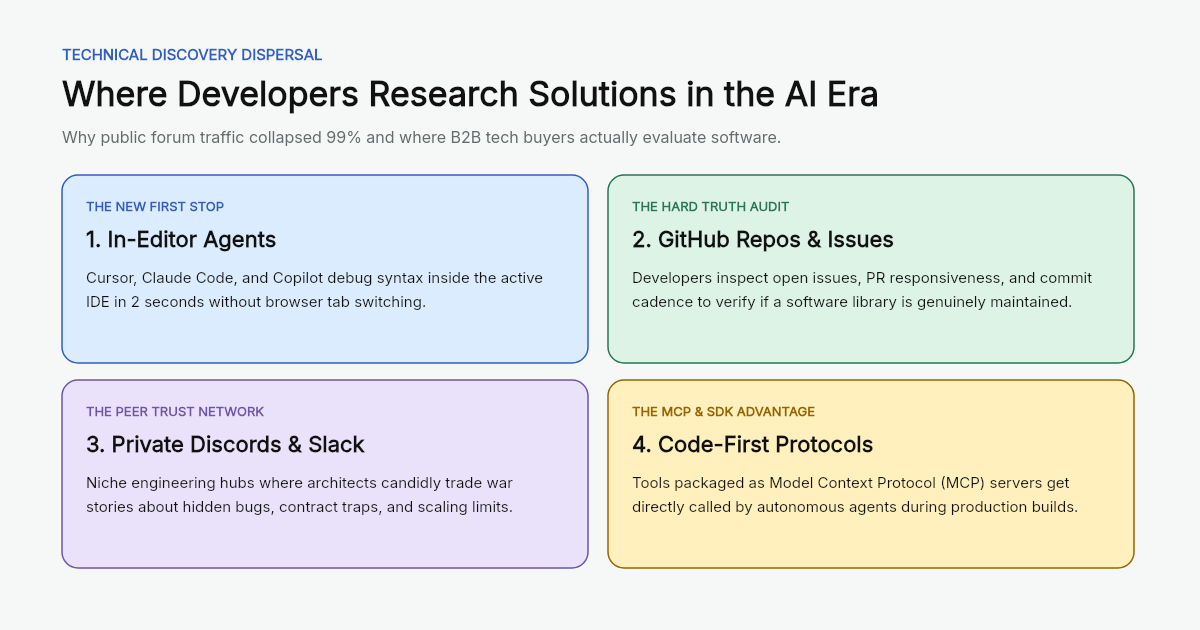 Figure 1: The dispersal of technical discovery away from public Q&A portals toward IDE agents, GitHub repos, and private developer networks.
1. In-Editor Agents as Gatekeepers
When an engineer asks their coding agent, "What is the best library to handle PDF table parsing in Node?", the model recommends packages based on its training weights and documentation quality. If your software library is not easy for LLMs to parse, you are completely invisible at the exact moment of intent.
2. GitHub Discussions and Issue Backlogs
Technical buyers no longer trust glossy marketing case studies. Before adopting an enterprise tool, they inspect the GitHub repository:
- How fast do maintainers respond to open issues?
- Are enterprise customers complaining about silent data corruption or unannounced breaking changes?
- Is commit velocity healthy, or has the repo become stagnant shelfware? Your open-source repository is now your highest-converting landing page.
3. Private Engineering Slacks and Niche Discords
The candid, high-stakes conversations have retreated behind closed doors. In invite-only engineering communities, senior architects trade unvarnished war stories:
"Does Vendor X's database actually scale past 10,000 QPS, or does their connection pool crash?""What hidden overage fees did they hit you with after year one?" These closed-door recommendations carry far more weight than public forum posts ever did.
4. Code-First Protocols (The MCP Advantage)
Modern developers favor tools that plug directly into their autonomous workflows. Frameworks structured around open standards like the Model Context Protocol (MCP) allow agents to trigger actions directly from code, turning your product into an active utility rather than a passive dashboard.
3. The New Playbook for B2B Tech Brands and DevTool Teams
For any in-house market research analyst conducting developer-focused consumer research or strategic marketing research, the playbook has completely changed:
[The Modern Developer Go-to-Market Engine]
  1. MCP & SDK-First Distribution
        │  --> Package your tool as an agent-callable server
        ▼
  2. Machine-Readable Documentation (/llms.txt)
        │  --> Feed clean Markdown directly to frontier models
        ▼
  3. Community Infiltration & Authentic DevRel
        │  --> Solve hard bugs in public GitHub Issues & Discords
        ▼
  4. Radical Openness & Public Benchmarks
           --> Publish transparent stress tests that build engineering trust
1. Package Your Product as an MCP Server
Do not force developers to write custom boilerplate to integrate your API. Package your tool as a standardized Model Context Protocol server. When an engineer's autonomous agent can query your database or call your service directly from the command line, you bypass traditional sales friction entirely.
2. Publish a Clean /llms.txt at Your Domain Root
Ensure your documentation is structured for AI crawlers:
- Provide a concise, markdown-formatted directory outlining your API syntax, parameter constraints, and code snippets.
- When a developer asks Claude or Cursor how to implement a complex feature, the model can digest your documentation instantly and generate working code featuring your SDK.
3. Invest in Deep, Unfiltered Technical Benchmarks
Engineers despise vague corporate buzzwords like "blazing fast" or "enterprise-grade." Win them over with radical transparency:
- Publish reproducible stress tests detailing where your system excels and where it hits throughput limits.
- Showing your engineering trade-offs proves you respect their technical discernment.
Summary: From Public Portals to Deep Workflow Integration
The collapse of StackOverflow’s question volume is not a tragedy; it is an evolution.
When searching for answers, developers have bypassed traditional web directories—rendering generic reports from legacy market research companies and static market research services largely irrelevant.
For tech companies conducting competitor research and planning B2B growth, the mandate is clear:
Stop trying to win yesterday's SEO games on dying Q&A forums.
When you package your product into open protocols, make your documentation effortless for AI agents to ingest, and engage honestly in developer communities, you do not just survive the death of public forums—you establish an unshakeable competitive moat in the new agentic economy.
Sources and date notes
- StackExchange Official Data Explorer (October 2026):
- Official Query Record: StackOverflow Monthly Question Volume Trend (Query #1926661)
- Verified System Ledger: Documents monthly question volume dropping below 1,000 queries in late 2026, compared to a peak exceeding 250,000 monthly posts in 2014.
- Hacker News Community Benchmark & Technical Investigation (October 2026):
- Discussion Thread: "StackOverflow now gets fewer than 1000 questions a month"
- Industry Observations: Features practitioner commentary from software architects, CTOs, and engineering leaders documenting the migration from public Q&A boards to IDE copilots.
- GitHub Octoverse & Developer Relations Research (2026):
- Annual Report: "The State of Developer Workflows: Code Assistance, Community Dispersal, and Autonomous Tooling"
- Quantitative Metrics: Tracks the global decentralization of technical troubleshooting away from standalone forums into repository-native discussions and local agents.
Notice and fair use statement: Public database query records, developer survey metrics, and community commentary referenced in this article are cited for software industry analysis, marketing methodology, and technology evaluation under fair use. All trademarks and brand names belong to their respective corporate entities.
Disclaimer
This review is intended for technology industry analysis, developer relations strategy, and commercial go-to-market planning purposes only. Platform traffic volumes and developer adoption metrics evolve across technology release cycles.
CTA
Looking to navigate the shifting landscape of developer tools and track unvarnished competitive intelligence? Discover how ResearchMaster AI uncovers multi-source technical sentiment and verified market evidence.