
Over the past twenty-four hours, automotive forums, X (formerly Twitter), Hacker News, and mainstream business publications have been dominated by a single story:
Tesla and Elon Musk officially hosted a live public demonstration of the long-delayed, next-generation Roadster.12
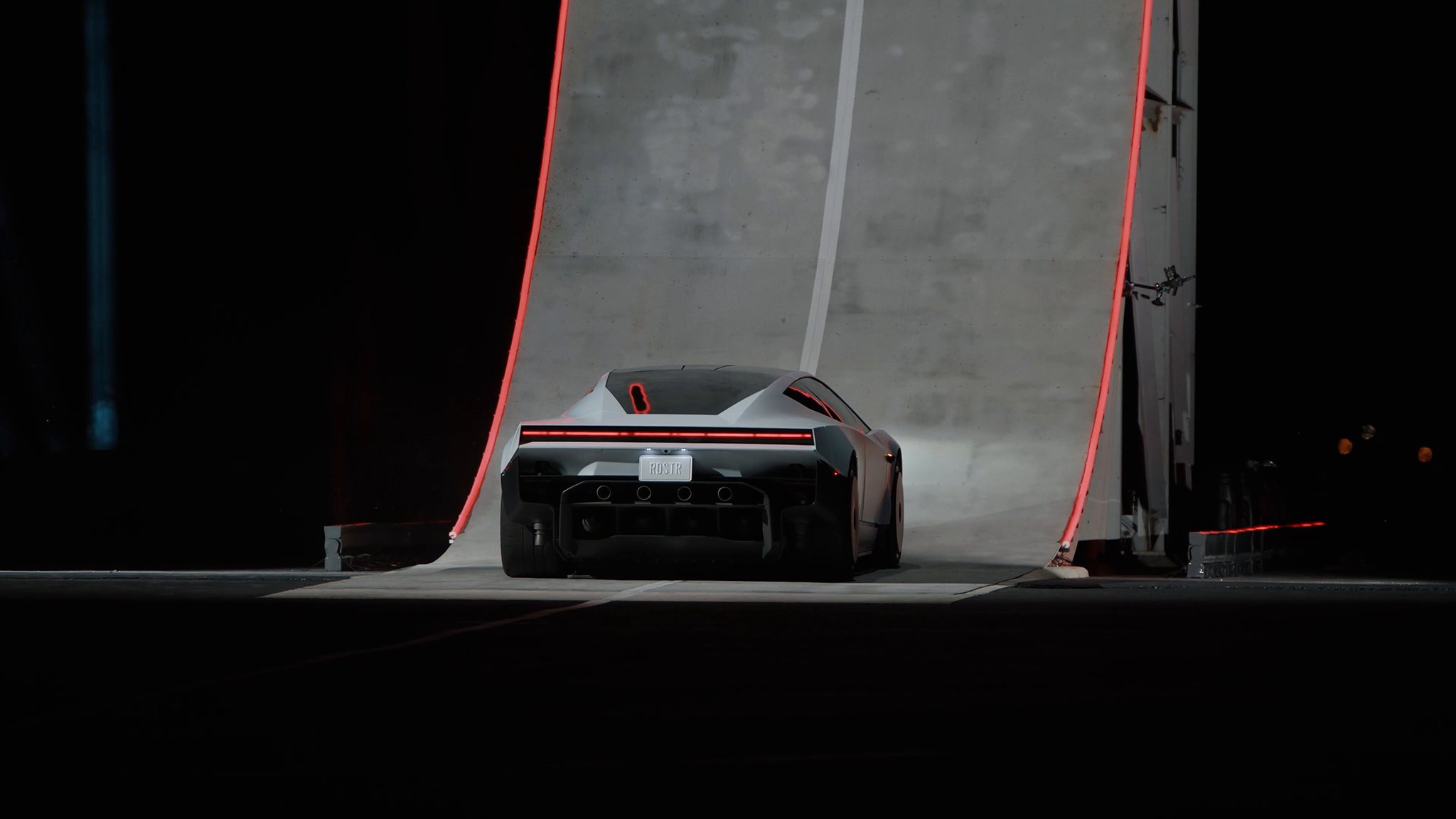 Figure 1: Official broadcast demonstration snapshot showing the next-generation Tesla Roadster prototype navigating the curved vertical ramp during the October 2026 showcase (Source: Tesla Official Broadcast).
During the livestream, prototypes demonstrated extreme acceleration runs, an underbody active vacuum suction system, and pneumatic cold-gas thruster pulses derived from SpaceX aerospace hardware.3
Across social media and financial analyst channels, community reactions polarized almost immediately:
- On one side, engineering enthusiasts praised the showcase as a historic demonstration of electric powertrain density, aerodynamic downforce, and cross-industry hardware collaboration.
- On the other side, institutional automotive analysts and vehicle safety specialists raised grounded questions regarding homologation, pedestrian crash compliance, and realistic commercial delivery timelines.4
For an in-house market research analyst or strategic executive observing the electric vehicle transition, gathering objective competitive intelligence matters far more than sensational headlines.
Below is an objective, evidence-based dissection of what Tesla demonstrated, the real-world manufacturing and regulatory context surrounding the vehicle, and the classic commercial playbook behind automotive "halo" cars.
1. What Was Actually Demonstrated: Three Revealed Configurations
According to the official showcase broadcast and reports verified by publications including Wired, The Verge, and the New York Times, Tesla detailed three distinct performance tiers for the next-generation Roadster platform:132
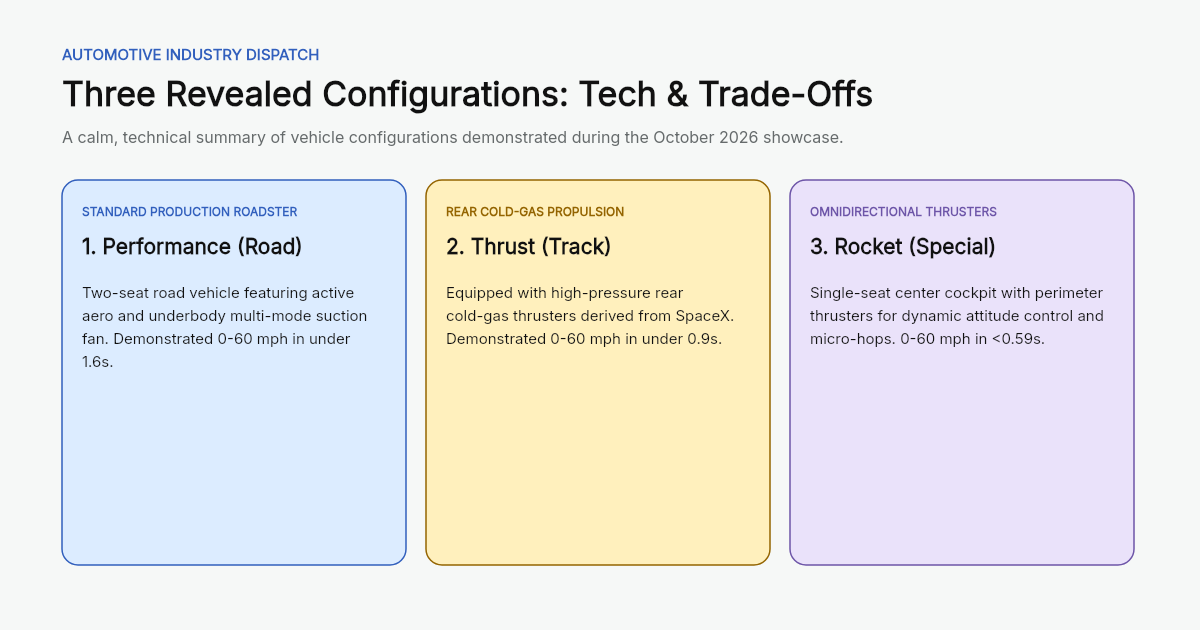 Figure 2: Technical summary of the three distinct configurations demonstrated during the October 2026 showcase.
1. Performance Configuration (Road Legal Production Baseline)
- Architecture: Traditional two-door, two-seat sports coupe configuration.
- Demonstrated Capabilities: Equipped with active aero wings and an electric underbody multi-mode suction fan system designed to generate immediate downforce independent of vehicle road speed.
- Performance Claim: Demonstrated 0-60 mph acceleration in under 1.6 seconds. Available via standard customer reservations on the company website.5
2. Thrust Configuration (Track Package with Rear Thrusters)
- Architecture: Retains the two-seat interior layout while incorporating rear-mounted cold-gas thrusters supplied by high-pressure composite overwrapped pressure vessels (COPVs).
- Demonstrated Capabilities: Uses compressed pneumatic pulses to supplement mechanical tire traction during launch phases.
- Performance Claim: Demonstrated 0-60 mph acceleration in under 0.9 seconds. Designated as a limited-run release.
3. Rocket / SpaceX Package (Special Demonstration Prototype)
- Architecture: Reconfigures the cabin into a single-seat center-cockpit layout to accommodate internal pneumatic plumbing and structural reinforcement.
- Demonstrated Capabilities: Incorporates perimeter-mounted cold-gas thrusters capable of micro-hops and active rotational attitude control in controlled track settings.
- Performance Claim: Claimed 0-60 mph acceleration under 0.59 seconds and top speeds exceeding 230 mph. Available strictly on an invitation-only basis.
2. Technical Mechanisms: Borrowing from Formula 1 and Aerospace
The core mechanical innovations showcased during the event rely on engineering principles that exist in motorsport and spaceflight, but have rarely appeared in consumer production:
Active Ground Effect Suction
Traditional supercars generate aerodynamic downforce using passive front splitters and massive rear wings. However, wings only create downforce at high speeds and introduce aerodynamic drag.
The Roadster's suction system draws inspiration from historic motorsport concepts—such as the 1978 Brabham BT46B "fan car" and the modern McMurtry Spéirling—using high-velocity underbody fans to evacuate air beneath the chassis. This creates a partial vacuum, mechanically pulling the tires into the asphalt from a standstill.
Cold-Gas Pneumatic Assist
Rather than burning chemical rocket fuel, the SpaceX package relies on compressed inert gas stored in ultra-high-pressure tanks. Discharging this gas through calibrated supersonic nozzles delivers thousands of pounds of instantaneous thrust without thermal exhaust hazards, allowing the vehicle to overcome the fundamental coefficient of friction limits of standard street tires.
3. The Analyst's Reality Check: Regulatory and Production Realities
While the engineering feats demonstrated on the test track are mechanically impressive, deploying these systems into retail driveways faces steep regulatory and manufacturing hurdles:
1. Homologation and Pedestrian Impact Regulations
Automotive regulatory bodies—such as the National Highway Traffic Safety Administration (NHTSA) in the United States and Euro NCAP in the European Union—enforce stringent safety standards.
High-pressure gas vessels inside passenger compartments, downward-firing pneumatic nozzles that can dislodge road gravel, and underbody fans that expel debris present unprecedented homologation hurdles. Outside of closed racing circuits, passing road-safety certification for the thruster variants remains a major legal hurdle.
2. Reservation Fatigue and Timeline Disconnect
First unveiled as a concept in November 2017 with an initial target delivery date of 2020, the Roadster has experienced recurring delays. Thousands of early reservation holders placed deposits ranging from $50,000 to $250,000 over eight years ago.
While the new prototype demonstrations reassure depositors that the project remains active, transitioning bespoke prototype stunts into reliable high-volume factory tooling remains an unfulfilled step.
4. Strategic Perspective: The Classic "Halo Car" Playbook
To understand why Tesla invests engineering capital into a niche vehicle with low unit volume, one must look at how legacy market research companies and automotive strategists analyze the Halo Vehicle Effect:
[The Halo Strategy Mechanism]
  1. Radical Halo Unveil (Roadster Demonstration)
        │  --> Generates global media dominance and validates extreme engineering capabilities
        ▼
  2. Brand Equity Lift (Premium Perception)
        │  --> Reinforces technology leadership against intensifying global EV competitors
        ▼
  3. Commercial Downstream Impact (Mass Production Pull)
        │  --> Consumers considering Model 3/Y or Cybertruck associate everyday models with halo engineering
        ▼
  4. Technology Trickle-Down
           --> High-density battery packaging, advanced thermal loops, and power electronics migrate to core fleet
In automotive history, legendary halo cars—such as the Lexus LFA, the Ford GT, or the Audi R8—rarely generated substantial operating profit on their own balance sheets. In fact, many lost money on a pure unit-economics basis.
Their real commercial value lies elsewhere:
- Elevating Everyday Models: When an average family car buyer compares a Tesla Model Y against an electric SUV from Hyundai, Ford, or BYD, the halo car acts as a subconscious signal of technical supremacy.
- Capturing Global Cultural Mindshare: In a market saturated with generic EV crossovers, a street car that demonstrates rocket thrusters creates unpaid organic reach that traditional advertising cannot buy.
- Testing Extreme Hardware: Extreme thermal management, 48-volt architectures, and cutting-edge battery cell chemistries are tested under punishing track conditions before trickling down into the broader consumer lineup.
Summary: Separating Spectacle from Market Reality
For strategic observers conducting competitor research and tracking the automotive landscape, Tesla’s October 2026 Roadster demonstration represents a fascinating case study.
As a pure commercial product, the vehicle addresses a tiny fraction of global car buyers and faces complex regulatory clearance hurdles. But as an instrument of strategic marketing research, brand reinforcement, and technology signaling, it confirms that Tesla remains uniquely skilled at capturing global attention.
By examining the physical engineering, conducting grounded consumer research into buyer discussions, and leveraging professional market research services, analysts can appreciate the technical boldness of the vehicle while keeping its practical business impact in clear, sober perspective.
Sources and date notes
Notice and fair use statement: Automotive engineering analysis, public livestream demonstrations, and social commentary referenced in this review are cited for commercial strategy and technology evaluation purposes under fair use. All product names, logos, and trademarks belong to their respective corporate entities.
Disclaimer
This article is intended for automotive industry analysis, commercial strategy evaluation, and educational reference only. Performance specifications and production availability reflect initial public company demonstrations and are subject to ongoing homologation and testing.
CTA
Looking for deep, source-backed market analysis on electric vehicles and automotive disruptors? Explore how ResearchMaster AI tracks multi-source industry trends with cited evidence.
Footnotes
- The Verge, The Tesla Roadster flew, drove upside down, and hit 60mph in under a second, published October 16, 2026, accessed October 2026. ↩ ↩2
- The New York Times, Tesla Debuts 2026 Roadster at Live Demonstration, published October 15, 2026. ↩ ↩2
- Wired, The Tesla Roadster 2 Is Here—and It Flies, published October 16, 2026, accessed October 2026. ↩ ↩2
- Electrek, Tesla unveils cyberfied new Roadster with SpaceX package demonstrations, published October 15, 2026. ↩
- Tesla Official Portal, The Next-Generation Tesla Roadster Specifications and Reservation Overview, accessed October 2026. ↩