Emotion AI—often referred to as affective computing—is moving rapidly from speculative academic research into high-stakes commercial infrastructure: automotive in-cabin driver monitoring, contact-center conversational coaching, healthcare remote monitoring, and real-time consumer research.
Recently, industry analysts examining the sector published dedicated forecasts covering the decade from 2026 to 2035. Two notable perspectives illustrate the current state of market estimation:
- Report A (Saturate Insights): A focused single-firm study titled "Emotion AI Market Size, Share & Growth Report 2035", authored by research analyst Ethan Collins, presenting a steady, linear growth path across enterprise software deployments.1
- Report B (ResearchMaster AI): A multi-source meta-analysis titled "Market Size Forecast and Competitive Landscape for Emotion AI Market Size Forecast Reports 2026 2035 across Relevant Markets", synthesizing 21 independent analyst databases, academic preprints, and European regulatory filings.2
Both reports share common ground regarding underlying technology drivers: both highlight the shift toward multimodal inputs (combining facial vision, vocal inflection, and text sentiment), and both agree that customer experience and automotive in-cabin monitoring represent the primary commercial engines.
However, when it comes to baseline market valuations, long-term upper bounds, annual growth rates, and regional expansion leadership, the two reports present starkly different pictures.
Below is an objective, side-by-side breakdown of the core findings from each report, followed by a factual comparison of where their figures and methodologies diverge.
1. Core Perspectives from Both Reports
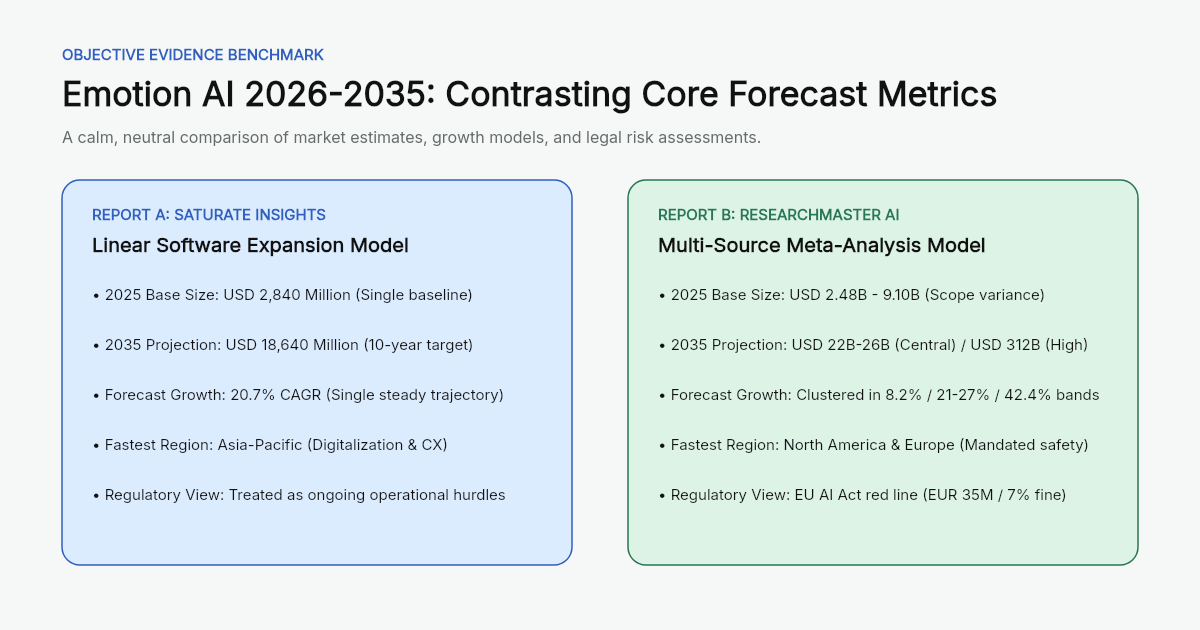 Figure 1: Objective side-by-side benchmark contrasting core forecast metrics, growth assumptions, and regulatory considerations.
Report A (Saturate Insights): The Steady Software Expansion Thesis
Saturate Insights treats Emotion AI primarily as a specialized enterprise software and services category expanding at a predictable, healthy pace:
- Baseline and Target Valuation: The report establishes a baseline market valuation of USD 2,840 million for 2025, projecting the market to reach USD 18,640 million by 2035.
- Constant Compounding Rate: The forecast models a steady, single-trajectory Compound Annual Growth Rate (CAGR) of 20.7% over the ten-year forecast window.
- Geographic Expansion: The report identifies the United States as the largest single country market, while highlighting India as the fastest-growing individual country. Regionally, it points to Asia-Pacific as the fastest-expanding geography, fueled by rapid enterprise digitalization and massive digital consumer interaction volumes.
- Component and Technology Breakdown: Software is identified as the dominant revenue driver over services, with facial emotion detection and text sentiment analysis representing the largest existing segments, gradually transitioning toward multimodal platforms.
- Operational Risk Outlook: Sourcing constraints are framed around algorithmic accuracy, cultural variations in emotional expression, and evolving biometric privacy rules, viewed as ongoing operational hurdles that advancing models will progressively solve.
Report B (ResearchMaster AI): The Divergent Meta-Analysis & Regulatory Boundary Thesis
ResearchMaster AI constructs its analysis by evaluating how definitions differ across the broader market research ecosystem, tracking conflicting boundaries and rigid legal constraints:
- Wide Baseline Discrepancies: The meta-analysis reveals that base-year estimates across credible research houses do not align: Market.us reports a narrow base of USD 2.48 billion for 2024, whereas Precedence Research sets a broad 2025 base at USD 9.10 billion. The report attributes this nearly 4x variance to whether researchers include underlying cloud compute and custom enterprise SDK licensing.
- Bimodal Long-Term Targets: By 2035, the industry's published outlooks split into two separate worlds:
- A conservative-to-central consensus band (MarketsandMarkets, Verified Market Research, Roots Analysis, Grand View Research) projecting markets between USD 22 billion and USD 26.5 billion (implying 21%–27% CAGR);
- An extreme high-case scenario published by Precedence Research and SNS Insider projecting USD 311.99 billion by 2035 (implying a 42.4% CAGR).
- Binding Regulatory Red Lines: The report emphasizes that growth is not purely demand-driven, pointing to Article 5(1)(f) of the EU Artificial Intelligence Act (EU AI Act), which entered into force in February 2025 and outright bans biometric emotion recognition in workplaces and educational institutions across the European Union, backed by penalties up to EUR 35 million or 7% of global turnover.34
- Concrete Commercial Anchors: Real-world commercialization is concentrated in three pockets: mandated automotive driver-monitoring systems (DMS adopted by 24 OEMs across 380+ vehicle models), FDA-cleared contactless vital monitoring, and contact-center conversational coaching.
2. Objective Contrast of Core Conflicts
For any in-house market research analyst or strategy team conducting competitor research on emerging technologies, comparing these reports illustrates why figures from syndicated market research companies cannot simply be averaged together. Here is how their specific metrics contrast:
| Comparison Metric | Report A (Saturate Insights) | Report B (ResearchMaster AI Synthesis) | The Underlying Distinction |
|---|---|---|---|
| 2025 Base Market Size | USD 2,840 Million (Single fixed point) | USD 2,480M – USD 9,100M (Range across 8 sources) | Report A adopts a tight software-centric baseline; Report B documents that incorporating hardware and platform licensing quadruples initial market sizing. |
| 2035 Target Market Size | USD 18,640 Million | USD 22,080M – USD 26,550M (Central) vs. USD 311,990M (High scenario) | Report A’s projection sits slightly below the peer central band (USD 22B–26B); Report B notes the presence of outlier scenarios exceeding USD 300 billion. |
| Projected CAGR (2026–2035) | 20.7% (Single steady trajectory) | Three distinct tiers: • Narrow: ~8.2% • Central: 21%–27% • High-case: ~42.4% | Report A models a stable 20.7% rate; Report B outlines how scope definitions dictate whether the market compounds at 8%, 21%, or 42%. |
| Fastest-Growing Region | Asia-Pacific (Driven by scale & digital interaction) | North America & Europe (Driven by safety mandates & clinical trials) | Report A projects Asia-Pacific to expand quickest; Report B finds that regulatory automotive safety mandates in Europe and North American clinical spending drive the near-term commercial volume. |
| Role of Legal Regulation | Operational challenge (Ethics & biometric rules require compliance) | Binding statutory ceiling (EU AI Act bans workplace and school use under EUR 35M fines) | Report A views compliance as a routine engineering consideration; Report B treats statutory bans as hard legal ceilings on total addressable market size. |
3. What Strategy Teams Can Take Away
Rather than attempting to declare one figure "right" and another "wrong," experienced analysts look at what these divergent methodologies reveal about the broader market:
- For bottom-up software budgeting: The figures presented by Saturate Insights (scaling from USD 2.84B to USD 18.64B at 20.7% CAGR) offer a grounded, conservative reference point for pure-play software vendors focusing on customer experience and marketing analytics.
- For top-down risk management and cross-border expansion: The multi-source evidence presented by ResearchMaster AI provides an essential reality check. When evaluating global GTM plans or long-term TAM, teams must account for severe regulatory restrictions like the EU AI Act and recognize that hyper-bullish USD 300B+ forecasts represent theoretical ceilings rather than guaranteed baselines.
Whether evaluating bespoke market research services or synthesizing internal competitive intelligence alongside broader marketing research, real clarity comes from inspecting how forecast models are built—giving leaders the context needed to make informed, defensible commercial decisions.
Sources and date notes
Report A Source and Documentation
Report B Source and Underlying Reference Set
Notice and fair use statement: Market research estimates, baseline valuations, compound growth projections, and regulatory frameworks cited in this article are derived from publicly accessible market research reports, syndicated databases, and government legislative registries. All company names, logos, and trademarks belong to their respective corporate entities.
Disclaimer
This comparative review is conducted strictly for methodology evaluation, industry research benchmarking, and strategic planning reference only. Organizations should cross-reference empirical source parameters when evaluating long-term capital allocation or financial projections.
CTA
Looking for auditable, multi-source evidence synthesis across emerging AI sectors? Explore how ResearchMaster AI reconciles conflicting market forecasts into verifiable strategic intelligence.
Footnotes
- Ethan Collins, Saturate Insights, "Emotion AI Market Size, Share & Growth Report 2035", Report ID: SI_1175, published September 2026, accessed October 2026. ↩
- ResearchMaster AI, "Market Size Forecast and Competitive Landscape for Emotion AI Market Size Forecast Reports 2026 2035 across Relevant Markets", Public Share Archive, generated October 2026. ↩
- European Parliament and Council of the European Union, Regulation (EU) 2024/1689 of the European Parliament and of the Council (Artificial Intelligence Act), Official Journal of the European Union, published July 2024, applicable February 2025. ↩
- Future of Privacy Forum (FPF), "Red Lines Under the EU AI Act: Unpacking the Prohibition of Emotion Recognition in the Workplace and Education Institutions", published March 2026. ↩