Over the past year, nearly every major frontier AI model introduced built-in web browsing. Yet, for any market research analyst, strategy lead, or product builder tasked with serious marketing research, these native search features consistently hit a wall:
"When you prompt a chatbot with a nuanced industry brief—such as evaluating cold-chain logistics SaaS vendors and their unit pricing—the model performs one or two shallow queries, skims the top search snippets, and generates a vague summary that lacks primary empirical data."
This single-hop retrieval pattern cannot support rigorous desk research. Genuine market intelligence requires decomposing briefs into verifiable hypotheses, cross-checking contradictory claims across diverse domains, parsing unstructured tables, and recursively dispatching secondary probes to clarify emerging anomalies.
Historically, organizations solved this by commissioning external market research companies or contracting specialized market research services. Today, a major engineering shift is underway on GitHub. Open-source autonomous research frameworks—led by assafelovic/gpt-researcher (approaching 30,000★) 1, u14app/deep-research (4,600+★) 2, and jordan-gibbs/hyperresearch (3,800+★) 3—have proven that autonomous multi-hop research loops can execute complex desk research in minutes.
More importantly, the rapid adoption of the Model Context Protocol (MCP) 4 is transforming these once-siloed Python tools into composable, standardized local microservices that integrate directly into developer environments and agent workflows.
1. The Anatomy of Multi-Hop Autonomous Research
Why does an open-source deep research agent consistently outperform a standard chatbot with web access? The differentiator lies in the transition from ad-hoc scraping to a five-stage recursive verification loop:
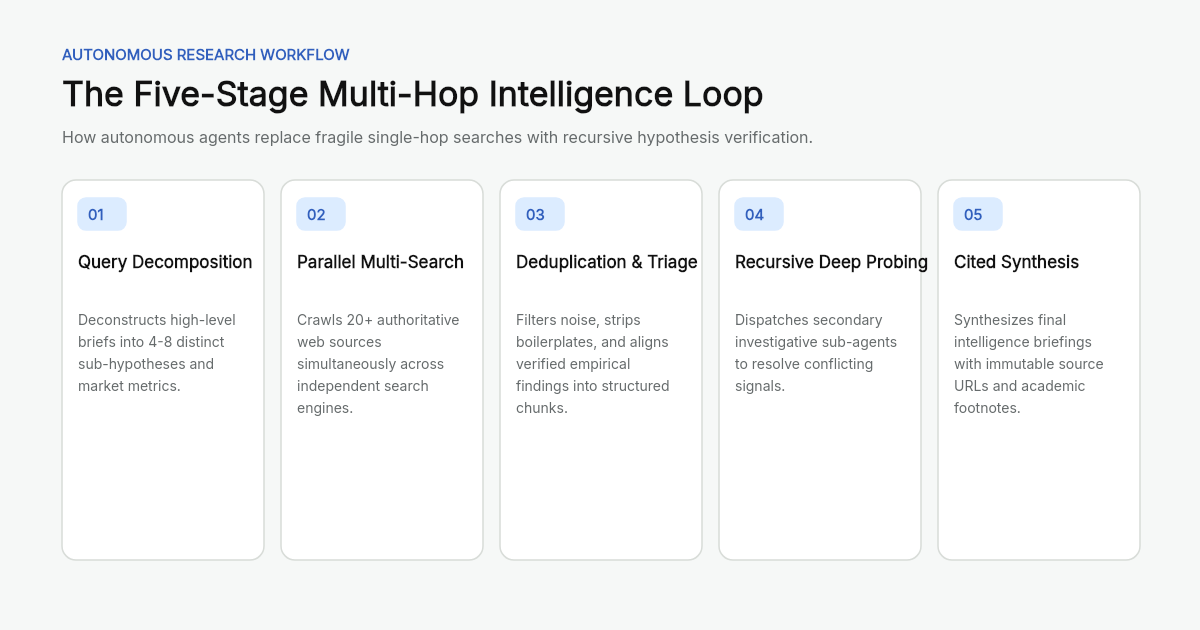 Figure 1: The five-stage autonomous intelligence pipeline, from initial query decomposition to verified, cited synthesis.
Stage 1: Query Decomposition
Faced with a broad strategic question, the agent does not immediately query the headline. Instead, it breaks the brief into 4 to 8 targeted sub-hypotheses: total addressable market (TAM), regulatory hurdles, top vendor financials, and authentic customer churn drivers extracted from community feedback for consumer research.
Stage 2: Parallel Multi-Search and Headless Crawling
The agent queries multiple independent search backends (such as Tavily, SearxNG, or DuckDuckGo) simultaneously. It fetches 20+ full-text HTML and PDF documents in parallel, stripping away navigation bars, cookie banners, and marketing boilerplate to uncover authentic competitive intelligence.
Stage 3: Deduplication and Evidence Extraction
Raw text is parsed into structured semantic chunks. The agent evaluates passage relevance, discards repetitive SEO filler, and extracts hard data points (percentages, headcount milestones, pricing tiers).
Stage 4: Recursive Deep Probing
When an initial source surfaces an unverified claim—such as a competitor's reported system outage or unexpected enterprise price hike—the agent dynamically spins up a focused sub-query to track down post-mortems or customer discussions, executing thorough competitor research without human intervention.
Stage 5: Cited Synthesis
The final output is compiled into a structured briefing with paragraph-level footnotes and exact source URLs, allowing analysts to audit every claim back to primary web evidence.
2. Protocolization: Why MCP Changes the Equation
Before the Model Context Protocol gained industry-wide traction, integrating autonomous research into production workflows was cumbersome. Engineering teams had to deploy standalone web servers, configure complex WebSocket bridges, or build custom REST endpoints for every new tool.
MCP standardizes this interface completely. An autonomous research engine is packaged as an MCP server, exposing tools like deep_research, fetch_web_evidence, or query_research_wiki through a lightweight JSON configuration:
{
  "mcpServers": {
    "deep-research": {
      "command": "python",
      "args": ["-m", "gpt_researcher_mcp"],
      "env": {
        "OPENAI_API_KEY": "sk-...",
        "TAVILY_API_KEY": "tvly-..."
      }
    }
  }
}
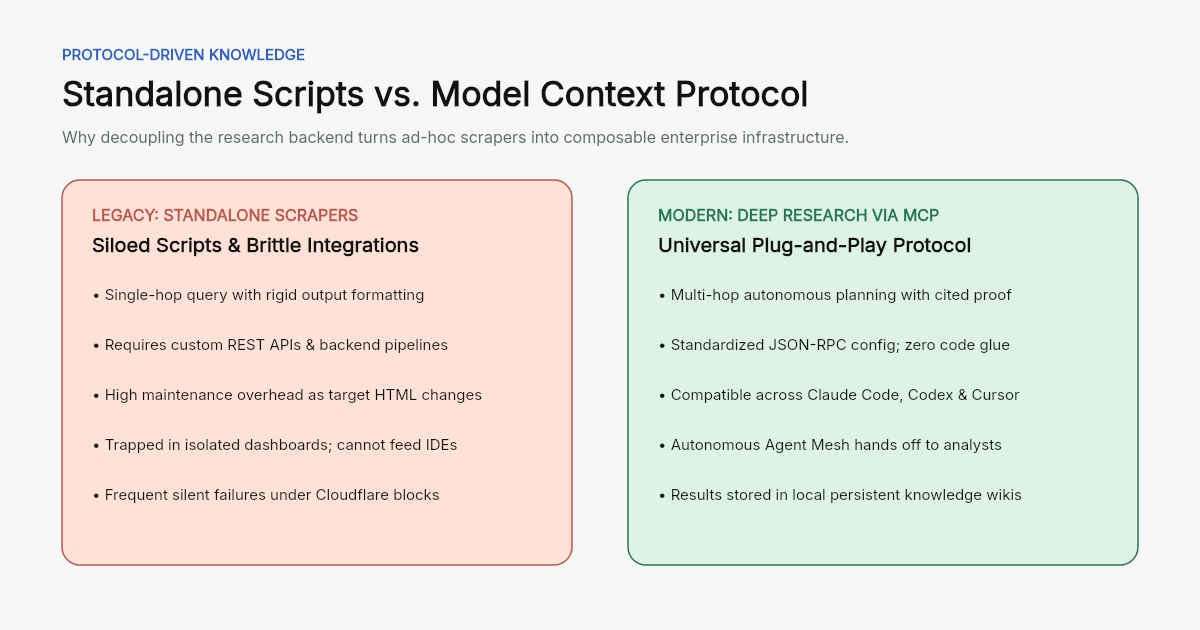 Figure 2: Architectural comparison between legacy standalone scrapers and composable Model Context Protocol research servers.
This protocol shift unlocks three practical advantages for insights and strategy teams:
- Zero Context Switching: Every modern market research analyst working in agentic environments (such as Claude Code, Codex, or Cursor) can invoke in-depth research directly within their authoring flow. You can draft an executive memo and ask
@deep-researchto verify competitor pricing without opening a browser. - Autonomous Multi-Agent Mesh: Research agents no longer operate in a vacuum. Under MCP, a research server can serve as an automated reconnaissance scout, feeding structured JSON evidence into a downstream financial modeling agent or automated presentation builder.
- Persistent Local Knowledge Repositories: Frameworks like
hyperresearchdo not discard retrieved context after generating a single response. They index scraped sources into a local, searchable Markdown wiki, building an institutional memory that reduces redundant token costs over time.
3. Production Realities: Three Engineering Constraints
While open-source research agents represent a significant leap over static scraping scripts, deploying them in enterprise environments requires addressing three real-world constraints:
Constraint 1: Token Throughput and Cost Escalation
A comprehensive multi-hop investigation across 30 web pages can consume between 200,000 and 500,000 tokens per run. Running flagship frontier models across every crawl stage quickly becomes cost-prohibitive. Production implementations require hierarchical model routing: deploying lightweight, cost-effective models (such as 8B-parameter local weights) for passage extraction and deduplication, reserving frontier models exclusively for final strategic synthesis.
Constraint 2: PDF Parsing and Table Distortion
Primary market intelligence—such as annual 10-K filings, industry whitepapers, and investor decks—is predominantly distributed in PDF format. Generic text scrapers frequently misalign multi-column layouts and strip critical metadata from data tables, creating hallucination risks if left unverified.
Constraint 3: WAF Mitigation and Rate Limits
High-velocity parallel crawls targeting high-value commercial databases often encounter bot-mitigation firewalls (such as Cloudflare Turnstile or Akamai). Open-source setups typically require dedicated proxy pools or commercial search APIs to maintain operational reliability.
The Next Phase of Open-Source Intelligence
The milestone of gpt-researcher reaching 30,000 GitHub stars and the rapid adoption of MCP servers signal a clear transition: market research tools are evolving from isolated web destinations into foundational, composable protocols.
For modern strategy and engineering teams, the competitive edge no longer comes from manually clicking through search results. It comes from orchestrating autonomous research loops that can gather, verify, and cite primary market data with speed and precision.
Sources and date notes
Notice and fair use statement: Open-source project repositories, GitHub star counts, code snippets, and architectural models referenced in this article are cited for educational, technical evaluation, and software architecture analysis under open-source licenses. Trademarks and repository assets belong to their respective creators.
Disclaimer
This article is intended for software architecture evaluation, open-source workflow research, and educational reference only. Organizations should evaluate API rate limits, web scraping legality, and data privacy policies prior to deploying autonomous research agents in production environments.
CTA
Ready to build verified, source-backed market research pipelines without manual scraping headaches? Explore how ResearchMaster AI integrates multi-source evidence synthesis into production workflows.
Footnotes
- Assaf Elovic, GPT-Researcher GitHub Repository: Autonomous agent for online multi-source research, accessed October 2026. ↩
- u14app, Deep Research GitHub Repository: Autonomous Deep Research with SSE API and MCP Server, accessed October 2026. ↩
- Jordan Gibbs, HyperResearch GitHub Repository: Deep Research Agent and Persistent Wiki Builder for Codex and Claude, accessed October 2026. ↩
- Model Context Protocol Official Documentation, MCP Specification and Architectural Architecture, accessed October 2026. ↩