Market research often feels difficult for the wrong reasons.
The hard part should be deciding what a market signal means. Instead, teams spend hours searching across tabs, copying numbers into spreadsheets, checking where a claim came from, reconciling conflicting definitions, rewriting the same findings for different stakeholders, and turning research into presentation slides.
An AI market research tool should change that balance. It should make the traditional production work simpler without pretending that judgment can be automated away.
ResearchMaster is designed around that idea. It turns topics, URLs, and files into verified market research by finding relevant sources, organizing evidence, checking data boundaries, preserving cited sources, and producing formats that teams can use. The goal is not to generate more words. The goal is to give people more time to think, challenge assumptions, compare options, and make a decision.
Why traditional market research consumes so much time
Traditional market research is not one task. It is a chain of small, connected tasks, and every handoff creates friction.
| Traditional task | Why it slows the team down | What an AI-assisted workflow can simplify |
|---|---|---|
| Search across reports, company pages, databases, and news | Relevant evidence is scattered across different formats | Multi-source discovery from one research question |
| Copy facts into notes or spreadsheets | Context and source links are easily separated from the claim | A structured source map that keeps evidence traceable |
| Compare market estimates | Definitions, periods, regions, and units may not match | Explicit data boundaries and cross-checks |
| Build a competitor matrix | Product, pricing, users, and channels live in different places | Repeatable competitive analysis dimensions |
| Rewrite findings for meetings | The same research is reformatted several times | Full text, summary, PDF, PPTX, and Markdown outputs |
| Update slides after new evidence appears | Every revision creates another version to maintain | A reusable research workspace instead of a static deck |
None of these tasks is meaningless. But most of them are production work, not decision work. When production takes most of the available time, people have less time to ask whether the evidence is strong enough, what could invalidate the recommendation, or which trade-off matters most.
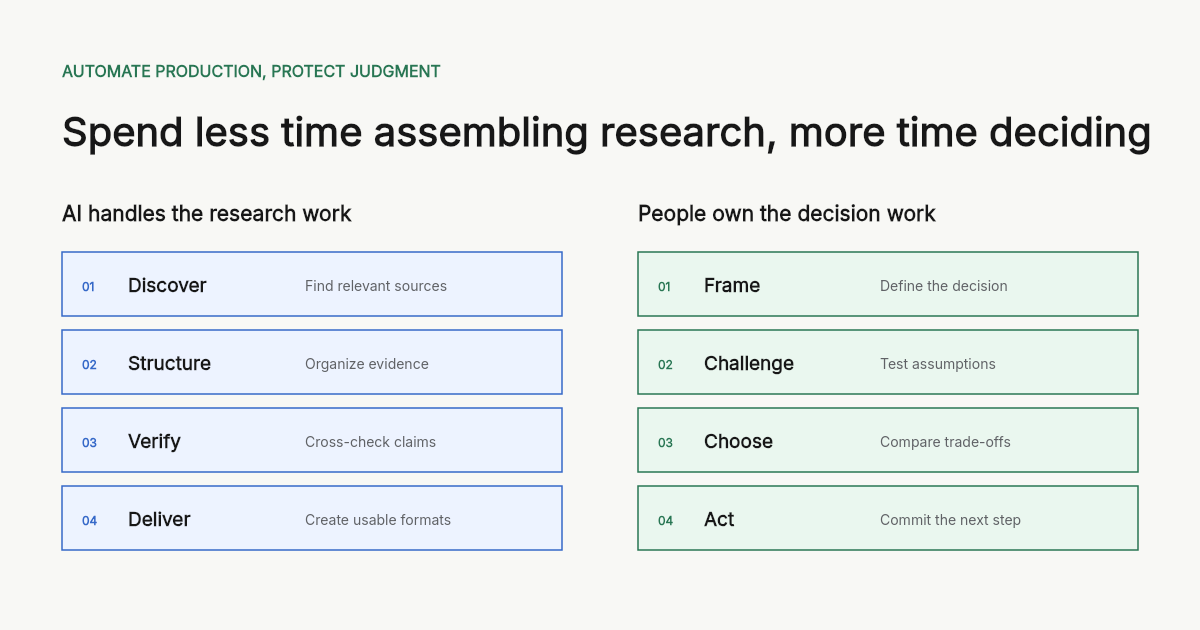
The best AI-assisted workflow automates research assembly while protecting the parts that require context and judgment.
What AI-assisted market research should actually automate
Useful automation begins before the report is written. It supports the full path from an unclear question to a defensible choice.
1. Turn a broad topic into a decision question
"Research the market" is not a useful brief. A stronger starting point names the decision, the audience, the deadline, and the evidence that could change the outcome.
For example, a founder doing market validation may need to decide whether a customer problem is urgent enough to build for. A product manager may need competitive analysis before choosing the next feature. An overseas operator may need to compare two countries before entering a new market.
AI can help expose missing dimensions and organize the brief, but the team still owns the question. A precise question prevents a polished report from answering the wrong problem.
2. Define market boundaries before collecting numbers
Market size figures often disagree because the sources are measuring different things. One source may cover a global category, another a regional segment, and another only paid software revenue. Combining them without checking definitions creates false precision.
A reliable industry research framework records:
- Geography and customer segment
- Product or category definition
- Time period and currency
- Revenue, users, shipments, registrations, or another unit
- Historical observation, current estimate, or forecast
These boundaries make later comparisons possible. They also make uncertainty visible instead of hiding it inside a confident conclusion.
3. Start from topics, URLs, and files
Teams rarely begin with a clean dataset. They may have a topic, a few competitor URLs, a PDF from an analyst, customer notes, and an internal spreadsheet.
ResearchMaster brings those inputs into one research flow. Public sources can expand what the team already knows, while supplied URLs and files preserve the context that matters to the business. This is especially useful for competitor research, overseas market research, and investment research, where evidence is distributed across company pages, regulatory documents, trade publications, reports, and internal material.
4. Keep every important claim connected to its source
Source verification is not a footnote added at the end. It is part of the reasoning process.
For every decision-relevant claim, the reader should be able to ask:
- Where did this information come from?
- What exactly did the source measure?
- How current is it?
- Does another source support or challenge it?
- Is the conclusion observed, inferred, or still uncertain?
Verified market research keeps those questions answerable. Cited sources allow a founder, manager, analyst, client, or investor to inspect the evidence instead of trusting a paragraph because it sounds professional.
5. Cross-check metrics before turning them into insight
A single source can be useful, but it rarely settles a market question. Cross-checking helps reveal when two sources use different definitions, when a forecast is being repeated as a fact, or when a small market is being mistaken for a large opportunity because its growth rate looks impressive.
ResearchMaster uses multi-source research to organize these comparisons. The output should state what is supported, what is inferred, and what still needs validation. That distinction makes the final recommendation easier to defend and easier to revise when new evidence appears.
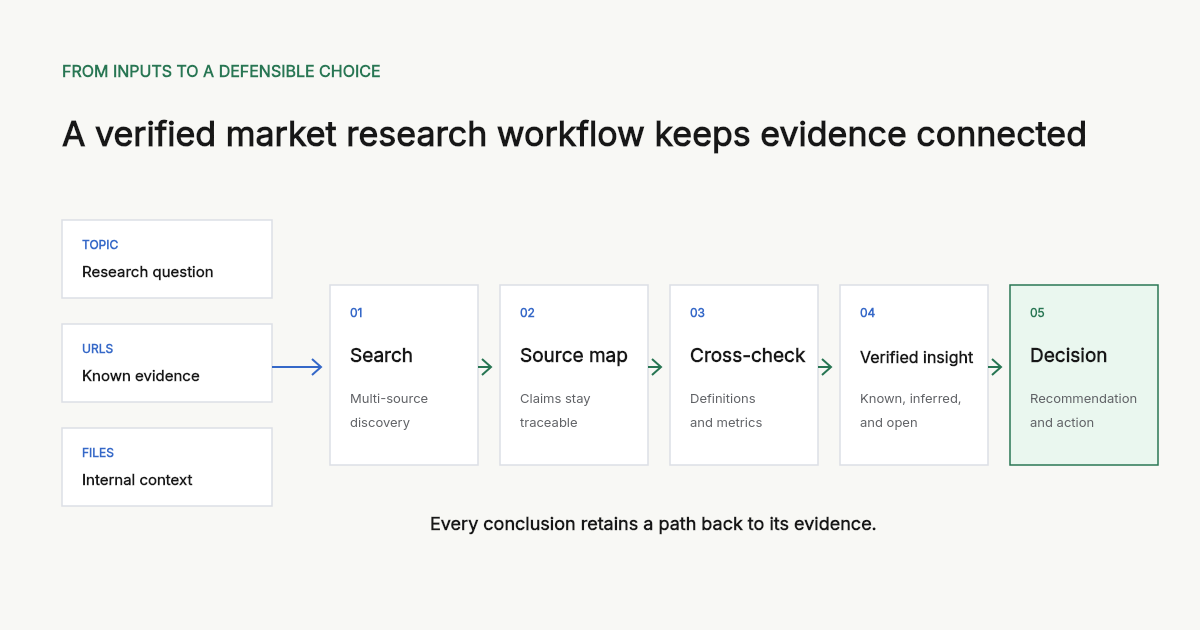
A conclusion becomes useful when its path back to the original evidence remains visible.
6. Produce decision-ready formats without rebuilding the research
Research often becomes trapped in presentation work. An analyst finishes the thinking, then spends another day shortening the report, building slides, adjusting layouts, exporting a PDF, and creating a separate version for a meeting.
That work should not require rebuilding the analysis. ResearchMaster can produce Full Text, Summary, PDF, PPTX, Markdown, slides, and mind-map views from the same research workflow. The formats serve different audiences, but the evidence base remains connected.
This does not mean a presentation never needs editing. It means the team can begin with a structured deliverable instead of a blank deck. Time moves away from formatting and toward deciding what the audience needs to understand.
A practical framework for faster decisions
The following workflow keeps AI useful without handing it responsibility for the final choice.
Step 1: State the decision
Write one sentence describing what must be decided and by when. If the decision is unclear, pause before collecting more data.
Step 2: Set the research boundaries
Define the market, region, customer, period, metrics, and acceptable source types. Record assumptions that could change the scope.
Step 3: Add known evidence
Provide the relevant topics, URLs, and files. Include internal context that public search cannot recover, such as customer feedback, product constraints, or an existing competitor list.
Step 4: Build the source map
Organize sources by the question they can answer: demand, market size, customer pain, pricing, product capability, distribution, regulation, or risk.
Step 5: Cross-check decision-critical claims
Compare definitions, dates, units, and methodology. Use more than one source for claims that could materially change the decision.
Step 6: Separate evidence from interpretation
Mark what is known, what is inferred, and what remains open. Do not let a clean narrative erase uncertainty.
Step 7: Choose and communicate the next action
End with a recommendation, the evidence behind it, the main counterargument, and the next validation step. Export the format the audience needs without recreating the research from scratch.
Where this framework helps most
The same workflow can support several common research tasks.
Market validation
Market validation is not a search for reasons to build. It is a test of demand, urgency, willingness to change, available alternatives, and the assumptions most likely to fail. AI can expand the evidence base, while the founder decides whether the opportunity is strong enough to pursue.
Competitive analysis
Competitive analysis becomes useful when companies are compared on a decision-relevant axis, not when features are copied into a large table. ResearchMaster can organize pricing, positioning, users, channels, product capabilities, and source-backed signals. The product team still decides which differences matter.
For a deeper comparison workflow, see Competitive Analysis Prompts That Produce Better Strategy.
Overseas market research
Country comparisons require consistent definitions and local context. Market size alone may hide regulation, distribution, payment behavior, customer expectations, or supply constraints. A structured workflow makes these differences visible before the team commits resources.
Industry and investment research
Industry research and investment research combine market structure, company performance, regulation, risks, and forward-looking assumptions. Cited sources and explicit limitations matter because the reader may challenge both the numbers and the interpretation.
What should remain human
An AI market research tool can reduce friction, but it should not make the final judgment invisible.
People still need to decide:
- Whether the original question reflects the real business problem
- Which sources are credible enough for the decision
- Whether apparently comparable metrics actually describe the same market
- Which risks are acceptable
- What evidence would reverse the recommendation
- Who is accountable for the next action
This is the productive division of work: AI handles discovery, organization, source tracking, cross-checking support, and deliverable production. People handle context, skepticism, trade-offs, and accountability.
A decision-ready research checklist
Before sharing the result, check that the report can answer these questions:
- Is the decision stated clearly?
- Are the market and metric definitions explicit?
- Can each important claim be traced to cited sources?
- Were decision-critical numbers cross-checked?
- Are evidence and interpretation separated?
- Are limitations and unresolved questions visible?
- Does the recommendation explain the trade-off?
- Can the audience use the output without rebuilding it in another document?
If several answers are no, the work is probably still information collection rather than decision support.
The point is not faster writing
AI-assisted market research should not be measured by how quickly it generates a long report. The better measure is how much low-value production work it removes while preserving traceability and judgment.
ResearchMaster helps teams move from scattered inputs to verified insights and decision-ready outputs. It simplifies the traditional workflow so founders, product managers, overseas operators, investors, analysts, students, and researchers can spend less time assembling information and more time deciding what to do with it.
That is the real advantage of an AI market research framework: not replacing thought, but creating more room for it.
For a practical tool-selection framework, read How to Choose an AI Market Research Tool: Why Verification Matters.