Many competitive analysis projects end as a spreadsheet of features, prices, funding, customer reviews, and social mentions.
That information can be useful, but it only shows what competitors have today. It does not answer the questions that shape strategy:
- How is the industry changing?
- How much room does the market have to grow?
- What problem does each competitor solve especially well?
- Why do customers choose one option over another?
- Where should we copy, avoid, or build a clear difference?
Good competitive analysis is not about collecting more facts about other companies. It puts each competitor inside its industry, market, and customer context. The goal is to understand its current value, future position, and the choices your team should make next.
Traditional competitive analysis is slow for more than one reason
Traditional competitive analysis usually requires people to:
- Search company websites, product pages, and industry news
- Record features, prices, customers, and partnerships
- Read customer reviews and media coverage
- Build competitor matrices
- Turn the findings into strengths, weaknesses, and recommendations
The benefit is human context. An experienced analyst can notice weak signals, challenge a company claim, and connect the research to the business.
The cost is that much of the available time goes into searching, copying, organizing, and updating information. The depth of the result also depends on the analyst's experience, source choices, and available time.
Traditional research often starts with a fixed list of known competitors. That creates another risk: the team studies familiar companies but misses new entrants, substitutes, adjacent categories, and changes in the wider industry.
A detailed report can still be built on an outdated competitive boundary.
General-purpose AI is faster, but not always deeper
General-purpose AI can summarize public information quickly. Give it a list of companies and it can usually produce:
- Product and feature comparisons
- Pricing and target-user summaries
- Strengths and weaknesses
- A review of customer comments
- Basic positioning suggestions
This is useful for getting oriented or preparing for a meeting.
But general-purpose AI usually depends on the competitor list and analysis dimensions in the prompt. If the request says "compare these three companies," the answer often stays inside those three companies and reorganizes the information that is easiest to find.
Common limits include:
- Giving too much weight to company pages and widely repeated articles
- Treating marketing claims as product facts
- Mixing different dates, regions, or product versions
- Skipping the market boundary and future market potential
- Presenting a reasonable inference without showing that evidence is weak
- Reducing the conclusion to who has more features or better reviews
General-purpose AI makes information gathering faster. Without a clear research framework, it can still produce a faster competitor summary rather than a stronger strategic analysis.
Customer reviews and sentiment monitoring are not the full analysis
Customer reviews, social posts, news volume, and sentiment monitoring can reveal what the market is discussing.
They can help answer:
- Which complaints are becoming more common?
- How did users react to a product launch?
- Is a brand receiving more attention?
- Which product issues create negative feedback?
These signals matter, but they need context. A larger company will often have more positive and negative comments simply because it has more customers. High attention does not prove market share, and negative sentiment does not automatically mean weak competitive value.
Sentiment monitoring tells you what people are saying. Competitive analysis must also explain whether those voices represent the target customer, what business issue sits behind the feedback, and whether the signal changes the market outlook.
Reviews and sentiment are evidence inputs, not the final conclusion.
How ResearchMaster approaches competitive analysis
ResearchMaster is not designed to search for competitor pages, reviews, and mentions and stop there.
It first defines the research goal and competitive boundary. It then studies competitors across industry trends, market potential, customer needs, business models, current positioning, core value, and future room for differentiation.
| Analysis layer | Question to answer |
|---|---|
| Industry trends | How are technology, policy, channels, and customer behavior changing? |
| Market potential | How large is the opportunity, and where can it still grow? |
| Competitive boundary | Which direct competitors, substitutes, and new entrants matter? |
| Target customer | Who does each competitor serve, and which problem does it solve? |
| Core value | Why does a customer choose this product instead of another option? |
| Product capability | Which features support the core value, and which are surface differences? |
| Business model | How does the company price, sell, deliver, and earn revenue? |
| Competitive advantage | Does the advantage come from product, data, channel, brand, or cost? |
| Future position | Can the current advantage survive the next stage of the market? |
| Strategic direction | Should the team follow, avoid, defend, or create a new difference? |
The purpose is not to make the report longer. It is to avoid reducing competitor research to a feature checklist.
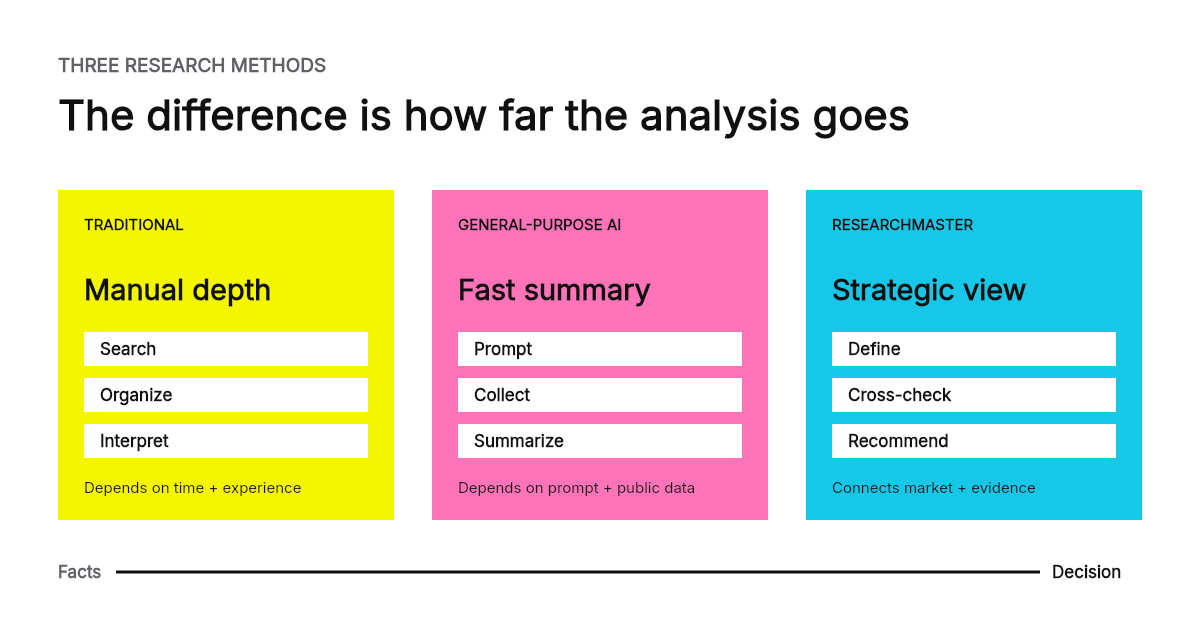
The main difference is not how quickly each method finds facts. It is how far the research moves from information to a decision.
Start by defining who really competes with you
Competitive analysis often fails because the initial competitor list is treated as complete.
A useful competitive boundary may include:
- Direct competitors with a similar product
- Indirect competitors solving the same problem in another way
- Manual workflows or internal tools customers use today
- New companies entering the category
- Adjacent companies that could enter through technology or distribution
For an AI market research tool, the competitive set is not limited to other AI report tools. It can include general-purpose AI search, consulting services, traditional research databases, and internal manual research processes.
If the competitive boundary is wrong, a detailed comparison of features and prices will still support the wrong decision.
Put current competitors inside future industry trends
A competitor's current strength may not remain a strength.
The analysis should ask:
- Is the market growing, maturing, or becoming smaller?
- Are customers moving from single features to complete workflows?
- Is new technology lowering an old barrier to entry?
- Will regulation or compliance change the cost of competing?
- Are buying behavior and sales channels changing?
A company may lead on feature count today. As the market matures, customers may care more about reliability, service, and return on investment.
Another company may have a small current share but be better placed for the next stage because of its channel access, local fit, or cost structure.
Competitor research without industry trends can describe today's ranking, but it cannot explain where that ranking may go next.
Find the core value behind the feature list
Similar features do not always create the same customer value.
For each competitor, ask:
- Which customer does it serve best?
- When and why does that customer choose it?
- Does it mainly improve speed, cost, risk, or growth?
- What is the customer truly paying for?
- How easily could another solution replace that value?
Two tools may both generate a research report. One may be chosen for fast orientation. Another may be chosen for source verification, deeper analysis, and a deliverable that can support a formal decision.
The visible feature may be similar. The job, customer, and core value can be very different.
The point of competitor research is not to discover more feature differences. It is to explain why those differences matter.
Cross-check sources and make conflicts visible
Competitor evidence is spread across product pages, pricing pages, help centers, company filings, job posts, customer reviews, industry publications, and market databases.
Those sources often disagree:
- The product has changed, but third-party reviews still describe an older version.
- The company says it serves one audience, while customer evidence suggests another.
- Users describe the product as expensive, while enterprise customers continue to buy it.
- An article reports fast market growth, but the official data uses a narrower definition.
ResearchMaster uses multi-source research and source verification to compare these claims. The report should separate:
- Facts supported by a direct source
- Findings supported by several independent sources
- Inferences drawn from market signals
- Assumptions that still need validation
Cited sources are not decoration at the end of a report. They show whether a conclusion can be checked and whether it is strong enough to guide product, market, or investment decisions.
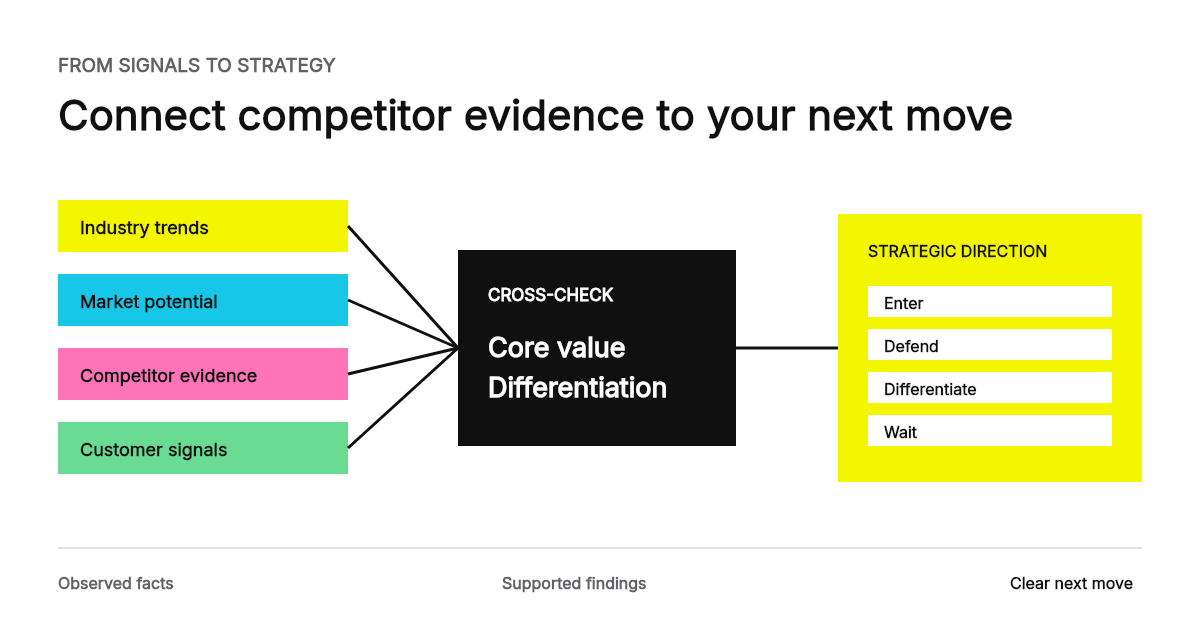
Competitive evidence becomes useful when it leads to a clear view of where to compete and what to do differently.
How the three approaches differ
| Dimension | Traditional research | General-purpose AI | ResearchMaster |
|---|---|---|---|
| Source collection | Manual search and organization | Fast summary of public information | Multi-source discovery with structured evidence |
| Research boundary | Depends on analyst experience | Depends on the prompt and initial list | Includes industry boundaries, substitutes, and entrants |
| Main focus | Features, prices, and company facts | Summaries, strengths, and basic comparisons | Trends, market space, users, value, and position |
| Customer reviews | Read and grouped manually | Summarized quickly | Checked against other evidence and customer context |
| Source verification | Requires manual review | Citations may be available, but depth varies | Emphasizes cross-checks and cited sources |
| Conflicting data | Found and handled manually | May collapse into one answer | Keeps definitions, conflicts, and uncertainty visible |
| Typical output | Competitor matrix and analyst report | Fast competitor overview | Structured analysis that supports positioning and action |
| Best fit | Small, clearly scoped projects | Fast orientation | Product strategy, market entry, and industry decisions |
These approaches are not always separate.
Traditional analysis brings human experience. General-purpose AI speeds up early discovery and summarization. ResearchMaster connects the competitive evidence to the industry, the market, and the decision so the team can move from information to a source-backed judgment.
What should a professional competitive analysis deliver?
A professional analysis should not only rank companies. It should answer:
- How did the current competitive structure form?
- What core value helps each competitor win customers?
- Which advantages are real barriers, and which are easy to copy?
- Which strengths may weaken as the industry changes?
- Which customer needs remain underserved?
- Where can the team build meaningful differentiation?
- Which assumptions should be tested next?
The final direction may be to enter a narrow segment, strengthen a capability, change the positioning, or wait.
The recommendation does not need to sound aggressive. It needs to follow clearly from the evidence, market trends, and competitive value described in the report.
Move from "what competitors do" to "what we should do"
Traditional competitive analysis combines manual source collection with human judgment. General-purpose AI makes early research faster. ResearchMaster goes further by placing competitor evidence inside the industry trend, market potential, and customer need.
It does not stop at which feature launched, which review appeared, or how much attention a brand received.
It asks why those signals matter, whether a competitor's core value can last, where the market still has room, and what difference the team should build.
The final purpose of competitive analysis is not to know more about competitors. It is to make a clearer decision about your own direction.