AI will replace some of the work market research companies do today. It will not automatically replace the research partner you need when a decision is expensive, ambiguous, or difficult to reverse.
That distinction matters. AI is already good at producing a first draft, organizing sources, summarizing interviews, and turning scattered findings into a readable report. Those capabilities reduce the cost of research production. They do not settle whether the question was defined correctly, whether the method fits the decision, or whether the evidence is strong enough to defend in a management meeting.
So the better question is not whether AI will replace research companies. It is which parts of the work should move to AI, and which parts still need experienced people.
AI is already changing research workflows
Marketing research has always involved a large amount of mechanical work: collecting public sources, cleaning data, tagging interviews, drafting questionnaires, formatting charts, and assembling the final report. AI can now shorten many of those steps.
Recent industry evidence suggests adoption is broad, but maturity is uneven. Research Live reported that Zappi's Connected Insights Imperative 2026 survey, which covered more than 250 marketing and insight professionals, found that 93% of organizations used AI in some form. Only 8%, however, had reached an "AI-accelerated" stage.1
Product development is moving in the same direction. Rep Data's Research Desk MCP Server, reported by Research Live in September 2026, lets users connect tools such as ChatGPT and Claude to its research platform, create projects, configure parameters, and generate survey deployment links through natural language.2
These are not speculative use cases. They show that project setup, survey execution, summarization, and reporting are becoming more automated.
Why the replacement question is too simple
A research project usually fails before the report looks bad. It fails because the team studied the wrong question, used a sample that could not support the conclusion, ignored an important source of bias, or treated a plausible inference as verified evidence.
Consumer research is a good example. AI can summarize thousands of reviews or open-ended survey responses, but it can also make the evidence look tidier than it is. Real customers contradict themselves, use language differently across regions, and say things in one context that they would not say in another. An experienced researcher looks for those inconsistencies rather than smoothing them away.
Competitor research has a similar problem. AI can quickly build a competitor table, but the harder questions remain: which companies belong in the market boundary, which claims come from product pages rather than independent evidence, and why a feature difference matters for the buyer. A list of competitors is not the same as a competitive judgment.
Research Live's August 2026 feature on insight skills made the same point through practitioners from Esomar, MRS, Kantar, Verve, and other organizations. As AI automates more collection, analysis, and presentation work, the differentiated value moves toward framing the problem, understanding the business, challenging AI output, and connecting evidence to a useful decision.3
AI makes production cheaper. It does not make judgment cheaper.
A practical division of work
The most useful approach is to split research work by task and risk.
| Research stage | Where AI helps | What people should keep |
|---|---|---|
| Problem definition | Suggest hypotheses, questions, and possible angles | Identify the real decision, stakeholders, and risks |
| Desk research | Find, summarize, and organize public material | Verify sources, detect bias, and find gaps |
| Questionnaire design | Draft questions and wording variations | Protect sampling logic, causality, and answer scales |
| Data processing | Clean, code, and summarize large datasets | Judge anomalies and whether results make sense |
| Qualitative analysis | Transcribe, tag, and cluster responses | Interpret context, silence, contradiction, and culture |
| Competitor analysis | Build first-pass competitor matrices | Define the market boundary and assess strategic meaning |
| Reporting | Produce drafts, tables, and summaries | Choose the decision implication and state the limits |
| Decision meeting | Prepare follow-up questions and scenarios | Handle trade-offs, disagreement, and accountability |
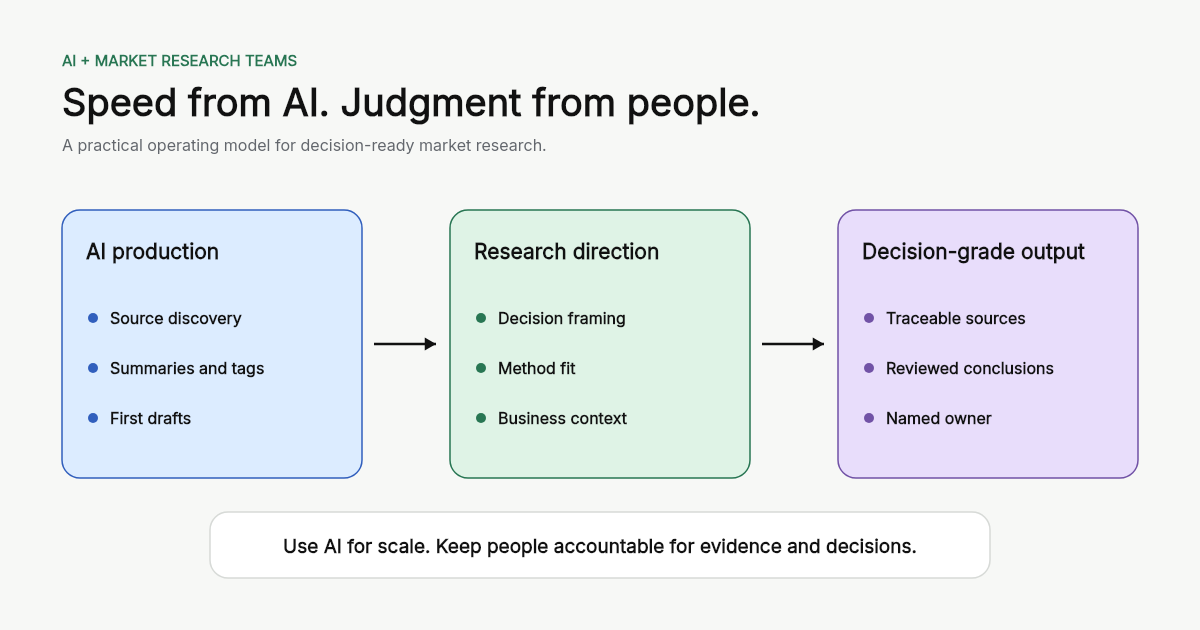
AI can accelerate production, while people define the decision, check the evidence, and own the final recommendation.
This table is not an argument for doing everything manually. It is also not permission to send unreviewed AI output directly to senior leaders.
For a broader method overview, see our guide to types of market research methods.
The real risk is ungoverned research
The more uncomfortable issue is not job displacement. It is the growth of ungoverned research inside companies.
An AiThority article published in September 2026 cited a survey of 154 U.S. insight professionals. It reported that 47% said AI-generated insights had reached senior leaders without researcher review, while 46% said non-researchers had used AI without sound methodology to create data that informed business decisions.4
The same article reported that 90% of researchers said AI output required editing or significant rework before it had value. Respondents spent an average of seven hours per week fixing AI-generated content.4
Those figures should be read carefully. The article was written by the CEO of an AI research company, so it has a commercial perspective and a small industry sample. Still, the underlying risk is concrete: an organization can use more AI while reducing its ability to check what the AI produced.
Zappi's study points to the same tension. Overall satisfaction with insight functions fell from 60% to 48% between 2025 and 2026, even though "AI-accelerated" organizations reported higher satisfaction than disconnected ones.1 AI use alone does not create better research. The surrounding data, workflow, and decision process matter.
What this means if you buy market research services
If you purchase market research services, avoid choosing only between "use AI internally" and "hire an agency." Separate low-risk discovery from high-risk decisions.
For low-risk exploration, AI can be used aggressively:
- Building context before a category review
- Summarizing public articles, filings, and product pages
- Producing first drafts of discussion guides
- Clustering customer feedback for early themes
- Formatting material for an internal working session
For higher-stakes decisions, method and review become more important:
- Entering a new market
- Changing pricing or packaging
- Making a major product investment
- Repositioning a brand
- Using research to support a board or investor decision
In those cases, ask any provider, internal team, or AI tool the same questions:
- What decision is this research supposed to support?
- What population, source set, or market boundary does the evidence represent?
- Which conclusions are directly supported by sources?
- Which conclusions are inferences?
- Who reviewed the output before it reached decision-makers?
- What would change the recommendation?
If those questions cannot be answered, the deliverable may still be useful as background. It should not be treated as decision-grade evidence.
What this means for market research companies
Market research companies will face pressure if their value is defined by execution volume: hours spent, pages produced, transcripts coded, or charts formatted. AI will keep reducing the cost of that work.
But agencies still have a clear role when they provide:
- Method design and sampling judgment
- Access to appropriate participants or datasets
- Quality control across sources and markets
- Interpretation rooted in category experience
- Independent challenge to internal assumptions
- Accountability when a leader questions the conclusion
The role of a market research analyst also changes. The analyst becomes less of a production bottleneck and more of a research director: defining the question, steering the tools, checking evidence, translating findings into business language, and deciding when a conclusion is not strong enough to act on.
That is not a smaller job. It is a different one.
A practical operating model
For most teams, the practical model will be hybrid:
- Define the decision and the consequences of being wrong.
- Let AI accelerate discovery, drafting, and organization.
- Apply human review at the points that affect methodology, evidence, and interpretation.
- Keep sources traceable so others can audit the conclusion.
- Separate facts, inferences, and open questions in the final deliverable.
- Assign a person to own the recommendation.
This is also how teams should evaluate AI research tools. If you are comparing options, our guide to choosing an AI market research tool covers the verification and workflow criteria that matter most. For strategic work, the guide to competitive analysis prompts that produce better strategy shows how to move from competitor facts to a decision.
The short answer
AI will not simply replace market research companies. It will change what clients are paying for.
The old contract was often execution: run the fieldwork, analyze the data, and deliver a report. The next contract is closer to judgment: define the right question, make the method defensible, verify the evidence, adapt AI output to the business context, and explain what the organization should do next.
Companies that only sell execution will feel pressure. Companies that can combine AI speed with rigorous method, source verification, and human accountability will still be valuable.
The same principle applies inside an organization. AI can produce the first draft. People still need to own the question, the evidence, and the decision.
Sources and date notes
Disclaimer
The Zappi findings were reported by an industry publication but originate from a commercial research technology company. The AiThority article was written by the CEO of an AI research agency and cites a 154-person sample. Treat both as useful market signals rather than universal industry benchmarks.
CTA
If your team wants an AI-assisted workflow that keeps sources visible and human judgment in the loop, start by testing ResearchMaster AI on one high-stakes research question.
Footnotes
- Research Live, "Insight satisfaction drops, but AI boosts support, says Zappi study," 2026-09-07, English, https://www.research-live.com/article/news/insight-satisfaction-drops-but-ai-boosts-support-says-zappi-study/id/5152597 ↩ ↩2
- Research Live, "Rep Data adds MCP feature to Research Desk platform," 2026-09-09, English, https://www.research-live.com/article/news/rep-data-adds-mcp-feature-to-research-desk-platform/id/5152706 ↩
- Research Live, "The new world: Crafting the insight skills to stay ahead," 2026-08-19, English, https://www.research-live.com/article/features/the-new-world-crafting-the-insight-skills-to-stay-ahead/id/5152106 ↩
- AiThority, "Why the Real AI Threat to Market Research is an Ungoverned Analytics Layer," 2026-09-10, English, https://aithority.com/guest-authors/why-the-real-ai-threat-to-market-research-is-an-ungoverned-analytics-layer/ ↩ ↩2