Brands used to ask one question about visibility: did we rank?
AI chat changes that question. A single answer can now include a model summary, links to sources, a sponsored placement, competitor mentions, and a direct recommendation. The user may never open a search results page. They may still make a decision.
That shift turns AI chat advertising into a measurement problem, not just a media-buying problem. Comscore's new AI Intelligence capability is one signal of the change: the company now measures sponsored chat advertising and its relationship to traffic, engagement, content influence, and consumer behavior.1
The teams that get this right will stop counting screenshots. They will separate paid from organic exposure, connect answers to downstream behavior, and treat user trust as a metric.
What "the answer layer" means
The answer layer is the space where an AI assistant summarizes information, cites sources, suggests options, and may show sponsored content.
It is not another search results page. In search, users scan titles and links. In chat, they read a composite answer and often accept it as sufficient. That makes every part of the answer commercially important.
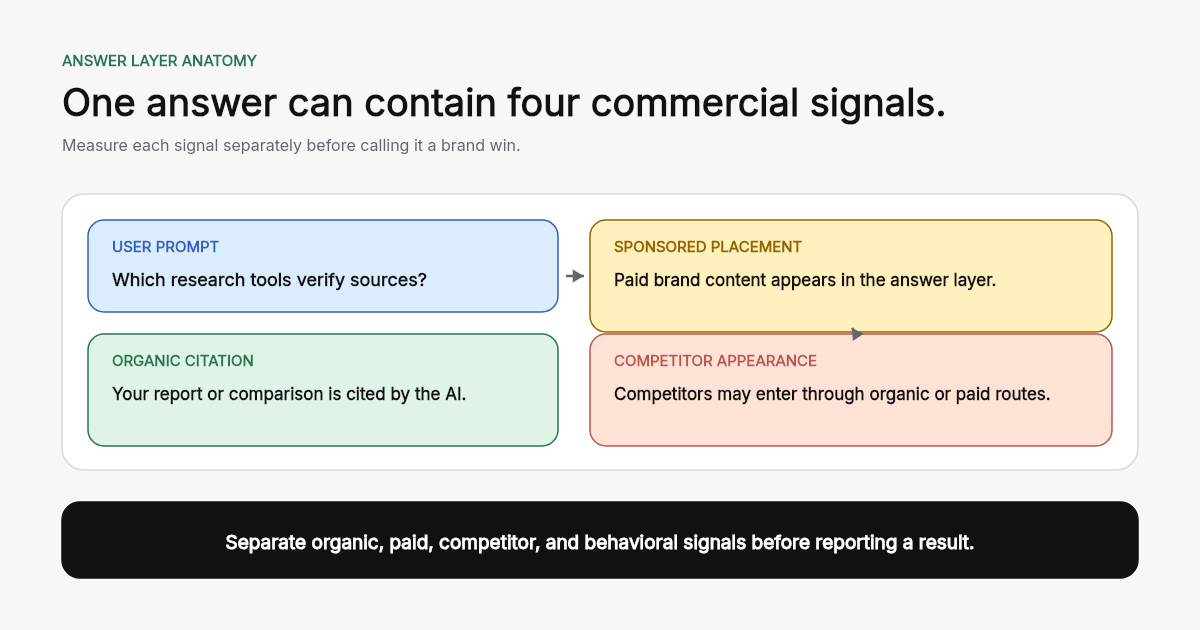
The prompt and answer are visible. The measurement challenge is to understand what each part causes.
Comscore's early travel data shows how quickly this can move. Among hotel-related ChatGPT prompts with identifiable source links, sponsored-ad presence rose from 6% in March 2026 to 14% in April and 24% in May.1 That is one category and one platform, but the direction matters.
Why this is different from search ads
Search ads usually compete for attention before a click. AI chat ads can appear after the system has interpreted the request, summarized the market, and selected sources. The ad competes with a confident answer, not a list of blue links.
| Dimension | Search ads | AI chat ads |
|---|---|---|
| Input | Keywords and short phrases | Scenarios, constraints, and full questions |
| Surface | Results page | Answer layer beside or inside generated content |
| Brand visibility | Ad position and organic rank | Citations, mentions, sponsored placements, and answer wording |
| Main risk | Poor click-through | Misleading summary, unclear labeling, or loss of trust |
| Attribution | Established tools and benchmarks | New models, limited benchmarks, and mixed paid/organic exposure |
This does not make AI chat ads impossible to measure. It means the old reporting format is incomplete.
Paid placements and organic citations are not the same win
Imagine a prompt such as: "Which market research platform can verify sources and produce a board-ready report?"
The answer may contain:
- A sponsored placement for a large vendor
- An organic citation to an independent comparison
- A community thread about pricing
- A mention of your brand without a link
- A competitor described as more suitable for enterprise buyers
Each of those has a different commercial meaning.
| Type of appearance | What it can show | What it cannot prove |
|---|---|---|
| Organic citation | Your content was considered relevant and credible | That the user clicked, trusted it, or acted |
| Brand mention | The brand entered the consideration set | Whether the description was accurate or favorable |
| Sponsored placement | Paid visibility inside the answer | That the placement changed preference or behavior |
| Competitor mention | A competitor entered the same decision context | Why it appeared or whether it outranked you |
Sponsored exposure can be useful. But if a paid placement appears next to an organic source that contradicts it, the user may distrust both. If a brand pays for visibility but the AI describes it inaccurately, the campaign can create recognition without preference.
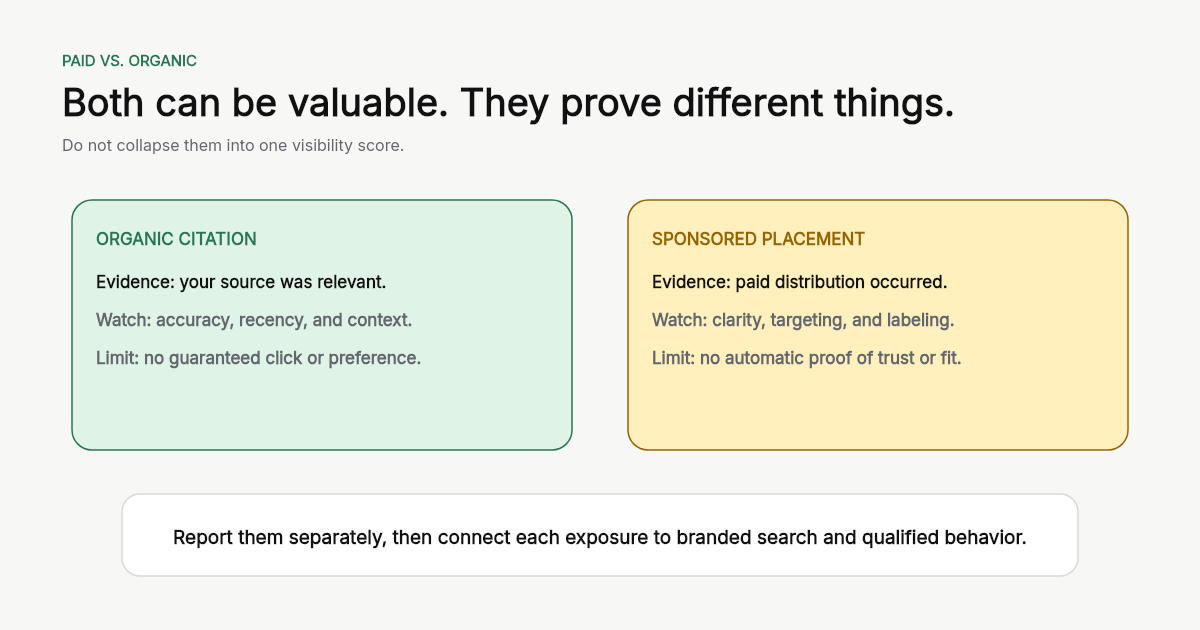
Paid and organic visibility should be reported separately before either is called a win.
A five-layer measurement framework
Start with five layers. They keep paid, organic, and behavioral results separate.
1. Exposure
Record whether the brand appeared, how it appeared, and whether the appearance was paid or organic.
Track:
- Organic citations
- Brand mentions without links
- Sponsored placements
- Competitor appearances
- Position in the answer
2. Context
Exposure without context is easy to overvalue.
Record:
- The prompt category
- The user's apparent decision stage
- Whether the brand was recommended, compared, qualified out, or described inaccurately
- Whether sponsored and organic results appeared together
3. Evidence quality
Check what the answer relied on.
Track:
- Cited domains
- Source dates
- Product-page claims versus independent evidence
- Conflicting sources
- Missing competitors or market definitions
4. Behavior
Connect exposure to what happens next.
Track:
- Link clicks
- Branded search
- Direct visits
- Pricing or case-study views
- Sign-ups, demos, consultations, and purchases
5. Trust
Trust determines whether short-term exposure creates long-term preference.
Track:
- Whether users can identify sponsored content
- Whether the brand description is accurate
- Whether paid and organic results are clearly separated
- Whether users say the answer felt neutral or promotional
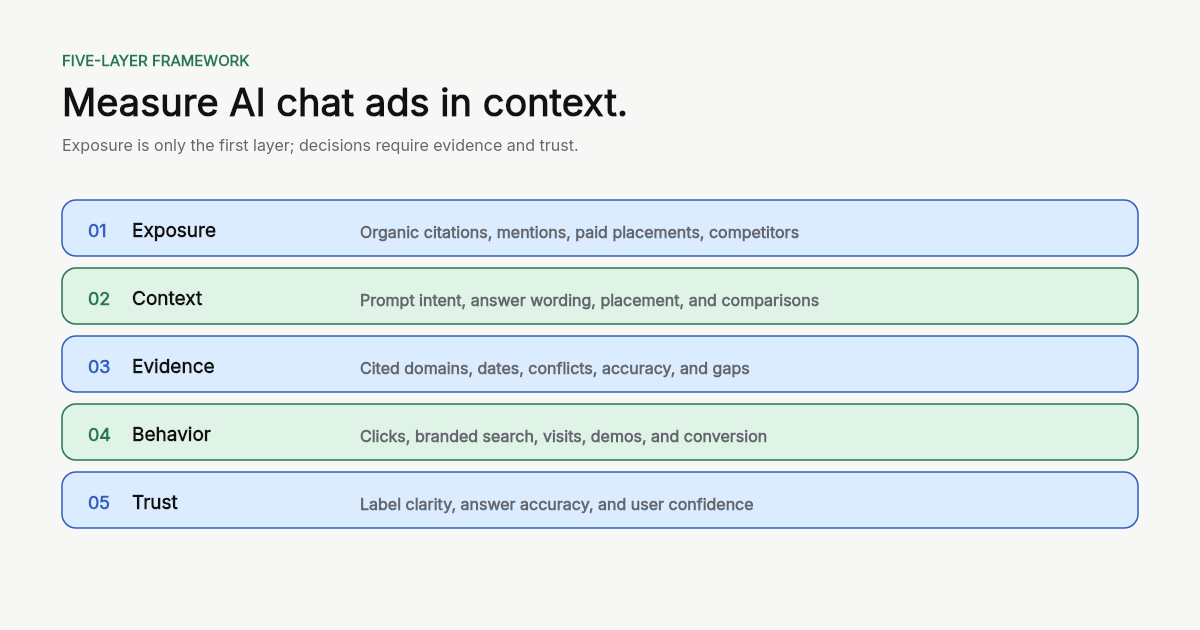
The framework separates what appeared, why it appeared, what it caused, and whether users could trust it.
Why user trust belongs in the report
OpenAI said in January that it planned to test ads in ChatGPT free and Go tiers. Its public post received 9,417 likes and 3,371 replies.2 Sam Altman's follow-up said OpenAI would not accept money to influence ChatGPT's answers and would keep conversations private from advertisers. That post received 9,799 likes and 4,637 replies.3
Those are not small numbers. Users are watching whether advertising changes answers.
Techmeme has also reported that OpenAI targeted roughly $60 per 1,000 views for ChatGPT ads, according to The Information.4 If pricing approaches premium media levels, advertisers should expect premium measurement questions: Did the answer describe the product correctly? Did the sponsored placement complement or compete with organic citations? Did exposure lead to qualified behavior?
Ad platforms can supply impressions. Brands still need evidence that exposure produced an accurate association and a defensible business outcome.
A practical reporting table
Use one row per prompt and one column per appearance type. A simple version looks like this:
| Prompt | Organic citation | Brand mention | Sponsored placement | Competitor presence | Answer accuracy | Downstream action |
|---|---|---|---|---|---|---|
| "Best tools for verified market research" | Yes | Yes | No | Two competitors | Mostly accurate | 12 branded searches |
| "How to compare overseas markets" | No | No | Competitor only | One competitor | Partially accurate | 3 pricing-page visits |
| "Board-ready industry report workflow" | Yes | No | No | None | Accurate | 1 demo request |
This table gives you something better than a screenshot. It shows the type of visibility and the behavior that followed.
Common measurement traps
Most reporting mistakes happen after someone turns a nuanced answer into a single score. A brand can be present and still be misrepresented. It can also be absent from one answer while remaining important in the buyer's final decision.
The five traps below are worth checking before an AI-chat visibility report reaches a stakeholder.
| Trap | Why it misleads | A better check |
|---|---|---|
| Counting every mention as preference | A neutral mention, a caveat, and a recommendation can all look identical in a count. | Label each mention as positive, neutral, conditional, negative, or unclear. |
| Treating sponsored reach as content authority | A paid placement proves distribution, not credibility. | Keep paid exposure separate from organic citations and sources. |
| Mixing paid and organic results too early | The combined number hides whether visibility came from content strength or budget. | Report organic and sponsored results side by side, then compare overlap and click behavior. |
| Using one prompt as a benchmark | One wording can favor one competitor and miss another decision context. | Use a panel of real buying questions and repeat them over time. |
| Ignoring inaccurate answers | Confident but wrong answers can still create visits, objections, or support tickets. | Compare product, pricing, and competitor claims with source material before reporting. |
Two questions catch most of these problems. First, would we describe this result the same way if the placement were organic rather than paid? Second, would a decision-maker still act on it after reading only the sources behind the answer?
If either answer is no, mark the result as exploratory. It can still inform strategy, but it should not be presented as decision-grade evidence.
What to do in the first 30 days
Start with a narrow test.
- Choose 20-50 prompts that match real buying questions.
- Include comparison, alternative, pricing, risk, and implementation questions.
- Run them across the AI tools your buyers use.
- Save the full answer, sources, date, platform, and version.
- Classify each brand and competitor appearance as organic, paid, mention, citation, or absence.
- Check factual accuracy against your product, pricing, and source material.
- Connect visible exposure to branded search, site visits, and qualified actions.
- Review the results with marketing, research, and sales together.
After the first pass, you will have more than a visibility score. You will know which questions expose your brand, which answers are wrong, and where paid or organic investment should go next.
What this means for research and marketing teams
Research teams should treat AI answers as evidence that needs provenance. Marketing teams should treat them as a media surface that can influence consideration. Neither team should own the measurement alone.
If you are comparing tools and methods, our guide to AI search visibility benchmarks explains why one prompt cannot represent brand visibility. For the broader division of work between AI and researchers, see what happens when AI enters market research companies. And if you need a structured way to evaluate platforms, use the checklist in how to choose an AI market research tool.
The short answer
AI chat ads are entering the answer layer. They can create visibility, but they can also blur the line between recommendation and promotion.
Measure five things separately: exposure, context, evidence quality, behavior, and trust. Then connect them to the decision the prompt was really about.
That is how AI chat advertising becomes something you can manage, not just something you observe.
Sources and date notes
Disclaimer
Comscore's travel-category data reflects its measurement methodology and early sample. It should not be generalized to every industry or AI platform. OpenAI's advertising rules, formats, pricing, and user experience may continue to change. X/Twitter engagement figures are public metrics captured for this research; they do not represent complete audience sentiment.
CTA
If you want to test this framework on real buyer questions, use ResearchMaster AI to trace answers back to sources, compare competitors, and document the evidence behind each recommendation.
Footnotes
- Comscore, "Comscore Expands Its AI Intelligence to Measure Sponsored Chat Advertising and Its Business Impact," September 3, 2026, English, https://www.comscore.com/Insights/Press-Releases/2026/9/Comscore-Expands-Its-AI-Intelligence-to-Measure-Sponsored-Chat-Advertising-and-Its-Business-Impact ↩ ↩2
- OpenAI, post on testing ads in ChatGPT free and Go tiers, January 16, 2026, English, https://x.com/OpenAI/status/2012223373489614951 ↩
- Sam Altman, post on ChatGPT ads principles, January 16, 2026, English, https://x.com/samaltman/status/2012253252771824074 ↩
- Techmeme, post citing The Information on ChatGPT ads pricing, January 26, 2026, English, https://x.com/Techmeme/status/2015794558408519840 ↩