AI can compare two headphones, build a travel kit, or shortlist laptops for video editing in seconds. The answer often looks complete: a few products, a neat set of trade-offs, and a recommendation that appears to fit the brief.
Then the shopper opens another tab.
They look for a long-term review. They search Reddit for a recurring complaint. They watch someone use the product in a situation that resembles their own. AI has helped them find the shortlist, but it has not finished the decision.
That gap matters. It suggests that AI is becoming a starting point for shopping research without becoming the final source of trust.
AI reduces search effort, not purchase risk
Traditional product research is slow because the buyer has to translate a vague need into a comparison. A commuter looking for noise-cancelling headphones under $300 may need to sort through dozens of models, specifications, retailer pages, and reviews.
AI is good at compressing that work. It can identify the budget, use case, and important features, then turn a broad market into three or four plausible options.
The closer the shopper gets to a purchase, however, the questions become less abstract:
- Will the headphones become uncomfortable after two hours?
- Does the noise cancellation work on a train, not just in a test room?
- Is the battery claim realistic after several months of use?
- What happens when something breaks?
These are not simply product-data questions. They are risk questions. The shopper wants evidence from people who have already lived with the consequences of the choice.
Recent research points to a second verification layer
In September 2026, IAB reported findings from 2,200 consumers in the United States, United Kingdom, Australia, Mexico, and India who had recently used AI for shopping research. Fifty-six percent said they preferred AI recommendations that included creator perspectives, while 65% said reviews from trusted creators increased their confidence in an AI recommendation.1
The important signal is not that one percentage is larger than another. It is that shoppers want AI recommendations to carry visible human context.
A creator or community member rarely adds value by repeating the specification sheet. They show what happens after the product leaves the box: which feature matters in daily use, where the design becomes irritating, and what the marketing page did not make obvious.
Reddit Business reported a similar pattern in an August 2026 survey of 13,956 U.S. respondents aged 18 to 65 who used social platforms, large language models, and ecommerce sites at least monthly. Half said they used Reddit to verify an AI-generated product recommendation.2
Both studies come from organizations with a commercial interest in creator or community-led advertising. They should be treated as market signals, not universal consumer truths. Even with that limitation, they point to a useful research question: are shoppers settling into an AI shortlist, human verification habit?
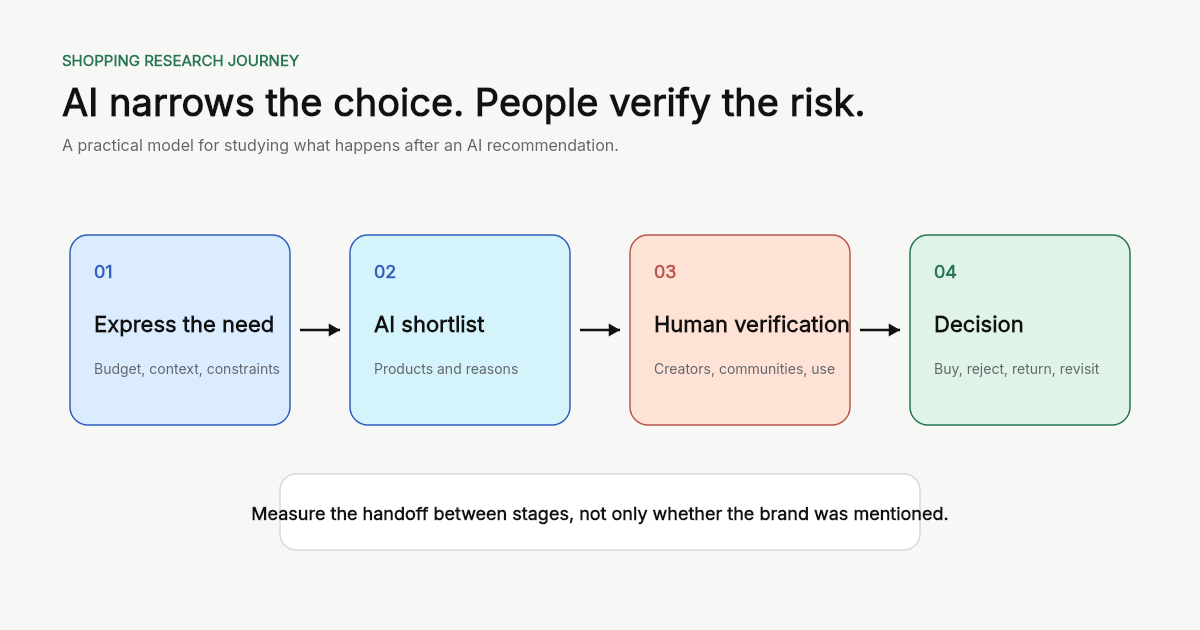
Editorial framework based on the research discussed in this article. It describes a verification journey, not a measured conversion funnel.
Trust depends on whether the evidence feels relevant
Brands often assume that better structured product information will make AI more likely to recommend them. That is partly true. Clear specifications, pricing, availability, and support documentation help a system understand what a product is.
They do not fully answer whether the product is right for a particular person.
A professional reviewer saying that a camera has strong autofocus is useful. A parent explaining that it repeatedly loses focus while photographing children indoors may be more relevant to another parent. The second account contains a matching situation, a visible trade-off, and a cost that the shopper can imagine carrying themselves.
AI can summarize these experiences. It may not make their provenance clear. Who had the experience? How long did they use the product? Were they paid? Did they test the same model that is currently on sale?
When those conditions are hidden, the shopper has a reason to go looking for the original human evidence.
The useful research unit is the whole decision journey
Measuring whether a brand appears in an AI response captures only one moment. It can easily overstate the commercial value of a recommendation.
A stronger study follows what happens next.
| Stage | What the shopper is trying to do | Evidence worth collecting |
|---|---|---|
| Need expression | Explain the problem in ordinary language | Real prompts, constraints, budgets, and use cases |
| Shortlist formation | Reduce the market to a few options | Brands mentioned, recommendation reasons, and missing alternatives |
| Human verification | Check whether the recommendation holds up in practice | Creator reviews, community threads, recurring complaints, and long-term use |
| Decision and reflection | Buy, reject, return, or reconsider | Conversion, return reasons, post-purchase feedback, and regret signals |
This approach connects AI discovery, social proof, community research, and purchase behavior. Looking at any one channel in isolation can hide the information that actually changed the decision.
Brands should study verification paths, not just AI mentions
The practical questions are straightforward:
- Where do people go after receiving an AI recommendation?
- Do they search for the brand, a specific model, or a known problem?
- Which evidence increases confidence, and which evidence removes a product from consideration?
- Does the AI description match what long-term users report?
- Are shoppers looking for expert authority, people like themselves, or both?
There is a counterintuitive implication here. A brand does not need every piece of verification content to be positive.
Shoppers know that no product is right for everyone. A review that explains the limits, the right use case, and a credible alternative may build more trust than a page of vague praise. When every community mention sounds like advertising, the verification layer stops working.
What research teams can do now
Start with a fixed panel of shopping questions rather than a single brand prompt. Vary the budget, user profile, environment, and risk:
- What would an AI recommend to a price-sensitive buyer?
- What would it recommend to someone who values support and returns?
- Which important limitation does the answer omit?
- Can the recommendation reason be verified in product documentation or user evidence?
- Does the shortlist change when the use case becomes more specific?
Repeat the questions over time and preserve the answers, cited pages, and follow-up searches. The goal is not to make a brand appear more often at any cost. It is to understand how a recommendation survives contact with real evidence.
Teams building this kind of study can use the existing guide to types of market research methods to choose between interviews, observation, surveys, and desk research. The guide to starting market and industry research with AI explains how to frame the question before collecting sources.
Final view
AI shopping assistants are becoming useful discovery tools. They have not removed the hardest part of a purchase decision: deciding whether the recommendation deserves to be trusted in a specific situation.
Product data may earn a place on the shortlist. Human experience often determines whether the product stays there.
For brands and research teams, the opportunity is not simply to monitor AI visibility. It is to understand the full verification path: what the AI said, where the shopper checked it, which evidence felt credible, and what finally changed the decision.
ResearchMaster can help teams organize AI answers, public sources, community evidence, and internal research into a traceable record that separates verified facts, reasonable inferences, and unresolved questions. Build a source-backed research workflow with ResearchMaster.
Sources and date notes
This article discusses public consumer-research signals. It does not imply that every shopper follows the same path or guarantee the effectiveness of any platform, content format, or marketing strategy.
Footnotes
- IAB, “Consumers Want AI Shopping Recommendations to Include Trusted Creator Perspectives”, September 9, 2026. The study covered 2,200 consumers in the United States, United Kingdom, Australia, Mexico, and India who had used AI for shopping research in the previous three months. IAB has a direct interest in digital advertising and creator marketing, so the results should be read alongside independent research. ↩
- Reddit Business, “Half of US Shoppers Verify AI Recommendations on Reddit”, August 10, 2026. The online survey covered 13,956 U.S. respondents aged 18 to 65 who used social media, LLM platforms, and ecommerce sites at least monthly. The research was commissioned by Reddit and is used here as a behavioral signal rather than a market-wide estimate. ↩