
When people search for market research methods, they usually find a long list: interviews, surveys, focus groups, observation, competitor analysis, and more. The list is useful, but it does not answer the question a team actually has: which method should we use for this decision?
The answer depends on what is still uncertain. Are you trying to understand why people leave a product, test whether a new idea has demand, compare pricing options, or decide whether a market is worth entering? Each question calls for different evidence.
The short answer
The main types of market research methods are qualitative research, quantitative research, and research based on market evidence and real behavior. The most practical approach is usually to use them in sequence: review what is already happening, talk to people to understand why, then test how widely the pattern applies.
Start with the decision, not the method
"Research the market" is too broad to guide useful work. A better brief names the decision that needs support.
For example:
- Should we enter this market or wait?
- Which customer problem is worth solving first?
- Does our pricing make sense for this segment?
- Which competitor is changing the buying decision?
Once the decision is clear, it becomes easier to decide what information matters and what can be left out. This also prevents a familiar problem: collecting a large amount of research that does not change the next action.
Three types of market research methods
Qualitative research: understand the reason behind a choice
Qualitative research includes customer interviews, focus groups, usability sessions, and direct observation. It is most useful when the team needs to understand language, motivations, expectations, or the path that led to a decision.
Imagine that trial-to-paid conversion has dropped. Product data can show where the drop happened, but it may not explain it. A few well-run conversations can reveal whether people were confused by the product value, blocked by setup, or comparing it with a different type of solution.
The limitation is scale. Ten interviews can uncover a strong pattern, but they cannot prove that the same pattern represents an entire market.
Quantitative research: measure the size of a pattern
Quantitative research uses surveys, concept tests, pricing studies, structured scoring, and larger data sets. It helps answer questions such as: How common is this need? Which message is more persuasive? Which feature matters most to a defined customer group?
It is especially useful after the team has a few hypotheses to test. For example, interviews may suggest that buyers care most about faster implementation, lower cost, or better integrations. A survey or concept test can then show which factor matters most across a larger group.
Quantitative results are only as good as the questions and sample behind them. A large survey sent to the wrong audience can create more confidence without creating better evidence.
Market evidence and behavior signals: see what is already happening
This group includes industry reports, company filings, competitor pages, public reviews, search behavior, sales records, support conversations, and product usage data. It gives a team an early view of market movement, competitor activity, and what people actually do rather than only what they say.
For a market-entry or competitive-analysis question, this is often the right place to begin. It can show which companies are investing, how products are positioned, what customers repeatedly complain about, and which claims still need direct validation.
The goal is not to save every link. It is to keep the source date, market definition, geography, and context connected to the conclusion. That distinction matters when a finding moves from an initial discussion into a product, commercial, or investment decision.
How to choose a method for a business question
| Business question | Good starting point | Useful follow-up | What you can learn |
|---|---|---|---|
| Should we enter a new market? | Industry evidence, competitor signals, and demand data | Interviews with target buyers | Whether the opportunity is real and where to focus |
| Is a feature worth building? | Customer feedback and product data | Usability sessions, then concept testing | Who has the problem and how urgent it is |
| Is our pricing in the right range? | Competitor pricing and sales history | Price-sensitivity survey or offer test | Which range customers can accept |
| Does our positioning need to change? | Reviews, search terms, and sales calls | Positioning interviews and message testing | Which language customers understand and trust |
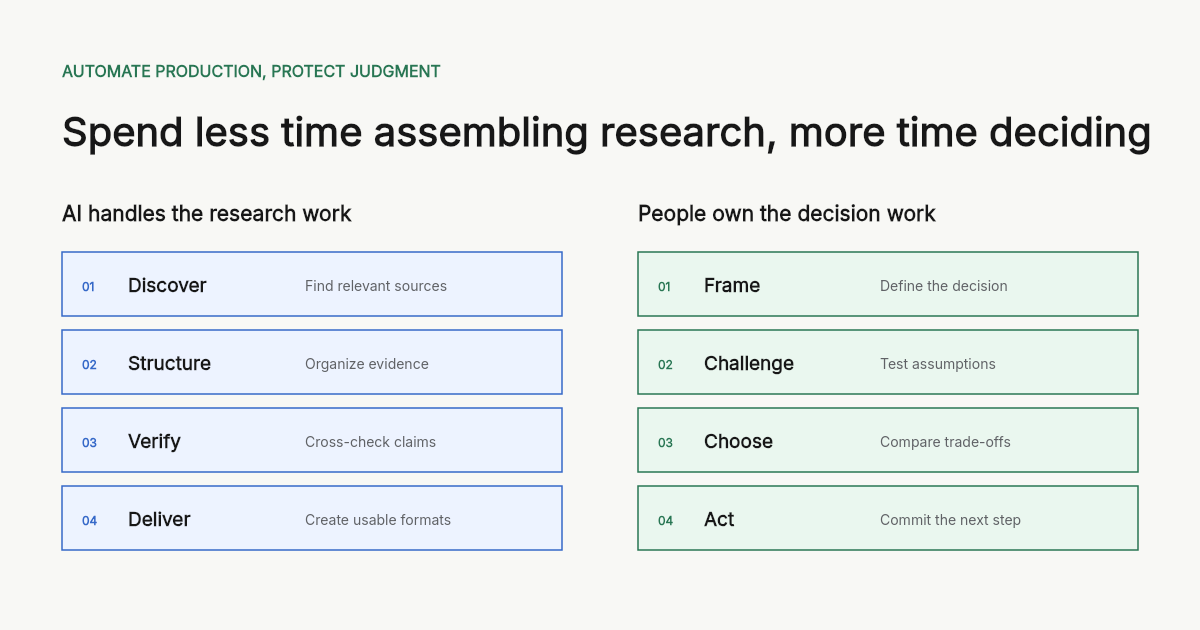
Research methods work better as a sequence: use existing signals to frame the question, use direct research to explain it, and use testing to judge its scale.
A lean way to combine methods
You do not need a large research program to get started. A useful first pass can follow three steps.
First, review the market evidence you already have. This might include sales notes, customer feedback, competitor pages, an industry report, or product data. The point is to separate observed facts from assumptions.
Next, use a small number of interviews or observations to understand the reasons behind the strongest signals. This is where a team can discover whether an apparent problem is really about price, onboarding, alternatives, timing, or customer fit.
Finally, when the decision needs broader confidence, test the strongest hypothesis with a survey, concept test, pricing exercise, or a controlled product experiment. Not every project needs all three stages, but the order helps avoid measuring the wrong thing too early.
Where ResearchMaster fits
ResearchMaster is useful when the evidence for a market question is scattered across public sources, competitor URLs, internal files, and notes. It can organize those inputs around a business question, preserve cited sources, and make it easier to compare important claims before a team reaches a conclusion.
That does not replace interviews or customer judgment. It helps make the work around them more manageable. For market validation, competitor research, and industry research, a source-backed workflow gives the team a clearer starting point and a record of what still needs to be checked.
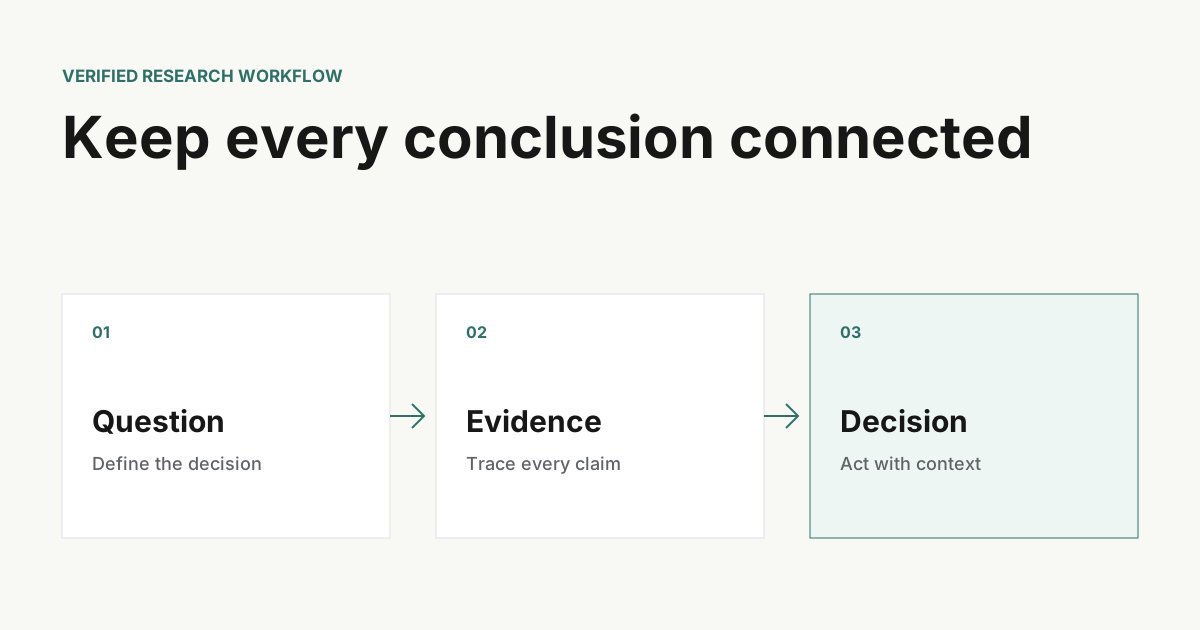
Source verification is most valuable when a conclusion will be shared, challenged, or revisited.
For a broader starting workflow, see How to Start Market and Industry Research Fast With AI. If you are evaluating software for this work, How to Choose an AI Market Research Tool covers the source and workflow criteria that are worth checking.
The practical rule
There is no single best market research method. Start with the decision, choose the evidence that can change it, and use each method for the question it is best suited to answer.
Use qualitative research to understand the reason behind a choice. Use quantitative research to measure how widely a pattern applies. Use market evidence and behavior signals to understand the environment around both. Combined in that order, the work is usually faster, more grounded, and easier for a team to act on.