Synthetic respondents have moved from an experimental idea to a practical buying question.
Can an AI persona test a new concept? Can it fill a question that was missed in a survey? Can it predict how a customer segment will react? More directly: can it replace part of a human research project?
The category tends to attract two answers. One says language models have absorbed enough human expression to simulate consumers at speed. The other says a model is not a person, so none of its responses belong in research.
Neither answer is precise enough to guide a real decision.
The better question is: what decision will the output support, what kind of synthetic data is being used, and how will the team detect a wrong answer?
“Synthetic respondent” can describe very different methods
Product pages often use terms such as AI persona, synthetic respondent, and digital twin as if they were interchangeable. Their evidence foundations can be completely different.
An ungrounded LLM response asks a general model to speak as a type of consumer. The answer may sound plausible, but it is not tied to observed data from a defined sample.
A segment-level persona adds information about a group, such as category buyers, small-business owners, or frequent travelers. It can reflect more relevant context, but it may still flatten the differences inside the segment.
An individual-level digital twin is constructed from information about a specific respondent. The goal is not merely to sound like a believable person. It is to estimate how that known individual might answer an additional question under defined conditions.
These methods should not share one accuracy claim. They use different inputs, fail in different ways, and belong in different parts of a research workflow.
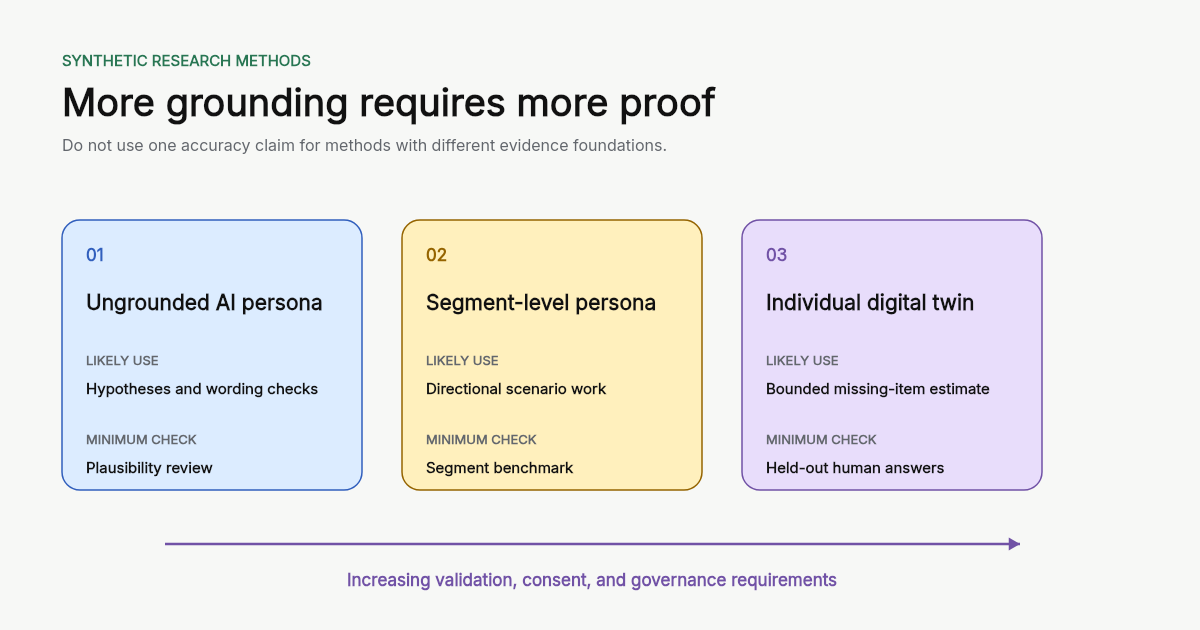
Editorial framework. Moving toward respondent-level prediction increases the need for validation, consent, privacy controls, and failure analysis.
A matching average can hide a failed model
Synthetic research is often presented through aggregate similarity. A generated sample may reproduce an overall preference share, an average score, or a rank order that looks close to the human result.
That can be useful. It can also conceal the most important failure.
Imagine a human survey in which half the respondents strongly prefer concept A and half strongly prefer concept B. A model gives every synthetic respondent a mild preference near the middle. The average may still look right, even though the model has preserved none of the real disagreement.
For a rough forecast, an aggregate match may be enough. For segmentation, message targeting, minority-group research, or individual prediction, losing that variation may invalidate the result.
A September 2026 preprint on synthetic data in marketing research makes this distinction explicit. The authors show that strong aggregate performance does not prove that a model contains respondent-specific information.1
When a vendor presents a high accuracy number, a research buyer should ask:
- Was the target an average, a distribution, a segment, or an individual answer?
- What information was provided to the model before it made the prediction?
- Were the test questions held out from model construction?
- How many questions failed badly, rather than merely lowering the average score?
- Did the validation use the same market, language, category, and decision type as the proposed project?
Without those conditions, “high accuracy” is a metric without a decision context.
Useful output is not automatically publishable evidence
Synthetic data can create value before it is reliable enough to become a formal research finding.
Suppose a team is preparing a product-concept survey. AI personas could help identify unclear wording, list objections the team has missed, or suggest answer options that deserve testing. The team improves the research instrument, then fields it with real participants.
That is very different from publishing a claim that “62% of synthetic consumers intend to buy.”
The first use treats AI as a research-design assistant. The second treats generated output as evidence about market demand. They require different validation standards.
The September preprint examines another useful but bounded case: a survey has already been completed, and the team later realizes that it omitted a valuable question. The researchers test whether individual-level digital twins, built from the existing respondent data, can provide an exploratory estimate for the missing item.1
Across 108 attitudinal questions from a nationally representative survey of 3,063 participants, the authors report that an ex-ante screening diagnostic using an R² > 0.7 threshold improved average twin-human individual-level correlation by 15%. It reduced the share of poorly answered questions from 25.9% to 4.3%.1
Those numbers are notable, but they are not a universal operating rule. They come from one study, one diagnostic, and one set of questions. A threshold that works there may not transfer to another country, language, product category, or behavioral outcome.
The durable lesson is simpler: screen whether a question is answerable before trusting the generated answer.
Use a decision-risk matrix
The right level of evidence depends on what happens after the result is delivered.
| Evaluation question | Lower-risk use | Higher-risk use |
|---|---|---|
| What is the output for? | Hypothesis generation, wording review, scenario exploration | Pricing, market sizing, investment, targeting, or public claims |
| How grounded is the model? | General context or a segment description | Consented respondent-level data tied to a known sample |
| What has been validated? | Plausibility and expert review | Held-out human answers at the required level of analysis |
| What happens if it is wrong? | The team runs a better human study | The business launches, invests, excludes a group, or publishes a claim |
This produces three practical groups of use cases.
Reasonable exploratory uses include generating hypotheses, checking a discussion guide, identifying missing survey options, simulating scenarios, and deciding what to investigate with people.
Conditional uses include estimating a question omitted from an existing survey, augmenting a fielded dataset, or tracking a directional signal when a human benchmark is available.
Weakly supported uses include predicting demand for a genuinely new concept, studying an emerging cultural behavior, representing small or historically underrepresented populations, and making decisions that depend on authentic lived experience.
A separate 2026 preprint testing five leading language models found that models were better at reproducing established common knowledge than generating genuinely novel survey findings. The authors argue for repeatable validation and reporting standards before synthetic responses are treated as research evidence.2
Human review has moved, not disappeared
Synthetic methods may reduce some fieldwork or analysis time. They increase the importance of deciding what must be verified.
Before generation, the team needs to define which claims require real respondents, what level of variation must be preserved, and what validation sample will be used.
After generation, the team needs to inspect failure cases rather than only the average score. It should record the model, prompt, source data, date, and evaluation method. Novel, sensitive, and high-impact questions should be escalated back to human research.
Greenbook’s August 2026 guide reaches a similar practical conclusion. It describes synthetic respondents as potentially useful for early exploration and directional work while warning against treating them as final validation or a replacement for real participants.3
That industry guidance is not peer-reviewed proof. It is still useful because it shows where practitioner attention is moving: away from a broad replacement claim and toward task selection, transparency, and validation.
Where ResearchMaster fits
ResearchMaster should not label model-generated answers as human evidence when the method and validation basis are missing.
Its more defensible role is to help teams manage the relationship among different evidence types:
- Keep human research, public sources, internal files, and synthetic estimates visibly separate.
- Trace important claims to their sources and study conditions.
- Compare results across methods instead of blending them into one polished summary.
- Mark assumptions, validation gaps, and unresolved questions.
- Produce a reviewable brief before the result enters a business decision.
The broader guide to types of market research methods can help teams decide when interviews, surveys, observation, experiments, or desk research are more appropriate. The workflow for turning raw sources into a verified industry report shows how evidence can remain traceable through analysis.
Final view
Synthetic data is not one category that deserves a single yes-or-no verdict. It is a family of methods with different grounding, validation requirements, and failure modes.
A plausible answer may be useful for improving a questionnaire while remaining too weak to support a demand claim. A matching average may help with a broad forecast while saying very little about individual customers.
Use synthetic respondents to expand what a team can explore. Require human evidence whenever the decision depends on real people being different, surprising, underrepresented, or new.
ResearchMaster can help teams separate source-backed facts, synthetic estimates, assumptions, and open questions before they become one confident-looking conclusion. Build a reviewable market research workflow with ResearchMaster.
Sources and date notes
This article discusses research methods. It does not establish that synthetic respondents are valid for any specific business, population, or decision. Teams should validate methods against authorized human data and separately review privacy, consent, and data-governance requirements.
Footnotes
- Oded Netzer and Rajan Sambandam, “Synthetic Data in Marketing Research: How to Evaluate and When to Trust”, preprint submitted September 12, 2026. The reported thresholds and performance changes are specific to the study described by the authors and should not be treated as universal benchmarks. ↩ ↩2 ↩3
- “Stochastic Parrots or Singing in Harmony? Testing Five Leading LLMs for their Ability to Replicate a Human Survey with Synthetic Data”, submitted February 27, 2026 and revised August 5, 2026. Used for its findings on conventional-pattern replication and the need for validation standards. ↩
- Greenbook, “Synthetic Respondents Explained: What They Are, How They Work, and When to Trust Them”, August 25, 2026. This is industry guidance rather than a peer-reviewed validation study. ↩