Many AI tools can produce a well-structured industry report in minutes.
But having a report is not the same as having useful research. The real test is whether the report understands your business context, uses what your team already knows, and supports its conclusions with evidence that other people can check.
Your company may already have years of market reports, customer interviews, sales reviews, product data, and competitor notes. These local files contain context that public search cannot recover. They can also be out of date, based on a small sample, or shaped by an internal point of view.
A strong industry analysis report should not rely on internal files alone. It should not simply summarize public web pages either. It should bring internal experience and external evidence into one research process, then cross-check claims, compare data, and make conflicts visible.
That is the purpose of ResearchMaster's Co-create Mode.
Why generic AI reports rarely feel like your report
If you ask an AI tool to "analyze the electric vehicle market," it does not know whether the report will support product planning, market entry, or an investment decision.
It also does not know whether you care most about market size, sales channels, supply-chain risk, customer behavior, or competitive pressure.
Without that context, AI tends to follow a familiar industry-report template. The result may look complete, but it often has three problems:
- The structure is generic rather than shaped around the real decision.
- The report ignores earlier research, interviews, and business data.
- The conclusions do not show whether internal experience agrees with external sources.
The problem is not that AI cannot write. The problem is that it has not taken part in the way you form a judgment.
Useful research starts by defining the decision and its boundaries. Only then should the researcher choose sources, resolve conflicting data, and decide how strongly the evidence supports a conclusion.
How Co-create Mode changes the research process
ResearchMaster's Co-create Mode lets AI handle source discovery, organization, and analysis while the user stays involved at the points that require judgment.
It is not a process where the user has to direct every paragraph. It is also not a one-click report that skips straight from a short prompt to a final answer.
Before research begins, the workflow confirms the goal, audience, analysis focus, and output preferences. During the research, the user can review local files and public sources, choose how to handle source conflicts, and confirm the report structure.
In simple terms, AI expands the evidence base and handles complex material. The user decides what matters, what is credible, and how the conclusion should support the decision.
| AI handles | The user decides |
|---|---|
| Finding and organizing external sources | What decision the report must support |
| Reading and grouping local files | Which analysis areas matter most |
| Extracting metrics, claims, and evidence | Which sources should enter the analysis |
| Finding repeated information and conflicts | How conflicting evidence should be handled |
| Drafting the structure and early findings | How the final conclusion should be expressed |
This split avoids two common problems. The user does not have to organize every file by hand, and the AI does not ignore the team's experience and make the important choices on its own.
Step 1: Turn internal experience into research material
Internal experience becomes useful to AI when it is provided as real material, such as:
- Previous industry reports
- Customer interviews and user feedback
- Sales records and project reviews
- Product data and internal analysis
- Competitor tracking sheets
- Channel feedback and regional market notes
These local files give the research its business context.
For example, public data may show that a market is growing quickly, while your customer interviews show that buying cycles are getting longer. An industry report may say price is the main competitive factor, while your sales reviews show that customers are more worried about setup costs and support.
If the research uses only public data, it can miss these internal signals. If it uses only internal material, it may mistake feedback from a few customers for a market-wide trend.
Local files are not a replacement for external research. They tell the AI what the team already knows, what it has observed, and which assumptions still need to be tested.
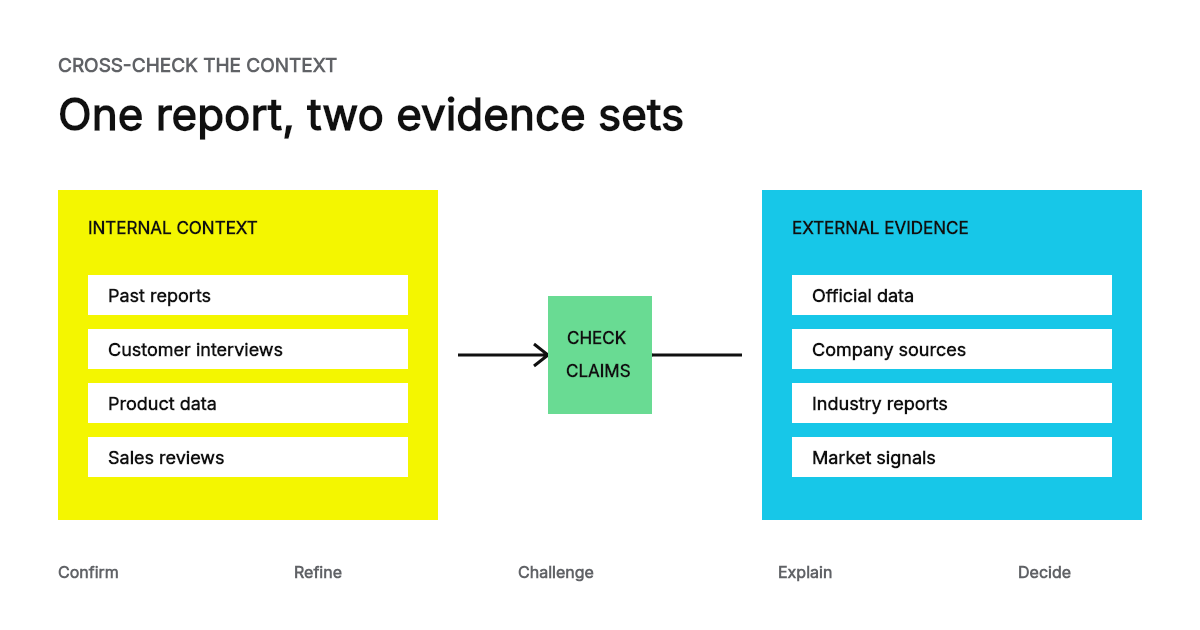
Internal context explains what the team has seen. External evidence helps confirm, refine, or challenge that view.
Step 2: Define the question before searching for answers
Weak research often begins by collecting information before anyone has agreed on the decision the report should support.
In Co-create Mode, the user first confirms:
- What decision will this report support?
- Who will read and use it?
- Which markets, regions, companies, and time periods are in scope?
- Which questions need the deepest analysis?
- Which claims must have cited sources?
- Should the report recommend one action or compare several options?
The same overseas market can require very different research. A product manager may focus on customer needs and competitor features. An overseas operator may care more about channels, local costs, and market access. An investor may start with market size, growth quality, and risk.
The topic is the same, but the research path is not.
Defining the purpose and boundaries first keeps source discovery, selection, and source verification connected to a real decision.
Step 3: Put local files and external sources in one evidence base
Once the scope is clear, ResearchMaster can search for relevant external evidence while reading the local files selected by the user.
External sources may include government data, industry associations, public company filings, official company pages, professional publications, and public market statistics. Internal material adds customer, product, channel, and operating context.
The goal is not to collect the largest possible number of sources. Each source should have a clear role:
- Official data can support market size, policy, and broad market change.
- Company sources can confirm products, pricing, partnerships, and strategy.
- Customer interviews can explain demand, objections, and buying behavior.
- Internal business data can show what the team has observed directly.
Before analysis begins, the user can confirm the final source set. Irrelevant, repeated, weak, or sensitive material can be excluded. Reading a file should never mean that the AI must treat it as reliable evidence.
Step 4: Resolve source conflicts instead of hiding them
Putting information in one place is not the same as cross-checking it.
Real source verification asks whether the same claim still holds when internal and external evidence are compared.
| Claim to test | Internal material | External evidence | Sensible treatment |
|---|---|---|---|
| Market demand is growing | Sales leads are increasing | Market data shows similar growth | Treat as a higher-confidence finding |
| Customers mainly want lower prices | Some interviews support it | Competitors stress service and delivery | Split the analysis by customer group |
| A competitor is entering a new region | Sales team reports the move | Hiring and channel activity support it | Mark it as an evidence-backed market move |
| A market is ready for entry | Internal view is positive | Compliance costs remain high | Keep the opportunity and state the risk |
When sources disagree, AI should not quietly choose the number that looks most convincing.
ResearchMaster makes important conflicts, uncertain information, and high-risk claims visible. The user can prefer a more direct or current source, keep two definitions side by side, or remove a claim that does not have enough support.
A verified report should clearly separate:
- Facts supported by several reliable sources
- Findings based on both internal experience and external signals
- Assumptions that still need more evidence
- Data that cannot be compared because the definitions or time periods differ
This is what makes cited sources useful. The report does not simply contain links; it shows how the evidence shaped the conclusion.
Step 5: Keep your own research logic in the final report
The character of an industry analysis report does not come from unusual wording. It comes from the way the researcher makes decisions.
One team may begin with market size and then study the competitive structure. Another may start with customer behavior and channel change. A third may organize the report around policy, supply chains, or business-model economics.
In Co-create Mode, the confirmed goal, analysis focus, source choices, and conflict decisions all shape the report. The final result can:
- Organize sections around the questions the user actually cares about
- Preserve internal experience without treating it as proven fact
- Use external data to support, correct, or challenge an existing view
- State uncertainty and research limits clearly
- Keep recommendations connected to the evidence that supports them
A report feels like your own when it reflects how you choose evidence, compare information, and move from facts to judgment. Copying a few writing habits is not enough.
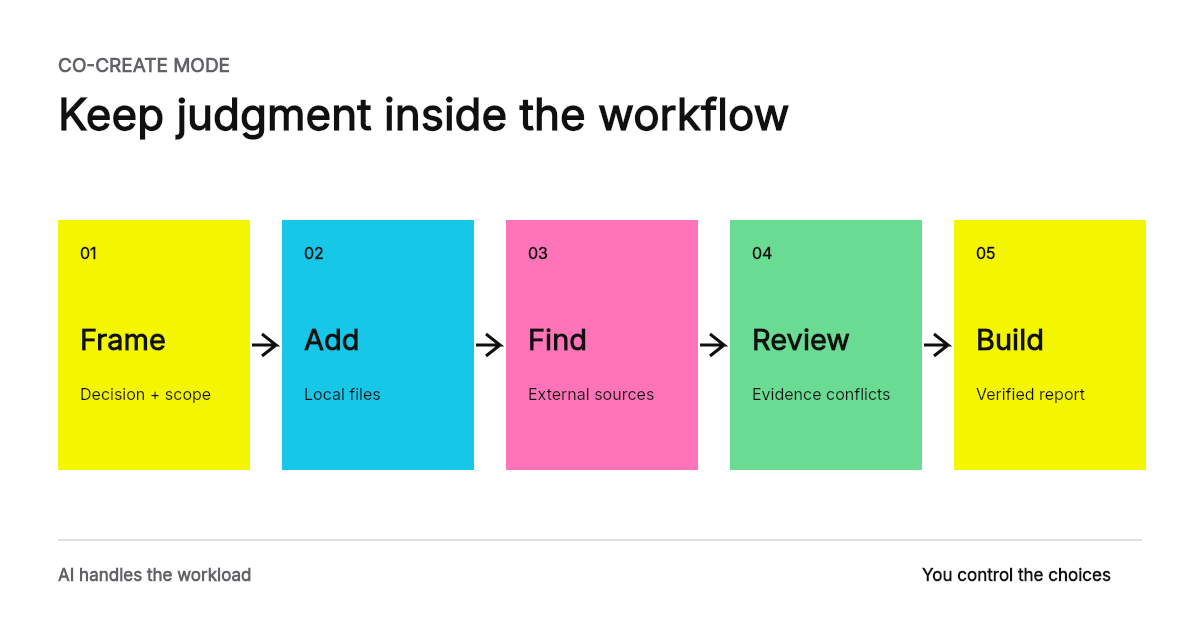
AI handles the research workload while the user controls the choices that shape the final report.
Spend more time thinking, not moving information around
Traditional industry research includes a great deal of necessary production work:
- Organizing files in different formats
- Pulling metrics from long reports
- Comparing numbers across sources
- Keeping source links and citations connected to claims
- Reworking the report structure
- Turning the same analysis into different deliverables
The final step is to export the format the audience needs without recreating the research from scratch.
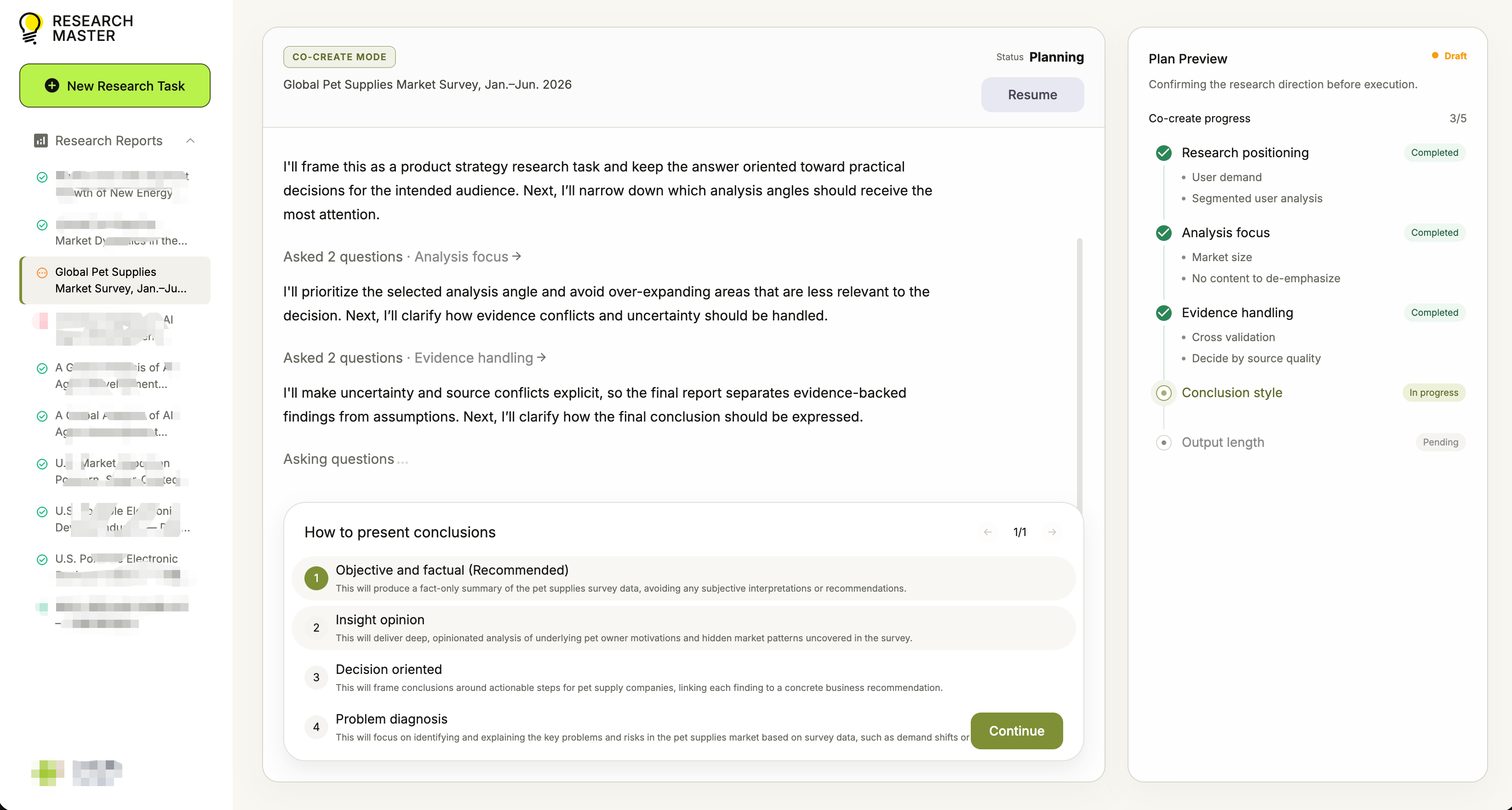
ResearchMaster is not designed to replace the user's judgment. It is designed to reduce this manual work. AI can support discovery, cleaning, grouping, evidence mapping, cross-checking, and early drafting. The user can spend more time on better questions:
- Does this new evidence change our original view?
- Why do two sources reach different conclusions?
- Which risk is most likely to affect the decision?
- Is the current evidence strong enough to act?
- What first-hand information do we still need?
The time saved by AI should not be used to produce more pages. It should be used for deeper analysis and better decisions.
Five checks before you use the report
Before publishing or sharing the report, ask:
- Does the report state which decision it is meant to support?
- Can every important conclusion be traced to specific evidence?
- Has internal experience been checked against external sources?
- Are data conflicts, different definitions, and uncertainty explained?
- Does the structure reflect the questions the user actually cares about?
If these questions cannot be answered clearly, the research is not finished, no matter how polished the document looks.
From a collection of files to a clear point of view
Local files preserve what a team has already learned. External evidence provides a wider view of the market. Either one can create blind spots when used alone.
ResearchMaster's Co-create Mode brings both into a research process that the user can review, correct, and trace. AI finds, organizes, compares, and drafts. The user defines the problem, resolves conflicts, and confirms the conclusion.
The result should not be a generic report that happens to look professional. It should be an industry analysis report that can explain why the team reached its view.
That is where AI market research creates real value: less time spent moving information and formatting documents, and more time spent thinking, judging, and deciding.