Fully automated AI research is fast. Give the system a topic, and it can collect information, organize findings, and draft a report with little input from the user.
That speed is useful when the question is clear. But many market research tasks are not clear at the start. A report may need to reflect internal experience, support a specific decision, or resolve conflicting evidence. In those cases, a complete-looking answer can still miss the real purpose of the research.
ResearchMaster's Co-create Mode changes this process. AI still carries out the time-consuming research work, but the user joins at the points where context and judgment can change the result.
What is Co-create Mode?
Co-create Mode is a guided AI market research workflow. Users can upload local files and confirm the direction of the report at key stages of the research process.
It does not require the user to direct the AI paragraph by paragraph. It also does not let AI move from a short prompt to a final report without feedback.
Before the research begins, ResearchMaster confirms the purpose, use case, research positioning, analysis focus, and output preferences. During the process, the user can review the source plan, decide how evidence should be handled, resolve source conflicts, and confirm the final report structure.
The division of work is simple:
- AI expands the information base, reads complex material, compares sources, and drafts the analysis.
- The user decides what matters, what is credible, and how the findings should support a real decision.
Co-create Mode vs. fully automated AI research
Auto Mode is better suited to research tasks with a clear goal and no need for mid-process decisions. After the user submits a request, AI moves through requirement analysis, resource allocation, data collection, and conclusion generation.
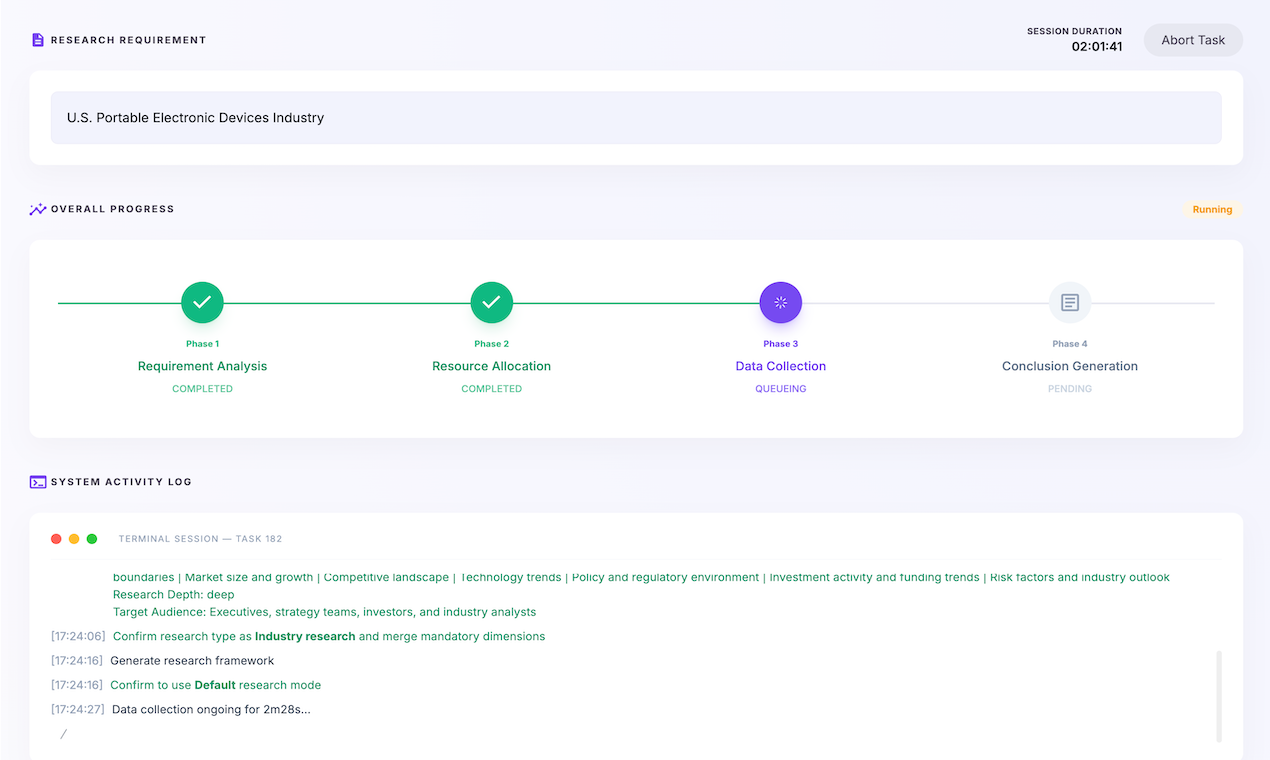
Auto Mode follows the confirmed research framework from start to finish, making it useful for clearly defined research tasks.
| Research step | Auto Mode | Co-create Mode |
|---|---|---|
| Define the task | AI interprets the request and starts the workflow | The user confirms the purpose, audience, and research boundaries |
| Select materials | AI mainly follows the available research path | The user can add local files and review the source plan |
| Handle evidence | AI compares and organizes sources automatically | The user can decide how important evidence and source conflicts are treated |
| Shape the report | AI follows the generated structure | The user confirms the analysis structure, conclusion style, and output length |
| Best fit | Clear questions and fast industry overviews | Strategic research that depends on business context and judgment |
The key difference is not whether AI performs the research. It does in both modes. The difference is whether the user can influence the decisions that shape the report before the final answer is produced.
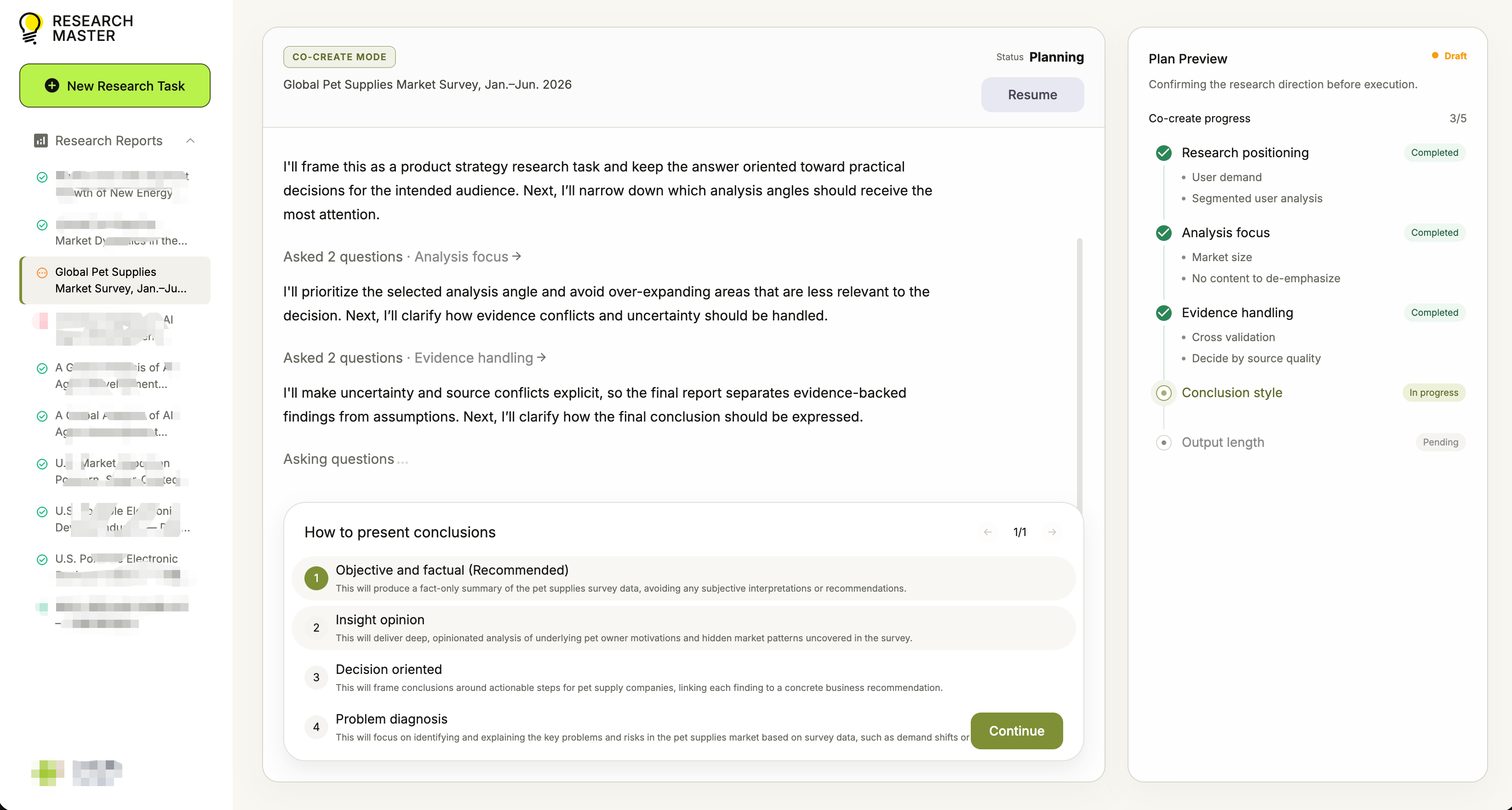
Co-create Mode keeps AI execution efficient while allowing users to shape the decisions that change the final report.
Step 1: Define the decision behind the report
A broad topic is not yet a useful research task. "Analyze the European electric vehicle market" could support product planning, market entry, investment review, or competitor research. Each purpose requires different evidence and a different report structure.
Before research starts, confirm:
- What decision should the report support?
- Who will read it?
- Which markets, companies, products, and time periods are in scope?
- Which questions need the deepest analysis?
- What should the final output help the reader do next?
This step prevents AI from using a generic industry template for a specific business question.
Step 2: Add local files as business context
Local files can include previous research, customer interviews, sales reviews, product data, competitor notes, project records, and regional market feedback.
These files give AI context that public search cannot provide. For example, public data may show that a market is growing, while customer interviews show that buying cycles are getting longer. An industry report may describe price as the main competitive factor, while sales reviews show that implementation cost and support are more important to actual buyers.
Local files are not a replacement for external research. Their role is to show what the team already knows, what it has observed, and which assumptions still need to be checked.
Step 3: Confirm which sources should enter the analysis
More sources do not automatically create better research. A useful evidence base should include materials that are relevant, current, and suitable for the claim being tested.
In Co-create Mode, users can review local and public materials before they shape the final report. This makes it possible to exclude repeated, outdated, weak, irrelevant, or sensitive files.
The source plan should also match the research question. Government statistics may be useful for market size. Company filings can support business performance. Customer interviews can explain demand and buying behavior. No single source type can answer every part of the report.
Step 4: Resolve conflicts instead of hiding them
Internal experience and external evidence will not always agree. That is not a failure of the research. It is often where the most useful analysis begins.
When sources conflict, users can ask ResearchMaster to:
- Prefer a more direct, recent, or authoritative source.
- Keep different definitions or estimates side by side.
- Separate findings by customer group, region, or time period.
- Mark a conclusion as uncertain when the evidence is incomplete.
- Remove a claim that cannot be supported.
This is where source verification becomes more than adding cited sources. The report shows how the evidence was compared and why a conclusion was accepted, limited, or rejected.
Step 5: Confirm the report structure and conclusion style
Different readers need different forms of analysis. An executive may want a concise decision summary. A product team may need detailed competitor and customer findings. An analyst may need assumptions, limitations, and source references.
Co-create Mode lets the user confirm the report structure, conclusion style, and output length before AI completes the final analysis. This keeps the report aligned with the audience without forcing the user to rewrite a generic result later.
The goal is not to copy a person's writing style word for word. It is to preserve the way that person frames a question, weighs evidence, and moves from findings to recommendations.
Step 6: Let AI complete the research workload
Once the important choices are confirmed, AI can continue with source collection, reading, grouping, cross-checking, analysis, citation mapping, and report drafting.
The user does not need to supervise every action. Their input is concentrated at the points where it has the greatest effect on quality. This creates a practical balance: automation for research production, human judgment for research direction.
How to use Co-create Mode effectively
Start with a decision, not only a topic. Add the local files that contain relevant experience, but do not upload every document by default. Review the proposed evidence base and pay special attention to sources behind high-impact claims.
When evidence disagrees, do not ask AI to make the report look cleaner. Ask why the difference exists. It may come from a different definition, sample, region, time period, or business model.
Finally, choose an output that matches the next action. A research report for internal discussion should not have the same structure as a market-entry recommendation or an investor briefing.
When should you use Co-create Mode?
Co-create Mode is useful when:
- The report will support a product, market-entry, investment, or strategy decision.
- Internal files contain important customer or operating context.
- The research includes several regions, definitions, or conflicting data sources.
- Important conclusions need cited sources and a visible verification process.
- The final report must reflect the team's own analysis priorities.
Auto Mode remains the faster choice for a clear question, an early industry overview, or a task that does not require user decisions during the research process.
AI should reduce production work, not remove judgment
Co-create Mode does not ask users to do more research work. It asks them to make the decisions that matter most.
ResearchMaster handles the heavy work of finding, reading, organizing, comparing, and drafting. Users bring business context, question weak assumptions, and confirm how the evidence should support action.
The result is not simply a longer AI-generated report. It is a more useful market research report: one that combines local knowledge with external evidence, makes source conflicts visible, and keeps human judgment connected to the final decision.