How many people in the United States use AI-powered products? It sounds like a market-size question. It is really a research-design question.
Does "use AI" mean someone has tried ChatGPT? Uses an AI tool every week? Uses AI at work? Or simply encounters AI inside products they already use? Each definition produces a different number and supports a different decision.
We gave the same brief to Sider and ResearchMaster: estimate the U.S. AI product user base, identify useful market survey techniques, and suggest a practical path for a team with a limited budget. Both reports were useful. They were useful in different ways.
This comparison is about the published reports linked at the end of the article, not a benchmark of model accuracy. The two tools do not need to produce the same wording or the same figures to be valuable. The practical question is what a team can do with the report after reading it.
The short answer
Use Sider when you need a well-organized research brief and want to establish the scope of the work quickly. Its opening questions make the trade-offs clear: what is the study for, what budget and timeline are available, and do you need a precise figure or a defensible range?
Use ResearchMaster when the result needs to inform a product, go-to-market, or investment decision. In this example, it turns a broad prompt into a research plan, keeps several adoption definitions separate, makes the number of independent sources visible, and connects the findings to a validation sequence.
Neither tool removes the need for judgment. A market estimate only becomes useful when its definition, evidence, and intended decision are clear.
Both reports begin by narrowing the question
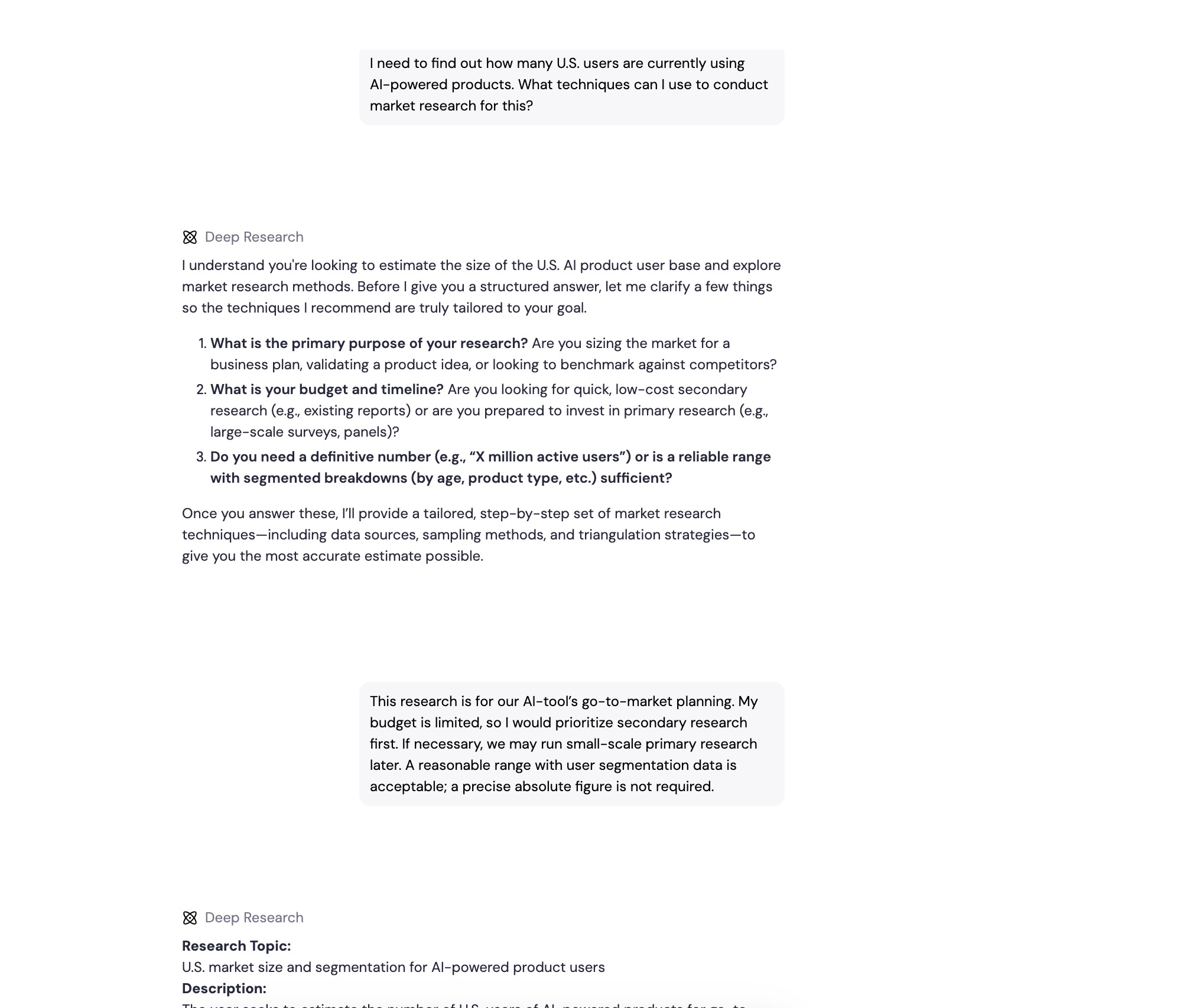
Sider starts with three sensible questions: the primary purpose of the research, the available budget and timeline, and the level of precision required. That is a good first move. A market estimate for a board deck does not need the same method as an early product-discovery exercise.
ResearchMaster also avoids answering the prompt at face value. Its Co-create Mode first frames the request as a product-strategy research task, then asks the team to choose the analysis focus. In the example, market size, customer demand, regional distribution, and growth drivers are separate choices rather than one blended request.
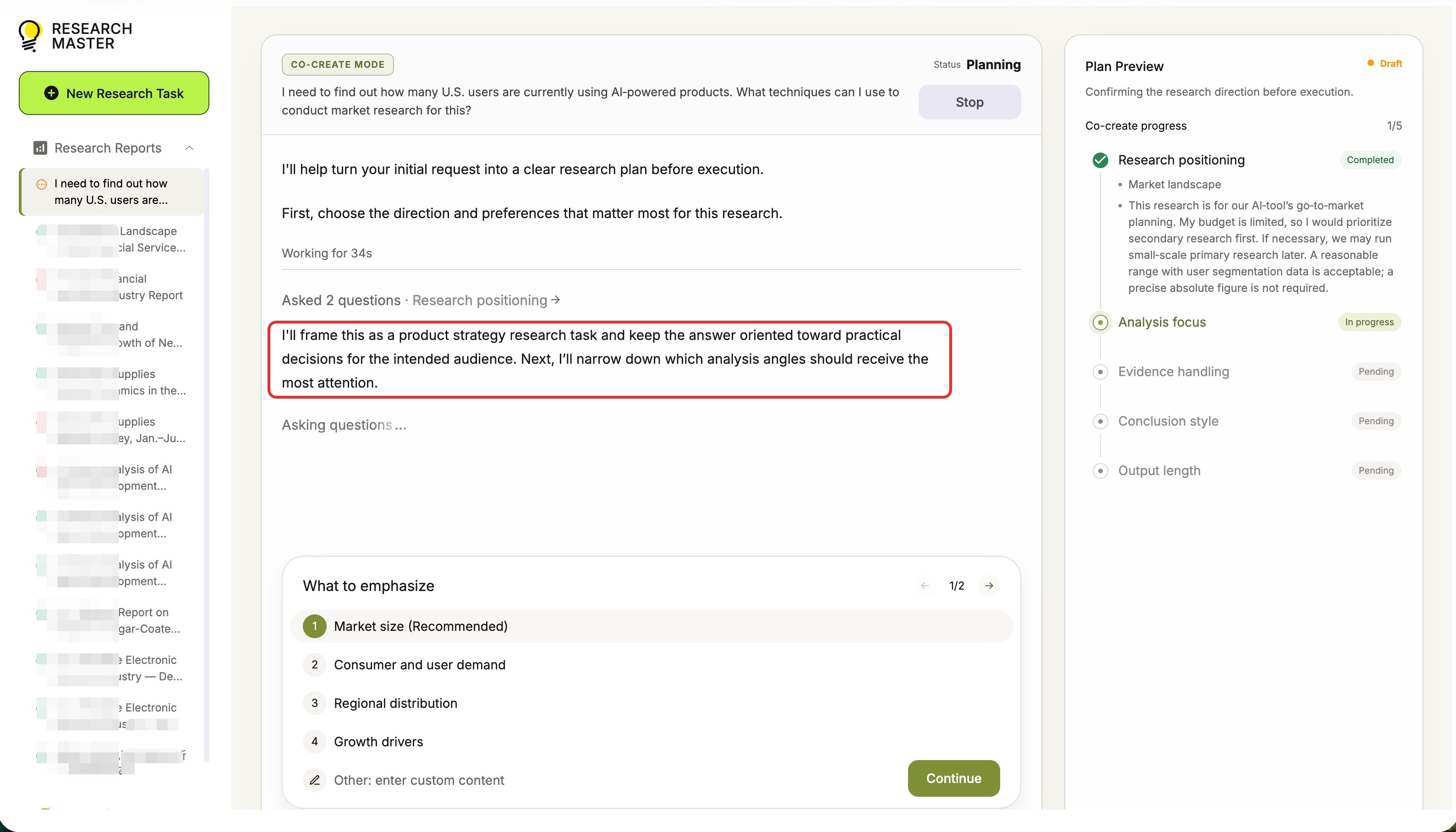
That distinction matters. Sider's questions are an efficient way to set research constraints. ResearchMaster carries the scoping step further into the evidence and output choices that will shape the final report.
What each report delivers
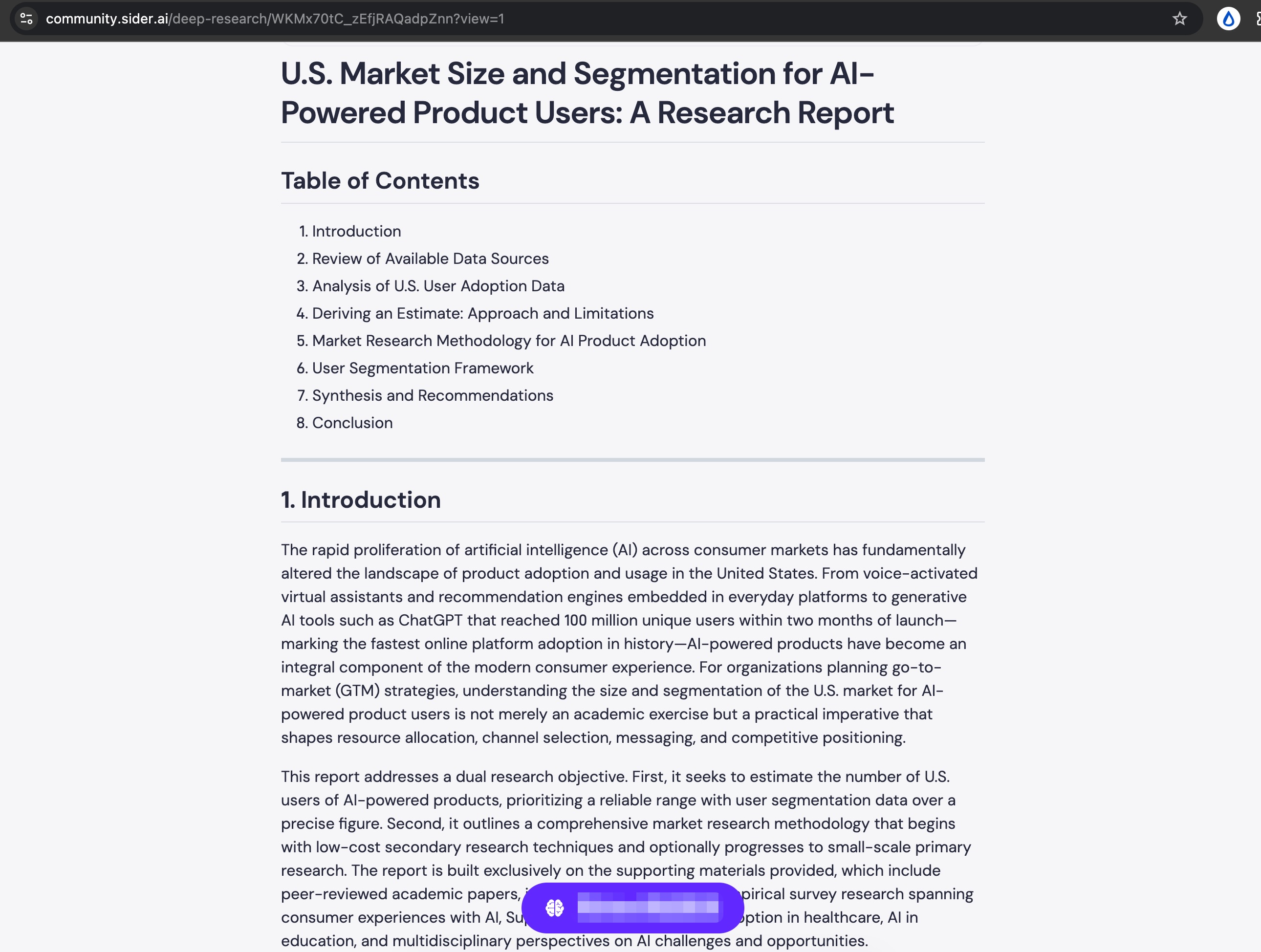
Sider's report, U.S. Market Size and Segmentation for AI-Powered Product Users, follows a familiar research-report structure. Its table of contents covers available data sources, U.S. adoption data, the estimation approach and limitations, market research methodology, user segmentation, recommendations, and a conclusion.
That layout is helpful when a team needs a complete orientation. It shows that market sizing is not just a matter of finding a large number: data sources, definitions, segmentation, and limitations all belong in the work.
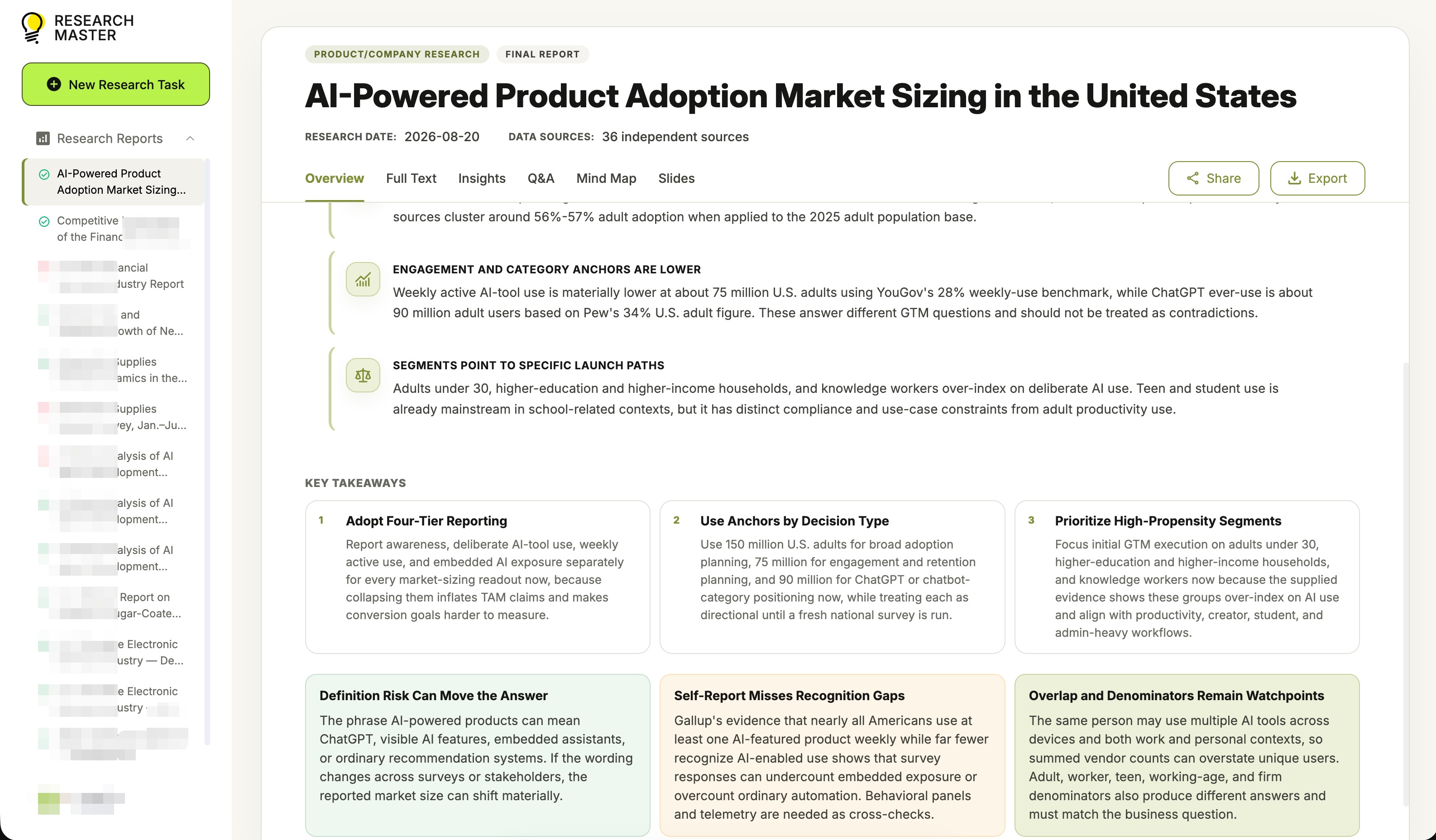
ResearchMaster's report takes a more decision-oriented route. Its report view lists 36 independent sources and presents the result as a set of separate planning anchors. In the example, deliberate use of AI tools or generative AI, weekly active use, and ChatGPT ever-use are treated as different measures rather than competing estimates of one market.
| Question | Sider | ResearchMaster |
|---|---|---|
| How does the work begin? | Clarifies goal, budget, timeline, and required precision | Clarifies research positioning, analysis focus, evidence handling, and output preferences |
| How is the report structured? | A conventional long-form research report with methodology and segmentation chapters | A report with overview, full text, insights, Q&A, mind map, and slides views |
| How are user counts handled? | Covers the estimation approach and limitations as dedicated sections | Separates deliberate use, weekly active use, named-tool use, and embedded AI exposure |
| What is visible about evidence in this example? | The report includes a data-source review; the provided public view does not show a source count comparable with the other report | The report view states that it used 36 independent sources and makes evidence handling part of the workflow |
| What is the strongest fit? | Building an initial research brief and a complete study outline | Checking definitions, validating assumptions, and preparing the next decision or research step |
Why one U.S. AI-user number is not enough
The central lesson from both reports is simple: define the market before sizing it.
ResearchMaster's report uses roughly 150 million U.S. adults as a planning anchor for deliberate AI-tool or generative-AI use. It also uses about 75 million adults for weekly active AI-tool use, and roughly 90 million adults for ChatGPT ever-use. These are not numbers to add together. They answer different questions.
| Measure | What it is useful for |
|---|---|
| Deliberate AI-tool or generative-AI use | Broad adoption and awareness planning |
| Weekly active AI-tool use | Engagement, retention, and frequency planning |
| Named-tool use, such as ChatGPT | Category positioning and competitor framing |
| Embedded AI exposure | Product education and discovery, not standalone AI-product demand |
This is the first rule of good techniques of market survey: fix the numerator and denominator before comparing sources. If one survey asks about ChatGPT and another asks about any AI-enabled feature, the results can both be credible while measuring different things.
A practical approach to market research for target audience
Market size tells you how broad the opportunity may be. Market research for target audience tells you where to start.
For a consumer AI product, younger adults, people with more education, and higher-income households can be sensible early hypotheses. They should not become fixed personas without validation. Ask what task they are trying to complete, which tools they already use, what they have tried to replace, and whether the improvement is strong enough to pay for.
For a B2B product, keep employee use and company-authorized deployment separate. Employees may already use AI informally while the company has not approved a tool, a budget, or a data policy. That gap can signal demand, but it can also signal procurement and governance barriers.
Five market survey techniques that work together
There is no single survey technique that answers every part of this question. A practical research stack uses different methods for different uncertainties.
- Set the definition first. Decide whether the study measures awareness, deliberate use, weekly use, paid use, or workplace use. Keep the wording stable throughout the study.
- Build an evidence table. Record the source, date, sample, geography, question wording, and denominator behind every figure. This makes conflicting results easier to explain.
- Run targeted interviews. Speak to 20 to 30 likely users before fielding a larger survey. Start with real tasks and current workflows, not with a general question about whether they use AI.
- Pilot the questionnaire. Check that people interpret "AI product" consistently and do not count ordinary automation or recommendation features by mistake.
- Triangulate before scaling. Compare survey results with behavioral panels, product analytics, and relevant business data. Do not add vendor user counts together without accounting for people who use multiple tools across devices and contexts.
For a directional internal decision, public evidence, interviews, and a small survey are often enough. If the result will determine a major budget, a fundraising claim, or an external market-size statement, use a representative sample and add behavioral or first-party data for calibration.
Which tool is better for the current stage?
Choose Sider when the immediate job is to form a research brief, understand the major components of the study, and decide what level of rigor is realistic for the available budget.
Choose ResearchMaster when the immediate job is to turn that brief into a source-backed research workflow. It is particularly useful when someone will ask what a number means, which source supports it, whether user groups overlap, and what should be validated next.
The useful outcome is not a single, impressive market number. It is a market view that a team can explain, challenge, and act on.
For a broader framework, read Types of Market Research Methods: How to Choose the Right One. For guidance on evaluating research software, see How to Choose an AI Market Research Tool: Why Verification Matters.