Many teams now run the same quick test. They open ChatGPT, Gemini, Perplexity, or Google AI Overviews, ask a category question, and check whether their brand appears.
If it does, someone saves a screenshot. If it does not, the team starts discussing SEO, PR, or content changes.
The exercise is useful for building intuition. It is not a brand visibility benchmark.
One prompt captures one wording, one platform, one moment, and one generated answer. Treating it as a stable measurement is closer to asking one person on the street than conducting market research.
Different AI engines do not see the same source landscape
Traditional search results are not perfectly stable, but they provide recognizable pages, links, and ranking positions. AI answers add more variables.
Each platform can use a different index, search partner, retrieval strategy, model, and citation policy. The same question may produce company pages and news coverage on one engine, then community discussions, videos, or reference sites on another.
Hendricks tested 480 questions across ChatGPT Search, Google AI Overviews, Gemini, and Perplexity. The study recorded 16,069 citations from 7,775 unique domains and found low citation similarity across engines.1
The publisher offers AI search intelligence services, so the study should be treated as a transparent method example rather than a universal industry benchmark. Its central measurement problem is still important: “visibility in AI” is not one ranking. It is a collection of outcomes shaped by the platform, question, and time.
Prompt wording changes the market being measured
“What is the best market research tool for a small business?” and “Which AI research tool can verify sources for a new-market decision?” sound related. They describe different jobs.
The first may favor price, simplicity, and general-purpose features. The second may favor traceable evidence, industry depth, and a structured decision workflow. A brand can be highly visible for one task and absent from the other.
Budget, geography, company size, risk tolerance, and required output can all change the candidate set.
That means a visibility study needs a question panel, not one “main keyword.” For an AI market research product, the panel might include:
- How can a team begin industry research quickly?
- Which AI tools preserve sources and citations?
- How should a company compare several competitors?
- Which tools combine internal files with external evidence?
- What can produce a report suitable for management review?
Together, these questions describe a category more faithfully than a single prompt.
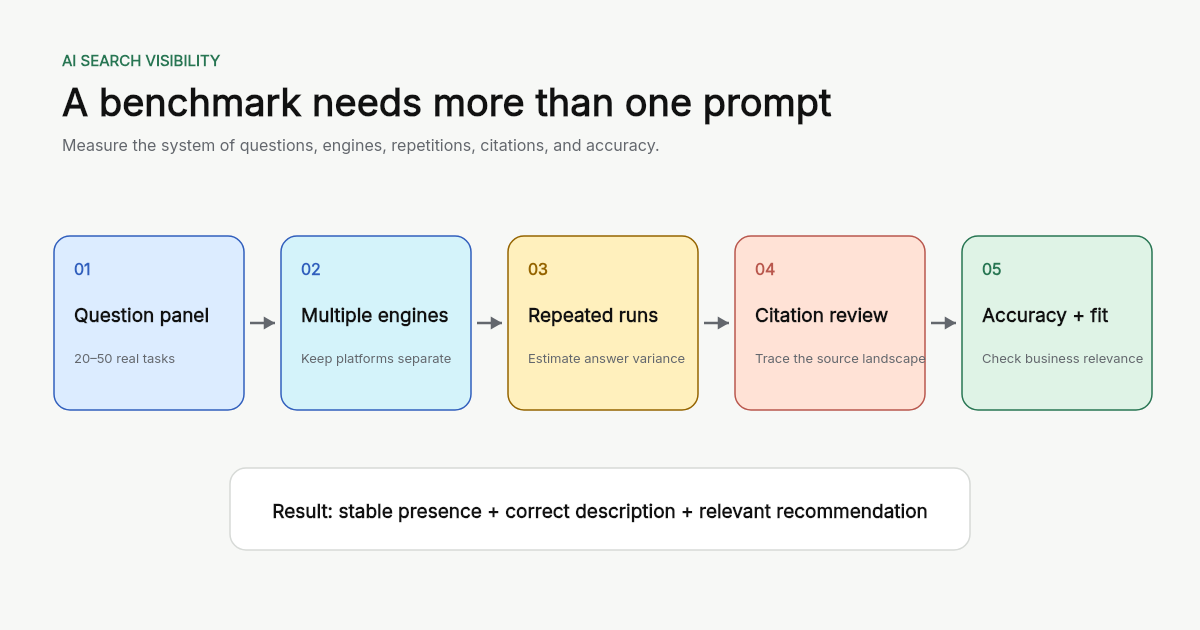
A measurement framework, not a claim that every platform exposes the same model, index, or citation behavior.
A mention is not the same as stable visibility
Suppose a brand appears in four out of ten answers today.
That result might reflect a durable presence in the sources used by the platform. It might also reflect one recently indexed page or a random choice among several plausible brands. Tomorrow, the count may be two or six.
Hendricks reported that repeated runs of the same engine were more similar to each other than answers across different engines, but the repeated outputs were still not identical.1
This is why repeated measurement matters. A brand that appears once and disappears in later runs has an exposure event. A brand that appears across relevant questions, platforms, and dates has something closer to stable visibility.
At minimum, record:
- How often the brand appears.
- Which user tasks trigger the appearance.
- Whether the brand is recommended, listed as an alternative, or described as unsuitable.
- Which pages the answer cites.
- Whether the product description is accurate.
- How the result changes across platforms and dates.
Being mentioned can be negative value
A visibility score can hide a serious problem: the brand may be present and wrong.
An AI answer may describe a discontinued feature, assign the product to the wrong category, use outdated pricing, or cite a page that no longer represents the company’s positioning. A simple mention count treats all of these outcomes as success.
A more useful benchmark separates three dimensions.
| Dimension | Question | Example failure |
|---|---|---|
| Presence | Did the brand appear? | The brand is absent from a relevant task |
| Accuracy | Was it described correctly? | The answer uses an old feature or price |
| Fit | Did it appear for the right reason? | The brand is recommended for a task it does not support |
A brand can have high presence and poor accuracy. Another may appear less often but only in high-intent questions where its description and recommendation reason are correct.
The second pattern may be much more valuable.
Citation analysis explains more than a brand list
When a competitor appears repeatedly, the instinctive question is: “How do we get included?”
The better question is: “Why was this competitor selected, and what evidence supported the choice?”
The answer may come from the competitor’s own site, a respected publication, an industry directory, a research report, product documentation, a video, or a community discussion.
Meltwater’s August 2026 AI Search Visibility Report analyzed approximately 7.3 million citations across eight AI platforms. It found that source patterns and platform behavior changed at different rates, reinforcing the need to measure each engine separately.2
Meltwater sells media-intelligence and AI visibility products, so its findings also need the normal caution applied to vendor research. The useful idea is the information-supply chain behind the answer.
If a company website is complete but credible third-party material is scarce, an engine may lack independent support. If media coverage is plentiful but describes an old product position, the brand may remain visible for the wrong reasons.
Citation analysis turns a vague visibility problem into questions a team can investigate:
- Does the official site clearly answer the user’s task?
- Are important capabilities supported by verifiable third-party material?
- Have recent product changes reached external sources?
- Which source types give competitors an advantage?
- Do the cited pages actually support the claims in the AI answer?
A practical AI visibility benchmark
A repeatable study can be built in five steps.
Build a question panel
Start with 20 to 50 questions based on real user tasks. Include different research stages, buyer types, budgets, regions, and comparison situations. Do not write every prompt around the brand.
Keep platforms separate
Do not collapse ChatGPT, Gemini, Perplexity, and AI Overviews into one score at the beginning. Each platform has its own source behavior. Study that behavior before creating a combined metric.
Repeat the runs
Run each question more than once and repeat the panel on a fixed schedule. Repetition helps distinguish generation variance from a meaningful change in the source landscape.
Record mentions and citations together
Capture whether the brand appears, how it is positioned, whether the description is correct, and which pages support the answer. When an answer gives no sources, record that too.
Preserve the test conditions
Save the platform, model or product mode when visible, date, region, login state, prompt, and output. Without those conditions, a change observed three months later will be difficult to explain.
Do not turn AI visibility into another vanity metric
More mentions do not automatically produce more qualified visitors. More citations do not prove that users trust the answer. A frequently mentioned brand with an inaccurate description may have a more urgent problem than a brand with lower but highly relevant visibility.
The benchmark should return to business questions:
- What task is the user trying to complete?
- At what point does the brand enter the candidate set?
- Is the recommendation reason consistent with the actual product?
- What does the user verify after seeing the answer?
- Which inaccuracies could change the decision?
Only then can visibility data be connected to site visits, trials, sales conversations, or user research.
Research teams can adapt the methods in competitive analysis prompts that produce better strategy to build the question panel. The guide to choosing an AI market research tool provides a practical example of evaluating tools by task and evidence rather than by one universal score.
Final view
One AI search can show what appeared in one answer today. It cannot establish how a brand performs over time.
A defensible AI visibility benchmark needs a question panel, multiple platforms, repeated runs, citation analysis, accuracy review, and a record of the testing conditions.
The goal is not simply to increase mentions. It is to know whether the brand appears in the right tasks, is described correctly, and is supported by evidence that can survive a human check.
ResearchMaster can help teams organize prompts, platform outputs, cited pages, competitor material, and internal positioning into a traceable research project. Build a repeatable competitive research workflow with ResearchMaster.
Sources and date notes
AI products, models, retrieval systems, sources, and generated answers change over time. This article describes a measurement method and does not guarantee visibility, ranking, traffic, or commercial results on any platform.
Footnotes
- Hendricks, “Search Intelligence Research and Methodology”, September 1, 2026. The published experiment covered 480 questions, four AI engines, 16,069 citations, and 7,775 unique domains. Hendricks provides AI search intelligence services, so the findings are used as a method example rather than a stable benchmark for every category. ↩ ↩2
- Meltwater, “AI Search Visibility Report for August 2026”, September 11, 2026. The report analyzed approximately 7.3 million citations across eight AI platforms. Meltwater provides media-intelligence and AI visibility products, so its public observations should be read with the usual caution applied to vendor research. ↩