Perplexity is fast. That is the first thing you notice.
For this test, I used the same research topic in both tools: "New Energy Vehicles: Growth Potential & Market Share in Europe and Southeast Asia." It is not a simple topic. Europe and Southeast Asia are both moving toward vehicle electrification, but the two markets behave very differently. Europe has stronger regulation, cleaner registration data, mature automakers, and a more developed charging ecosystem. Southeast Asia is more fragmented, more price-sensitive, and more dependent on local incentives, Chinese EV brands, battery supply chains, and country-by-country adoption patterns.
Perplexity produced a useful report quickly. In a few minutes, it gave me a clear overview of market share, regional growth, competitive dynamics, 2030 outlook, and strategic implications. If I needed a quick briefing before a meeting, I would be happy with it.
ResearchMaster took longer. The report generation process included a deeper analysis and cross-checking stage, closer to 30 minutes. That slower pace changes the expectation. It is not trying to be a faster answer engine. It is trying to behave more like an AI market research tool built for verified market research, source-backed analysis, and exportable business reports.
After reading both reports, the difference became clear: Perplexity is better for getting oriented quickly. ResearchMaster is better when the report needs to support an actual decision.
The case: why NEV market research is harder than it looks
New energy vehicle research sounds straightforward until you look at the definitions.
In Europe, most sources clearly separate BEVs, PHEVs, hybrids, registrations, and new-car sales. In Southeast Asia, the data is less standardized. Some reports focus only on BEVs. Others use broader EV or NEV definitions. Some markets, like Singapore and Vietnam, can show high BEV penetration, but that does not automatically mean they represent the largest long-term volume opportunity. Indonesia may have lower current penetration, but a much larger addressable market.
That is why a good industry research report cannot just collect numbers. It has to explain what the numbers mean, whether they can be compared, and where the limitations are.
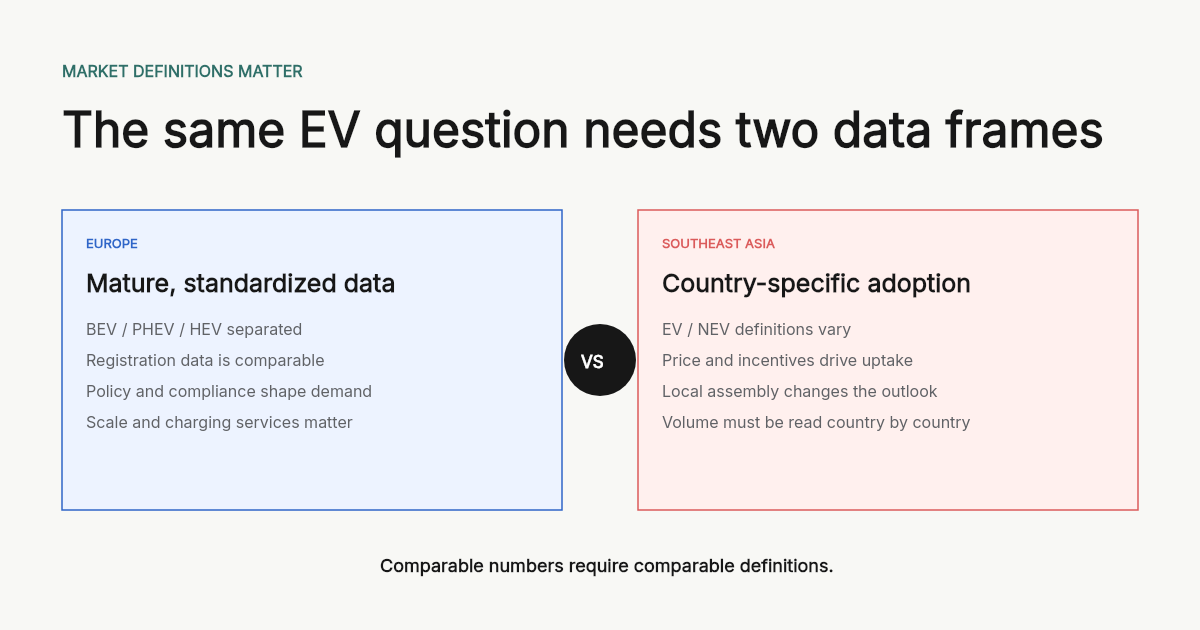
Comparable market figures start with comparable definitions, regional boundaries, and vehicle categories.
This is where the two tools started to feel different.
What Perplexity did well
The Perplexity report was strong as a fast market overview.
It opened with a clear regional contrast: Europe is a mature, policy-driven NEV market, while Southeast Asia is a lower-base, faster-growing region. It also included useful figures, such as BEV share in Europe, BEV penetration across several Southeast Asian markets, and the role of Chinese brands in the region.
The structure was easy to scan:
- Executive summary
- Scope and definitions
- Market share overview
- Growth potential
- Competitive landscape
- Market outlook to 2030
- Strategic implications
- Risks and limitations
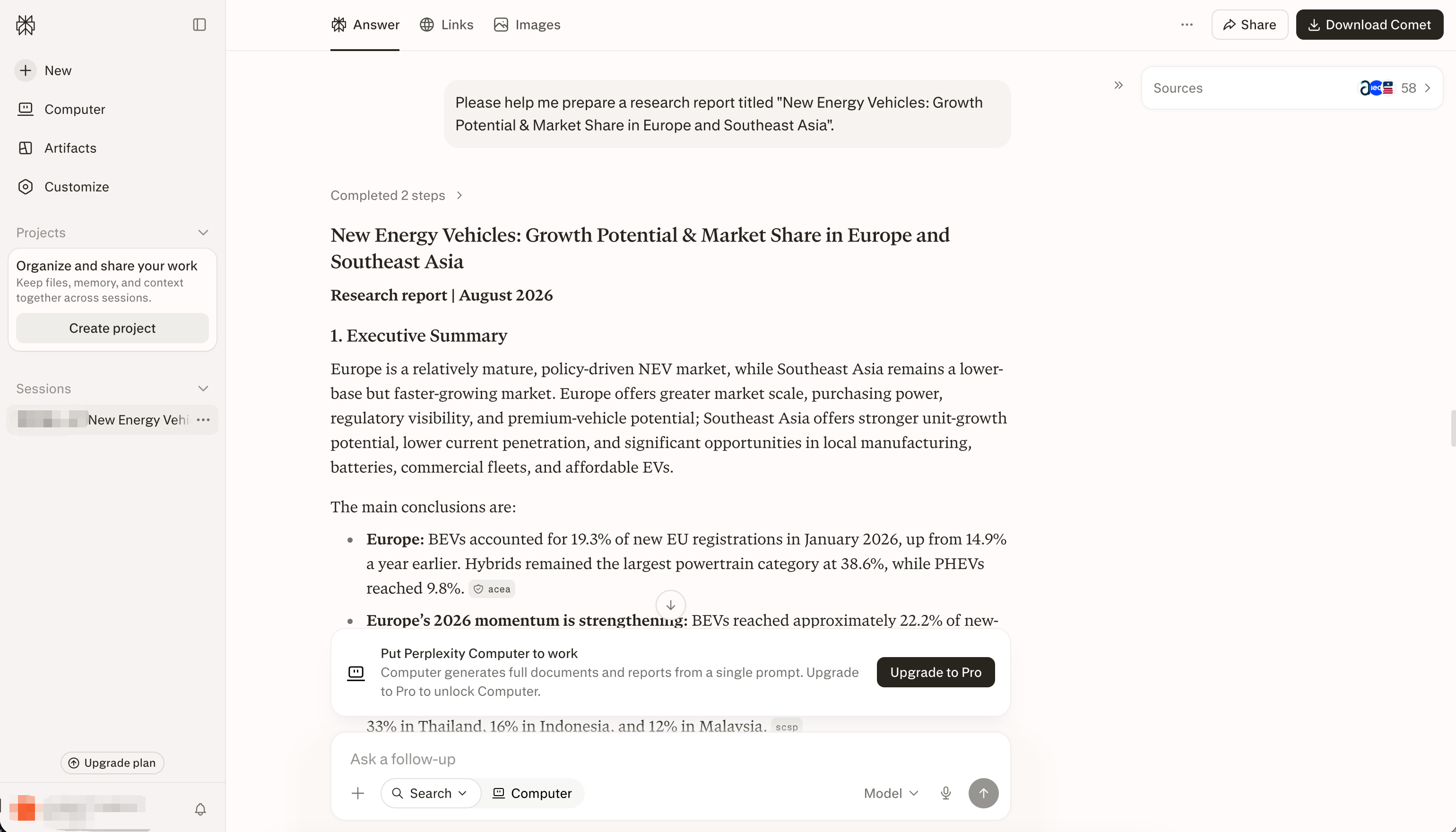
For early-stage research, that is genuinely helpful. Perplexity is good when you want to ask, "What is happening in this market?" and get a readable answer quickly.
But the report still felt like an organized answer rather than a full research workflow. It gave the big picture, but it did not spend as much time separating source quality, checking data comparability, or explaining where the numbers may not line up cleanly.
That matters in a niche market research report. A single market-share figure can look precise while hiding a definition problem underneath.
Where ResearchMaster felt different
ResearchMaster's report was less like a quick response and more like a structured research deliverable.
The report included sections on market definition, regional boundaries, BEV and PHEV segmentation, policy and infrastructure risks, integrated cross-checks, research limitations, recommendations, and appendix-style source references. It also produced multiple views, including full text, summary, mind map, slides, and export-ready formats.
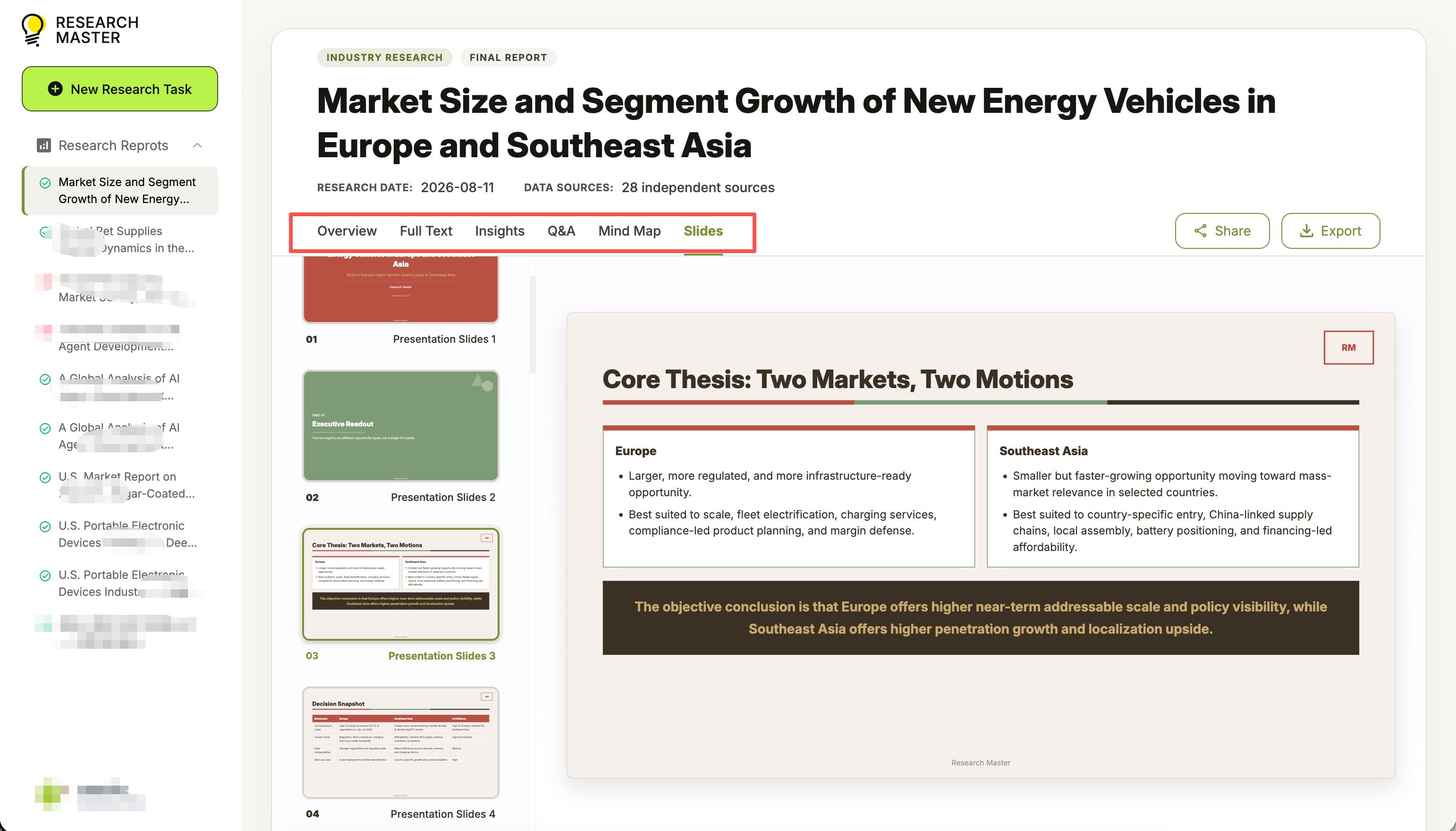
The biggest difference was not the writing. It was the research logic.
ResearchMaster treated Europe and Southeast Asia as two different growth cases, not one blended EV market. Europe was framed around scale, regulation, fleet electrification, charging services, and compliance-led planning. Southeast Asia was framed around local assembly, affordability, financing, battery ecosystems, and Chinese supply-chain influence.
That distinction is important. If an automaker, investor, analyst, or overseas expansion team is using the report, the next step for Europe is not the same as the next step for Thailand, Vietnam, Indonesia, or Malaysia.
This is where source verification and cited sources become more than cosmetic features. They help the reader see which claims are grounded in data, which ones are inferred, and which ones still need human review.
Report quality: speed vs verifiability
| Category | Perplexity | ResearchMaster |
|---|---|---|
| Best use case | Fast answers and market orientation | Verified market research and structured reports |
| Speed | Very fast, usually minutes | Slower, with deeper analysis and cross-checking |
| Report style | Search-led summary | Research workflow and deliverable |
| Source handling | Useful citations for quick checking | Stronger emphasis on source references and verification |
| Data boundaries | Present, but lighter | More explicit about definitions, regions, and limitations |
| Strategic output | Good high-level implications | More actionable recommendations and next steps |
| Export workflow | Mainly answer/report interface | Markdown, PDF, PPTX, full report, summary, slides |
| Better for | Quick learning, brainstorming, briefing | Market research, competitive analysis, investment research |
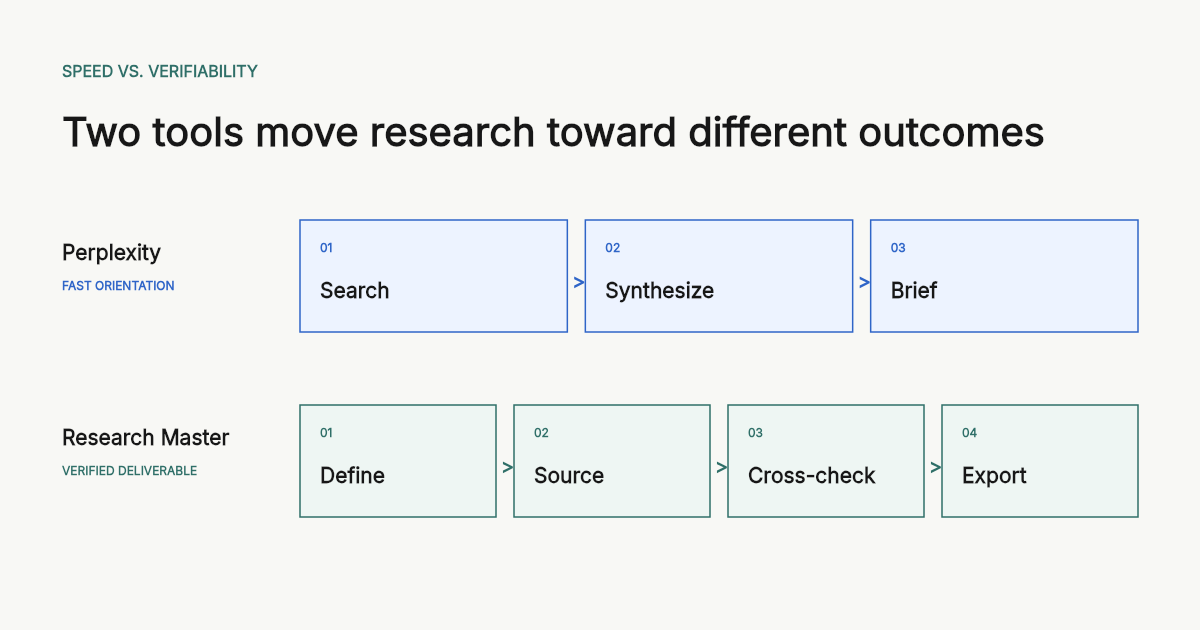
Perplexity accelerates orientation. ResearchMaster extends the workflow through sources, cross-checks, and export-ready deliverables.
Neither approach is wrong. They serve different jobs.
Perplexity helps you move from "I know very little" to "I understand the market shape." ResearchMaster helps you move from "I understand the market shape" to "I can defend this analysis in a team discussion."
Feature differences in practice
Perplexity is a broad AI search and answer product. It is useful across many daily workflows: web search, summarization, file analysis, model-based Q&A, image generation, and deeper research modes.
ResearchMaster is narrower by design. It focuses on research reports. You start with a topic, URL, company, market, or attached file, and the system builds a structured report around the kind of research task you are trying to complete.
That narrower focus is useful for work such as:
- Market validation
- Competitive analysis
- Overseas market research
- Industry research
- Investment research
- Product and company research
- Source-backed business reporting
In this NEV case, Perplexity answered the prompt well. ResearchMaster did something slightly different: it rebuilt the prompt into a research framework.
That is the practical difference between a general AI search tool and a dedicated AI market research tool.
When I would use each tool
I would use Perplexity when I need speed:
- Getting familiar with a new topic
- Finding recent market signals
- Summarizing news, policy, or company updates
- Asking follow-up questions in a flexible way
- Preparing a quick briefing before a call
I would use ResearchMaster when the report has to travel:
- Sharing research with a founder, manager, client, or investor
- Comparing regions, competitors, or market segments
- Creating a source-backed industry research report
- Turning research into PDF, PPTX, or Markdown
- Making sure claims can be traced back to cited sources
Final takeaway
Perplexity is excellent for quick research. It gives you speed, breadth, and a smooth search experience.
ResearchMaster is better when the output needs to become a real research asset. It is slower, but that extra time goes into structure, source verification, cross-checking, limitations, and decision-oriented recommendations.
For a topic like new energy vehicles in Europe and Southeast Asia, that matters. The market is too fragmented for a surface-level answer to be enough.
If you need a fast explanation, Perplexity is a strong choice. If you need verified market research with clear structure, cited sources, and export-ready deliverables, ResearchMaster is the better fit.