Almost every business website has a standard Frequently Asked Questions (FAQ) page.
Yet, if you check your web analytics or watch user session recordings, you will likely notice a depressing pattern:
"Ninety percent of your visitors never click on your FAQ page. The few who do scroll through it briefly, frown, close the tab, and quietly abandon their carts at checkout."
Why do conventional FAQs fail so consistently? Because most teams treat them as corporate vanity boards:
- They write questions like: "What is our brand mission?", "Why is our proprietary technology superior to legacy alternatives?", or "How do I contact an enterprise sales representative?"
- Meanwhile, real buyers holding credit cards in their hands are asking completely different, unglamorous questions: "If this doesn't fit, who pays the return shipping?", "Will I be hit with a surprise customs fee?", or "Is it going to be a nightmare to cancel this subscription?"
According to global benchmarking studies by the Baymard Institute across hundreds of thousands of checkout sessions, the average e-commerce and digital subscription cart abandonment rate sits at 70.19%.^1
Over 72% of those abandoned transactions are not caused by product pricing; they happen because a buyer's unvoiced, late-stage hesitation was never directly answered on the page.
A high-converting FAQ is not an afterthought for customer support. It is your final, most persuasive salesperson standing right beside the cash register.
Here is an investigative, practical playbook on how to mine Google Autocomplete wildcards and unfiltered Reddit complaints to uncover the real fears killing your conversions—and design a combat-ready FAQ that drives measurable revenue.
1. Tool 1: Using Google Autocomplete Wildcards to Eavesdrop on Buyer Doubts
Google's search dropdown suggestions are not random. They are an algorithmic reflection of what millions of real people are actively searching for when evaluating your category.
You do not need to buy thousands of dollars in specialized software. You just need to master four simple wildcard syntax patterns:
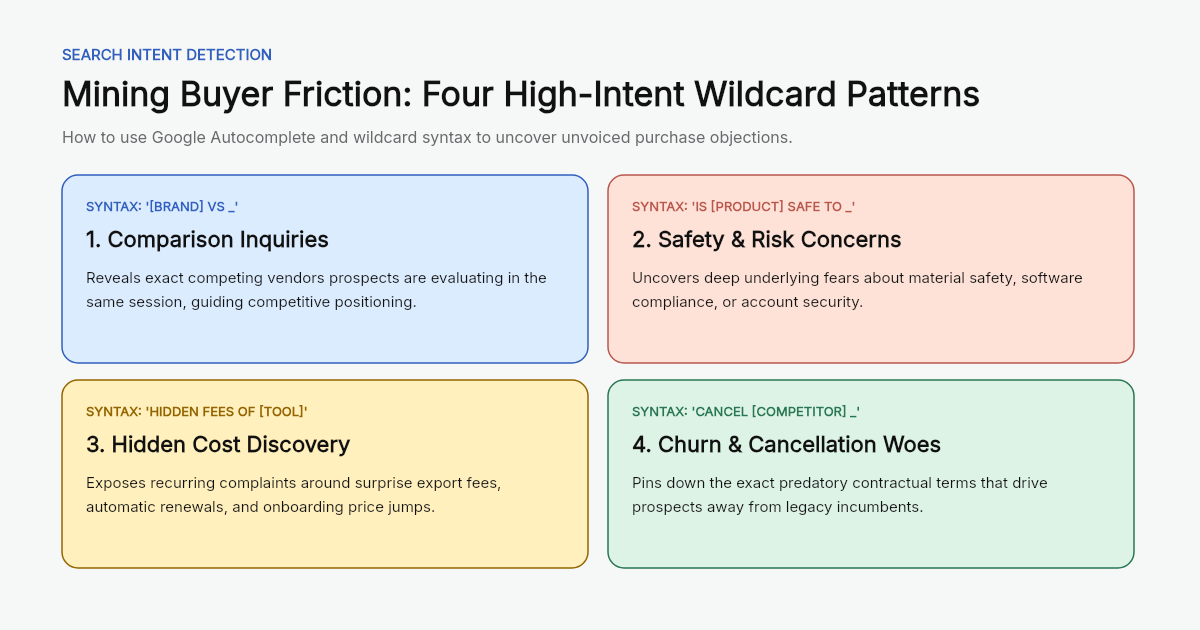 Figure 1: How to use Google Autocomplete wildcards to reveal unfiltered customer hesitations and competitive comparison queries.
The Four High-Intent Wildcard Queries
- 1. Comparison Inquiries (
[Brand] vs _): Reveals the exact competing brands buyers are weighing against you in the exact same buying window. - 2. Risk & Safety Concerns (
is [Product Category] safe to _): Highlights latent anxieties about material durability, skin sensitivities, or software data security. - 3. Hidden Cost Discovery (
hidden fees of [Category/Competitor]): Uncovers the specific billing surprises buyers are desperate to avoid. - 4. Churn & Cancellation Woes (
cancel [Competitor] account _): Exposes predatory terms that make customers run away from legacy incumbents.
Real-World Example:
If you sell ergonomic office seating, open an incognito window and type:
ergonomic chair return policy _orwhy are ergonomic chairs so _
Google immediately populates suggestions like: hard to return, expensive to ship back, and bad for tall people.
That is your customers handing you the test answers: their two biggest fears before buying are return shipping costs and height fit. If your product page does not address those two exact points directly above the checkout button, you are bleeding conversions.
2. Tool 2: Mining Reddit Review Boards for "Customer Heartbreak"
Your competitors' angry customers are your best strategic asset.
When conducting modern competitor research and field-level consumer research, official corporate press releases are useless. Honest feedback lives in public communities:
- Where to Look: Search relevant community subreddits like
r/eCommerce,r/BuyItForLife,r/SaaS, orr/scams. Look at 1-star and 2-star reviews on regional Trustpilot profiles. - What to Search:
[Competitor] customer support nightmare[Competitor] return fee surpriseworst thing about [Competitor Product]
- What You Discover: You will pinpoint the exact structural gripes driving buyers away from the market leader:
"Their website claimed a 30-day money-back guarantee, but they charged me a $40 restocking fee when I mailed it back!""Canceling required emailing customer support five days in advance, and they ignored my ticket until after they billed me again!"
Record those horror stories. Every single one of them represents a high-converting FAQ question you must openly dismantle on your site.
3. The 10-Word Direct Answer Rule: How to Write Combat-Ready FAQs
Most teams fail at FAQ writing because they cannot resist marketing fluff. When an anxious buyer reads an answer, they want an instant verdict, not a corporate lecture:
[The Fluffy Approach (Increases Abandonment)]
Q: Do you accept returns?
A: At our company, customer satisfaction is our highest purpose. We know that trying a new brand
   takes trust, which is why our product committee works tirelessly to deliver excellence...
   (The buyer closed the tab before reading paragraph two.)

[The Combat-Ready Approach (Drives Conversions)]
Q: If I don't like it, does returning cost me anything?
A: [First 10 words give the verdict]: 100% free returns within 30 days. No restocking fees.
   [Two clear procedural sentences]: Click one button in your account to print a prepaid return label.
   Once the carrier scans the box, your full refund is processed within 48 hours.
The 4 Non-Negotiable Checkout Defense Questions
- The Cost Transparency Barrier: "Will I get hit with unexpected shipping costs or import duties at checkout?" ➔ Guarantee Delivered Duty Paid (DDP) and transparent all-in pricing.
- The Zero-Risk Trial Barrier: "If I open and test the product, can I still return it?" ➔ Explicitly confirm that open-box trials are fully refundable.
- The Longevity Barrier: "What happens if this breaks six months from now?" ➔ Clearly state your replacement warranty terms in plain English.
- The Frictionless Exit Barrier: "Can I cancel my subscription with one click?" ➔ Promise an instant self-serve cancel toggle with zero mandatory sales calls.
4. Placement Strategy: Move FAQs to Where the Hesitation Actually Lives
The biggest operational mistake is hiding your FAQs on a detached footer page that nobody visits.
According to conversion research by the Nielsen Norman Group, FAQs belong directly inside the purchase funnel:^2
- On E-Commerce Product Pages (PDPs): Place an expandable accordion answering fit, materials, and return guarantees directly beneath the primary "Add to Cart" button.
- On SaaS Pricing Pages: Place answers regarding seat adjustments, cancellation, and data ownership right under the monthly/annual billing toggle.
- On Checkout Pages: Place a concise reassurance box confirming secure payments, refund speed, and zero hidden fees directly beside the credit card input fields.
Summary: Speak to the Customer's Fears First
Cart abandonment does not mean customers dislike your product. It means they feel exposed and uncertain at the finish line.
Rather than contracting costly market research companies or outsourcing generic market research services, spend thirty minutes observing what searchers actually type into Google and Reddit.
When a market research analyst gathers grounded competitive intelligence and treats FAQ design as an extension of marketing research—answering real anxieties with direct, generous clarity—you stop playing defense. You build trust, shorten sales cycles, and win transactions that competitors lose to unspoken doubt.
Sources and date notes
- Baymard Institute E-Commerce Usability Benchmark (2026):
- Empirical Research: "49 Cart Abandonment Rate Statistics 2026: Why Users Leave and How Cost Transparency Impacts Conversion"
- Core Findings: Long-term benchmarking across global e-commerce checkouts documenting a 70.19% baseline abandonment rate driven predominantly by hidden costs, shipping surprises, and complex return friction.
- Nielsen Norman Group (NN/g) UX & Conversion Studies (2026):
- Research Framework: "FAQs on E-Commerce Websites: When Users Need Them and How to Answer Real Questions"
- Usability Findings: Confirms that concise, direct-answer FAQ formatting embedded directly within product and checkout paths significantly reduces buyer drop-off.
- Search Engine Journal Intent Analysis Guide (2026):
- Practical Playbook: "Mining Google Autocomplete and Wildcards for High-Intent Customer Objections"
- Search Methodology: Details wildcard query structures (
_,vs,is safe to) to systematically detect latent customer anxieties and competitive friction points.
Notice and fair use statement: Usability benchmarks, cart abandonment statistics, and search intent methodologies referenced in this guide reflect public industry research and educational usability guidelines. All brand names, logos, and trademarks belong to their respective corporate entities.
Disclaimer
This playbook is intended for digital commerce strategy, conversion rate optimization (CRO) methodology, and operational UX planning only. Abandonment rates and conversion metrics vary across product verticals, price points, and geographic jurisdictions.
CTA
Looking to audit your customer discovery journey and eliminate friction points with source-backed evidence? Explore how ResearchMaster AI uncovers multi-source consumer sentiment and verified market intelligence.