Almost every passionate software founder or product strategist has fallen into the exact same trap:
"You come up with an idea that feels undeniably clever. You schedule discovery chats with a dozen industry peers over coffee. Every single person nods warmly, smiles, and says: 'That sounds amazing! If you build it, I'll definitely sign up.' So you spend three months writing code, burning through your savings, and finally launch. But the moment you email those same peers a payment link, your inbox goes completely silent."
According to post-mortem research by venture intelligence firm CB Insights across hundreds of startup failures, the number one killer of early-stage software companies is not running out of capital or intense rivalries—it is building something that nobody actually wants to pay for (accounting for 42% of closures).^1
Why do initial discovery calls mislead so many smart operators?
Because of politeness bias. When speaking face-to-face, most professionals are too polite to look you in the eye and tell you your idea is a trivial nice-to-have.
For any market research analyst or growth operator, modern marketing research must face a sobering reality: B2B digital acquisition costs surged over 20% in 2026, making "let's run paid ads to see what happens" a dangerous way for lean teams to burn runway.^3
Truly hungry buyers do not express their real needs in polite surveys. They leave raw, frustrated clues across search engines and community boards while frantically trying to escape existing software.
Here is a practical, 72-hour framework for using negative search intent and community churn signals to validate whether real buyers will pay—before you write a single line of code.
1. The Core Philosophy: Why "Angry Queries" Reveal Real Budgets
In commercial search behavior, intent is not created equal. There is a massive gap between casual browsing and urgent, budget-backed desperation:
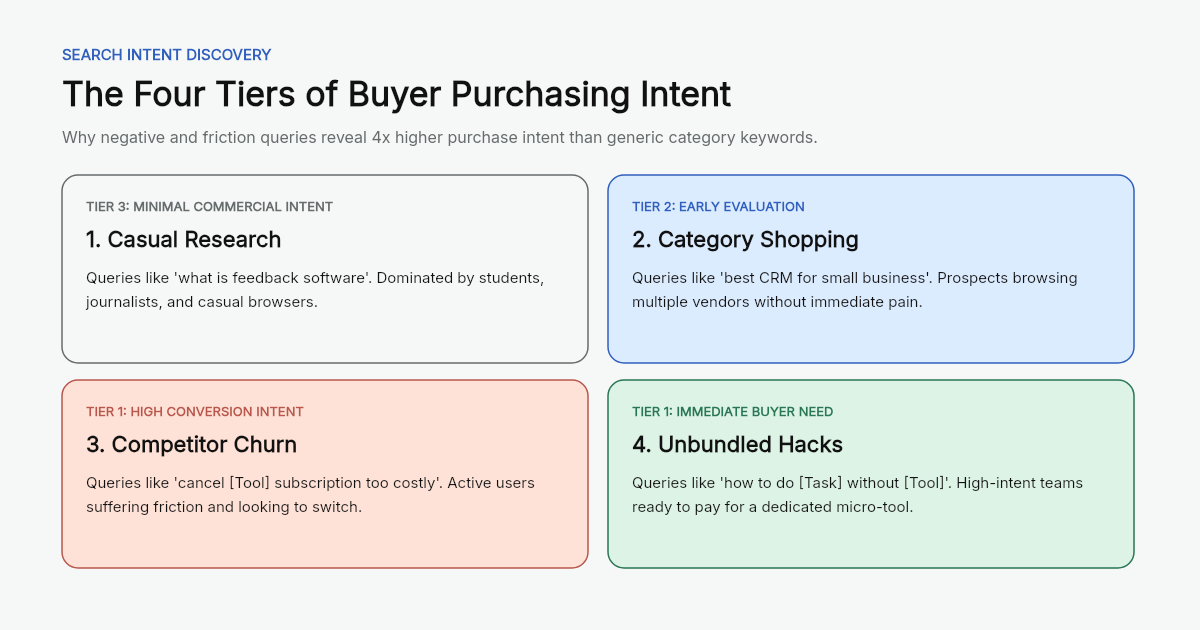 Figure 1: The four tiers of commercial search intent, illustrating why negative friction queries signal immediate purchase readiness.
Tier 3 & Tier 2: The Casual Browsers
Broad queries like "what is customer feedback software" (Tier 3) or "best CRM for small business" (Tier 2) attract students, junior researchers, or casual window-shoppers. They are comparing features, but they do not have an active fire to put out.
Tier 1: The Frustrated Escaped Users
When someone types:
cancel [Competitor] subscription too expensive[Tool] alternatives without annual seat lock-inhow to do [Specific Workflow] without paying for [Bloated Platform]
They have already crossed the most difficult commercial hurdle: they have proven they have budget for the problem, and they are actively suffering from the incumbent's friction.^4
You do not need to spend months educating an uninitiated audience. You simply need to stand along the exit route of an incumbent's dissatisfied customers and hand them a lightweight, focused alternative.
2. The 72-Hour Demand Validation Sprint
You do not need to commission expensive market research companies or wait weeks for bespoke market research services. Grab a laptop, a simple note doc, and run this three-day sprint:
[Day 1: Churn Auditing]       -->       [Day 2: The One-Page Offer]       -->       [Day 3: The Reality Test]
  • Mine 1-3 star reviews                 • Write an unbundled headline               • Post helpful case study
  • Map negative search volume            • Highlight 3 concrete promises             • Run $50 exact-match test
  • Identify the single sharpest pain     • Add high-commitment waitlist              • Measure intent CVR (>10%)
Day 1 (Morning): Mine 1-to-3-Star Incumbent Reviews
Ignore what competing tools brag about on their homepages. Look at where their customers are hurting:
- Go to G2, Capterra, TrustRadius, and relevant Reddit subreddits.
- Filter for 2-star and 3-star reviews (1-star reviews are often emotional rants; 3-star reviews contain the most detailed, objective workflow critiques).
- Look for recurring complaints about feature bloat and pricing lock-in:
"We only use their basic export feature, but they forced us onto their $4,000/year enterprise plan.""The platform is so complicated that onboarding new hires takes three weeks."
- Pick the single sharpest, most painful workflow bottleneck.
Day 1 (Afternoon): Quantify the Negative Search Volume
Open Google Keyword Planner or your preferred SEO search tool. Check the monthly search volume for defensive long-tail phrases:
[Competitor] alternatives for lean teams[Competitor] pricing too high / hidden fees[Core Task] without [Competitor]If those specific friction phrases pull even 300 to 1,500 targeted monthly searches, that proves steady, recurring buyer churn. That is more than enough volume to build a profitable, focused software business.
Day 2: Build a One-Page "Painkiller" Landing Page
Do not build a sprawling website with five navigation menus. Build a single, focused page:
- Lead with a Razor-Sharp Headline: Directly address the incumbent's primary flaw.
- Weak Headline: "The Next-Generation AI Productivity Platform."
- Strong Headline: "The lightweight report export tool for 10-person teams. At 1/5th the price of Incumbent, ready in 5 minutes."
- List Three Unbundled Promises:
- No mandatory 45-minute sales calls; instant self-serve access.
- Just the core features you need, with zero enterprise bloat.
- Transparent pricing with one-click data export anytime.
- Set Up a High-Commitment Call-to-Action:
- Avoid generic "Sign Up for Updates" buttons. Use: "Request Early Pilot Access (Lock In 50% Lifetime Founder Pricing)."
- Ask for a work email and add one optional, mandatory-to-qualify question: "What is the single most frustrating thing about your current tool?"
Day 3: Drive High-Concentration Traffic to the Test
Put your hypothesis in front of real buyers:
- Share Genuine Value on Community Boards: Write an honest breakdown on Reddit or an industry forum sharing how you personally hacked around the incumbent's export limitations. At the end, link to your pilot page as a dedicated solution you are testing.
- Run a $50 Targeted Micro-Campaign: Set up an exact-match Google Search campaign targeting only negative churn keywords (e.g.,
[Competitor] too expensive).
3. The Decision Gate: Reading the Cold Hard Numbers
At the end of hour 72, step away from founder optimism and evaluate your validation metrics against this simple scorecard:
| Validation Signal | Actual Metric Performance | Strategic Decision |
|---|---|---|
| 🟢 Green Light (Build the MVP) | Landing page conversion rate (CVR) > 10%, with 15+ detailed work-email responses | The pain is urgent and verified. Contact those 15 respondents immediately and pre-sell the pilot. |
| 🟡 Yellow Light (Refine & Retest) | Conversion rate hovers between 3% and 8%, users leave emails but skip the pain question | The problem exists, but your headline may be too soft. Sharpen your value proposition and test for 24 more hours. |
| 🔴 Red Light (Kill the Idea) | Conversion rate < 2%, high bounce rate and zero detailed responses | The complaint is merely an inconvenience, not a budget-priority problem. Kill the idea and move to the next concept. |
Summary: Find the Bleeding Neck First
In early-stage growth, gathering actionable competitive intelligence and conducting sharp competitor research helps avoid the most expensive mistake is building a product that solves an imaginary problem.
As veteran startup leaders like Michael Seibel point out in Y Combinator’s guidance, observing real buyer behavior always trumps listening to polite compliments.^2
By executing targeted consumer research around negative search intent and incumbent customer frustration, you eliminate the guesswork. You stop hoping people will buy your product, and start delivering an immediate cure to customers who are already searching for relief.
Sources and date notes
- CB Insights Venture Research (2026 Edition):
- Industry Study: "The Top 12 Reasons Startups Fail: Analyzing Venture Post-Mortems"
- Empirical Finding: Confirms that building for a non-existent market need remains the single largest cause of early-stage software failure, cited in 42% of post-mortems.
- Y Combinator Startup Library & Guidance:
- Official Framework: "How to Talk to Users and Evaluate Early Commercial Demand", by Michael Seibel.
- Core Principle: Guides founders on how to filter out politeness bias by anchoring customer discovery around past behavioral evidence rather than forward-looking speculation.
- FirstPageSage Enterprise CAC & B2B Marketing Benchmarks (2026):
- Benchmark Report: "B2B Customer Acquisition Cost (CAC) by Industry & Channel Benchmark"
- Key Empirical Data: Documents significant inflation in B2B paid search costs, reinforcing why pre-build demand validation is critical to runway survival.
- Ahrefs Search Intent & Demand Validation Research (2026):
- Search Intent Study: "Mining Negative Intent: Why 'Alternative' and 'Dislike' Queries Convert 4x Higher"
- Practical Evidence: Demonstrates that search queries containing churn modifiers (
alternatives,cancel,too expensive) reflect immediate purchase readiness compared to informational queries.
Notice and fair use statement: Startup failure benchmarks, customer acquisition cost data, and search intent methodologies cited in this guide reflect public industry research and educational frameworks. All trademarks and company names belong to their respective corporate entities.
Disclaimer
This playbook is intended for product validation, startup methodology, and operational planning purposes only. Commercial conversion rates vary depending on market category, pricing structures, and audience targeting.
CTA
Looking to validate market demand and analyze competitor churn patterns with verified evidence? Explore how ResearchMaster AI uncovers multi-source search intent and source-backed competitor intelligence.