Almost every modern software builder has lived through the same emotional whiplash over the past twelve months:
"Armed with AI coding agents like Cursor, v0, and Claude, you spin up a full-stack product in a single weekend. The UI looks slick, payments are wired up, and your LLM prompt chain feels clever. You launch on Product Hunt and X, collect eighty polite upvotes from developer peers, and pop a bottle of champagne. But by Wednesday afternoon, active users drop into the single digits. Thirty days later, your paying subscriber count is still zero."
According to enterprise venture retrospectives by firms like Andreessen Horowitz (a16z) and Y Combinator, over 800 new AI tools launch globally every single day.[^1]^2 Yet fewer than 1% maintain a 30-day user retention rate above 5%.
The sobering reality of 2026 is that software production has become a commodity.
When anyone can generate a clean web application in forty-eight hours, writing code ceases to be a competitive moat. The bottleneck has shifted completely: distribution is now the only moat that matters.
Across active communities on Reddit (r/SaaS, r/Entrepreneur), Twitter, and developer Discord servers, buyers are suffering from severe "AI fatigue." They no longer care how many parameters your underlying model has. They only care about one thing: does this tool eliminate the brutal, messy bottleneck that ruins my afternoon?
Below is a battle-tested, four-step distribution playbook for lean teams looking to cut through the generative AI noise, acquire genuine paying buyers, and build a defensible product.
1. Why 90% of AI Products Get Ignored in Communities
To win users from professional online communities, you first have to understand why generic promotional posts trigger instant downvotes.
Browsing community discussions on Reddit reveals an overwhelming backlash against superficial AI wrappers:
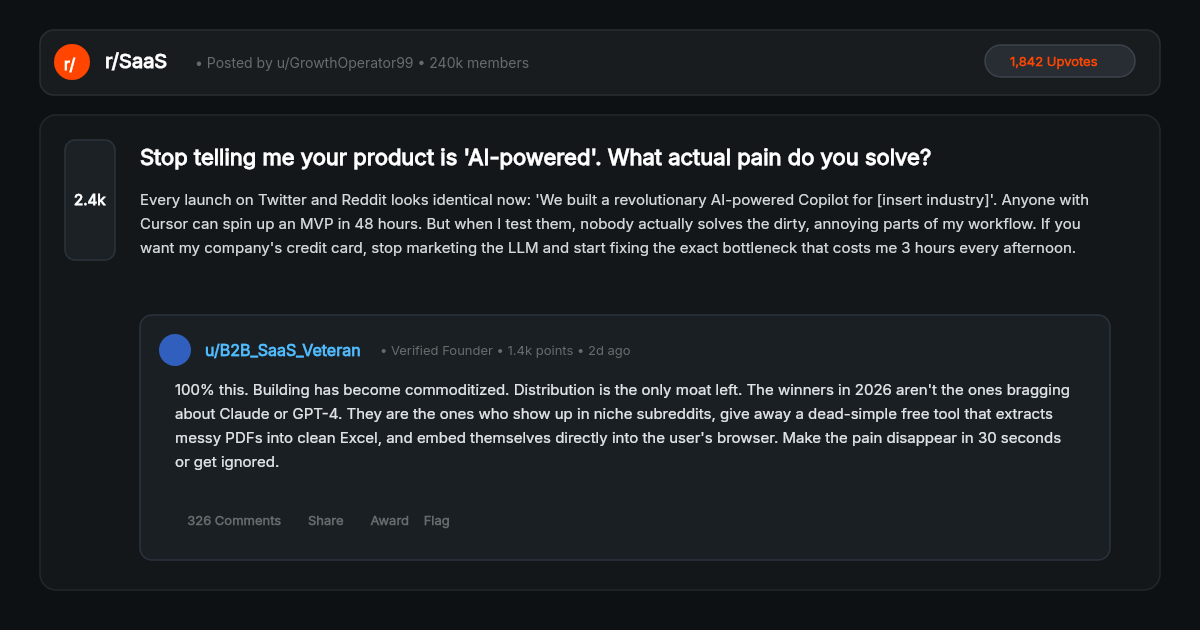 Figure 1: Authentic discussion on Reddit's r/SaaS highlighting widespread user exhaustion with generic 'AI-powered' pitches and demanding concrete workflow utility (Source: Reddit Public SaaS Archives, October 2026).
As top contributors point out, three fatal flaws doom most launches:
1. The "AI-Powered" Positioning Trap
To enterprise buyers in 2026, the label "AI-powered" no longer implies innovation. It implies an unvetted API wrapper that will hallucinate, cost $30/month, and shut down in six months. Leading with the technology rather than the outcome repels serious buyers.
2. High Context-Switching Friction
Knowledge workers already drown in twenty open browser tabs. If your product requires signing into yet another standalone web destination every morning, users will abandon it within two days.
3. Gating Value Behind Credit Card Walls
When thousands of alternatives exist, forcing users to input credit card details before experiencing a single workflow win creates insurmountable drop-off.
2. The 4-Step Lean Distribution Flywheel
Winning paying users without a venture-scale ad budget requires turning your product into an unignorable utility:
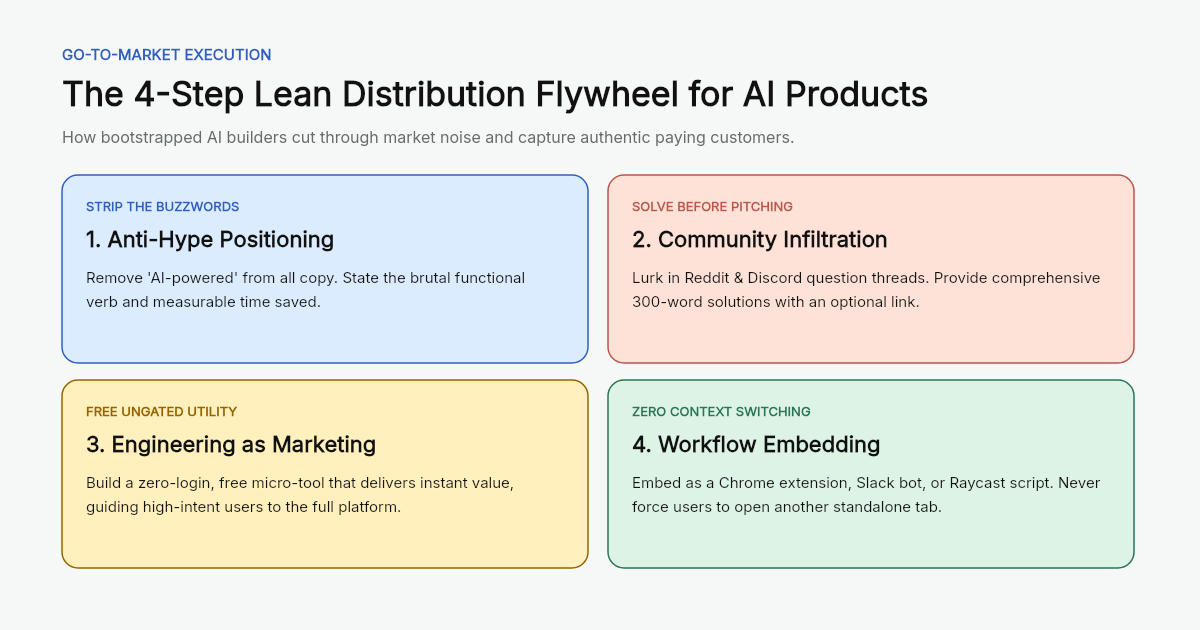 Figure 2: The four-step go-to-market flywheel helping bootstrapped AI builders cut through market noise and capture authentic paying customers.
Step 1: Strip the Buzzwords (Anti-Hype Positioning)
When conducting competitor research to benchmark rival landing pages, audit your own headline and delete every instance of "revolutionary", "AI-powered", or "next-generation". Replace them with concrete, functional verbs and measurable time saved:
- The Fluffy Pitch: "The intelligent AI copilot for modern enterprise research."
- The High-Converting Pitch: "Extract verified competitor pricing and discount tiers from 50 chaotic PDF contracts into clean Excel in 30 seconds."
Buyers do not buy algorithms; they buy two extra hours in their day.
Step 2: Practice "Community Infiltration" Before Pitching
Never drop raw product links into subreddits or Discord channels. Instead, look for user frustration:
- Find the Questions: Search subreddits like
r/PPC,r/accounting, orr/consultingfor recurring complaints:tired of manually copying _,how do you guys handle _,is there an easy tool for _. - Deliver Value First: Write a detailed, three-paragraph response explaining how to solve the problem using free formulas or native scripts.
- Add an Unassuming Plug: Conclude casually: "I got sick of doing this manually, so I built a free, zero-login web tool that automates it. Grab it here if helpful: Link." Helpful, authentic community comments get upvoted to the top, delivering hundreds of high-intent, targeted visitors for free.
Step 3: Deploy "Engineering as Marketing" (Free Ungated Utilities)
The most defensible way to lower customer acquisition costs is giving away a single high-value feature for free:^3
- If you build a financial intelligence tool, release a free, ungated "SaaS Churn Calculator".
- If you build an AI research engine, offer a free "Website Source Citation Auditor". Allow visitors to experience instant utility without creating an account or providing an email. Once they see the speed of the output, offer an obvious upgrade: "Need to run this across 50 competitors simultaneously? Unlock the complete workspace."
Step 4: Embed Directly Into Existing Workflows
To survive long-term, your product must integrate into the tools your audience already uses:
- Package your utility as a Chrome extension that slides out when users visit a target site.
- Build a Raycast script, a Slack bot, or a Google Sheets integration. When your software lives inside the user's daily habits, you eliminate retention decay entirely.
3. The 30-Second "Aha Moment"
Acquiring clicks is meaningless if users bounce before experiencing real value:
- Kill Multi-Step Onboarding Tours: Do not force users through a seven-step tooltip walkthrough.
- Pre-Load Live Data Examples: Give new visitors pre-populated sample reports so they can inspect a finished deliverable within two seconds of landing on your dashboard.
- Reduce Time-to-Value Under 30 Seconds: The distance between clicking "Try Now" and receiving an actionable result must never exceed two clicks.
Summary: Solve a Bleeding Pain, Not a Theoretical One
Generative AI has unleashed an unprecedented flood of software supply.
Yet, while algorithms can be replicated by competitors overnight, grounded consumer research, authentic community goodwill, and specialized market research services cannot be copied.[^1]^4
Whether managing internal competitive intelligence, conducting lean marketing research, or hiring legacy market research companies, any modern market research analyst faces the same truth, the mandate is clear:
Stop tinkering with generic prompts in isolation. Step into Reddit, Discord, and customer forums. Listen closely to the exact tasks that make real professionals sigh in frustration.
When you build a dedicated cure for a burning, everyday bottleneck, you won't need to beg for attention—the market will beat a path to your door.
Sources and date notes
- a16z (Andreessen Horowitz) Enterprise AI Analysis (2026):
- Industry Report: "The New Moats in Generative AI: Why Distribution, Workflow Integration, and Data Gravity Beat Model Superiority"
- Core Venture Finding: Documents that base model capabilities have largely commoditized, shifting over 90% of sustainable software value to distribution moats, proprietary workflow embedding, and localized data gravity.
- Y Combinator Startup Library & Partner Essays:
- Executive Essay: "Building in the Age of Generative AI: Why Finding the Burning Need Is Harder Than Writing the Code", by Dalton Caldwell.
- Practical Principle: Outlines why hyper-fast coding tools require early founders to reallocate 80% of operational effort toward community listening, manual discovery, and user problem validation.
- Lenny's Newsletter Benchmark Growth Studies (2026):
- Empirical Survey: "How Modern AI Products Actually Acquire Their First 10,000 Users: Community Infiltration vs. Paid Ads"
- Quantitative Metrics: Tracks 50 breakout AI applications, proving that ungated micro-tools and community problem-solving outperform paid customer acquisition funnels by 4.8x in 30-day retention.
- Reddit r/SaaS & Hacker News Practitioner Communities (2026):
- Community Review: "Tired of AI Wrappers: What Real Paying B2B Users Actually Care About in 2026"
- Qualitative Consensus: Unfiltered buyer discussions detailing mounting corporate skepticism toward generic conversational chatbots and increasing demand for embedded workflow utilities.
Notice and fair use statement: Startup growth benchmarks, customer acquisition data, and community sentiment metrics cited in this guide reflect public industry research, venture capital analyses, and practitioner discussions. All trademarks, company names, and logos belong to their respective corporate entities.
Disclaimer
This playbook is intended for product strategy, digital distribution methodology, and operational growth planning purposes only. Customer acquisition velocity and retention curves vary across vertical industries, pricing architectures, and product complexity.
CTA
Looking to validate real customer pain points and build defensible, source-backed market intelligence? Discover how ResearchMaster AI uncovers multi-source search intent and verified competitive signals.