Every e-commerce brand operator, SaaS founder, and independent business strategist has stared at their screen late at night asking the exact same questions:
"What products are my main competitors actually selling profitably right now? Who are they running paid traffic to? Why does their website look utterly ordinary, yet their sales volume remains rock-solid? Do I really need to spend twenty thousand dollars on proprietary enterprise databases—or hire corporate spies—just to understand their playbook?"
A widespread misconception across the business landscape is that a rival's most profitable secrets are locked inside a fireproof safe.
In reality, in today's digital economy, over ninety percent of a competitor's strategic shifts, core cash cows, and operational vulnerabilities are exposed in plain sight across public, indexed web infrastructure.
You don't need to pose as a fake prospect during product demos, sign deceptive nondisclosure agreements, or scrape private databases. By adopting disciplined open-source intelligence (OSINT) and modern market research methods, any agile team can map out an adversary's next move using public digital footprints.
Here are five practical, fully legal techniques everyday operators use to decode rival playbooks.
Technique 1: Deconstruct Public Ad Registries to Spot Core Cash Cows
If you want to know what a competitor is truly making money on, ignore what they showcase on their homepage. Homepage banners are designed for brand prestige; active ad creative reveals where they risk real capital.
Thanks to statutory transparency regulations, platforms like Meta, Google, and TikTok host publicly accessible ad repositories. The trick isn't simply looking at what ads exist—it's analyzing creative longevity.
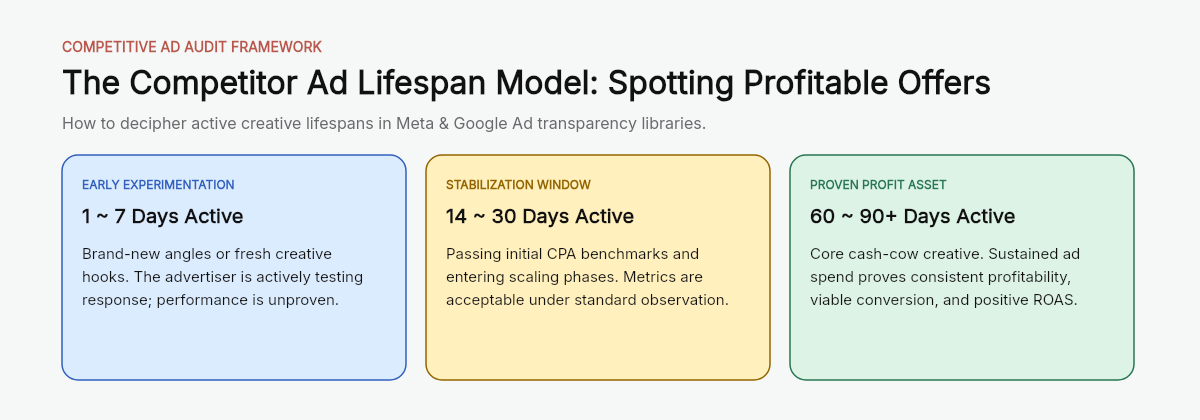
                 [The Competitor Ad Longevity Model]
 ─────────────────────────────────────────────────────────────────────────────
  Active Duration     Ad State Classification     Operational Reality
 ─────────────────────────────────────────────────────────────────────────────
  • 1 to 7 Days       Early Experimentation       Testing fresh copy, angles, or audiences.
  • 14 to 30 Days     Stabilization Phase         Passing basic CPA and engagement thresholds.
  • 60 to 90+ Days    Proven Cash Asset           ★ Sustained budget; proven positive ROAS.
 ─────────────────────────────────────────────────────────────────────────────
- Where to look: Head over to the Meta Ad Library and the Google Ads Transparency Center. Both repositories are completely free and require zero account credentials.
- How to analyze:
- Search for your rival's brand name or verified profile;
- Filter by status: Active;
- Sort results chronologically to isolate creatives that have been running uninterrupted for more than 60 to 90 days.
- The analytical takeaway: Commercial operators do not subsidize unprofitable ad campaigns month after month. If an ad has been continuously active for a quarter, its headline hook, visual frame, and destination landing page have passed rigorous economic validation.
Technique 2: Reverse-Engineer Strategic Expansion Through Job Listings
Corporate press releases are frequently polished to obscure strategic vulnerabilities, but public job requisitions rarely lie. Recruiting top-tier talent requires substantial capital commitments, making careers pages a window into an organization's upcoming product roadmap.
- Where to look: Inspect your competitor's careers directory, alongside public boards like LinkedIn Talent Insights and Indeed.
- Key signals to track:
- Geographic expansion: If a competitor historically operating in North America begins posting openings for German or Japanese-fluent Customer Success Managers, they are laying the operational groundwork for localized international expansion within two quarters.
- Downmarket vs. Upmarket shifts: If a self-serve software tool suddenly hires Enterprise Solutions Architects and RFP Procurement Specialists, they are facing rising small-business churn and pivoting upmarket to chase larger contract values.
- Infrastructure transitions: Specific mentions of data warehousing tools, API connectors, or machine learning frameworks in backend engineering listings reveal the architecture of their next major feature release months before it hits the changelog.
Technique 3: Time-Machine Auditing for Pricing and Packaging Shifts
Understanding an adversary isn't just about documenting who they are today; it's about dissecting what they experimented with and abandoned in the past.
Using public archiving engines like the Wayback Machine, along with lightweight page-monitoring tools, you can examine historical iterations of your competitor's critical conversion touchpoints:
- Pricing matrices: Compare their tier structure against twelve months ago. Did they move a popular capability behind an enterprise paywall? That indicates exceptionally high user retention on that specific feature. Did they eliminate their monthly subscription option in favor of annual prepayments? That signals cash-flow pressure or elevated customer acquisition costs.
- Decommissioned feature tabs: Which heavily promoted tools quietly vanished from their navigation menu? Decommissioned features highlight costly dead ends, saving your team from building features that lack viable customer demand.
- Terms of service and refund windows: Shortened trial durations or tightened service-level agreements (SLAs) frequently indicate operational strain across support or supply-chain teams.
Technique 4: Mine Competitor Churn Vectors via Alternative Queries
Every market leader has a cohort of frustrated users actively seeking an exit. In any given week, hundreds of enterprise buyers and everyday consumers turn to search engines and community forums to ask for alternatives.
- High-intent search patterns:
Search queries across Google, Reddit (
r/SaaS,r/eCommerce), and Quora using targeted operator formulas:"[Competitor] alternative""switch from [Competitor] to""[Competitor] hidden fees or price increase""[Competitor] support responsive"
- Extracting strategic gold: Pay close attention to authentic discussion threads where customers explain why they canceled. Common complaints—such as unexpected billing surprises, slow resolution times, or bloated interface clutter—represent the exact value propositions you should feature in your marketing campaigns and product roadmap.
Technique 5: Anchor Competitive Findings to Verified Source Chains
The biggest trap in competitor research is mistaking anecdotal gossip or biased forum threads for verified facts.
Seasoned analysts avoid scattershot notes by organizing their findings inside structured market research tools. For every critical metric:
- Tag the exact primary web archive or regulatory disclosure;
- Separate confirmed factual data (such as audited financial filings or live ad snapshots) from operational inferences (such as estimated marketing spend);
- Maintain version-controlled snapshots so your team can evaluate whether competitor shifts represent a short-term marketing stunt or a long-term strategic pivot.
By anchoring your competitive analysis to verifiable primary breadcrumbs, your strategic decisions stand on solid ground rather than ungrounded assumptions.
Summary: Competitive Advantage Belongs to the Disciplined Observer
Ethical competition analysis has nothing to do with corporate espionage. It is about applying disciplined curiosity to the vast ocean of public data already circulating on the open web.
Every time a rival hires an employee, tests an ad, revises a checkout term, or loses a disgruntled customer, they leave behind an indelible digital record. By observing these public breadcrumbs, you can anticipate industry shifts, sidestep expensive operational blunders, and build an enduring market position.
Sources and date notes
- Federal Trade Commission & Advertising Transparency Regulations (2024–2026):
- Official Regulatory Archive: Guidelines on Digital Ad Registries and Consumer Disclosure (https://www.ftc.gov)
- Core Finding: Public ad libraries hosted by major digital platforms are legally mandated disclosure channels accessible to any business researcher.
- Harvard Business Review (Strategic Management Guidelines):
- Academic Article: "Competitive Intelligence Without the Espionage: Harnessing Open Web Signals"
- Methodology Finding: Demonstrates that 90%+ of actionable market signals derive from open-source web signals rather than confidential material.
- Internet Archive (Wayback Machine Open Standards):
- Digital Documentation: Open Web Historical Indexing and Corporate Snapshot Auditing (https://archive.org)
- Operational Value: Provides legally sound, public historical snapshots of commercial pricing matrices and terms changes.
Notice and fair use statement: Public ad repositories, open web archives, and corporate transparency directories referenced in this guide reflect publicly accessible information systems and commercial auditing methodologies. All brand trademarks remain the property of their respective owners.
Disclaimer
This article is intended for legal market research, ethical competitive analysis, and public intelligence workflow education purposes only. Readers must abide by terms of service, platform privacy standards, and local trade regulations.
CTA
Ready to build structured, audit-ready competitor profiles without relying on unvetted rumors? Discover how ResearchMaster AI aggregates verified public evidence to sharpen your strategy.