Every founder, e-commerce operator, and product manager assessing their market has walked through the exact same routine:
"You open up Google or query ChatGPT: 'What are the main competitors in this specific product category?' The tool instantly spits out five multi-billion-dollar enterprise giants—or a laundry list of defunct startup names whose websites no longer resolve. You shut your laptop feeling reassured: 'The legacy incumbents are too bloated to care about my target audience, and no direct alternative matches our exact proposition. We have zero real rivals.'"
If that represents your competitor research process, you are likely operating with a dangerous blind spot.
In everyday commerce, the rivals that genuinely siphon away your sales are rarely the Fortune 500 giants. They are three to five nimble, mid-tier operators who quietly serve your exact customer segment without running expensive top-of-funnel brand campaigns.
At the same time, relying blindly on AI search engines (like ChatGPT, Perplexity, and Google AI Overviews) can easily lead you astray. While conversational engines compile comparison tables in seconds, their recommendations frequently mix active businesses with dead startups, hallucinated capabilities, and PR fluff.
You don't need a twenty-thousand-dollar annual subscription to PitchBook or CB Insights. Here is how modern teams use open entity graphs and disciplined AI search auditing to uncover their true competitive landscape in ten minutes using practical market research tools and proven market research methods.
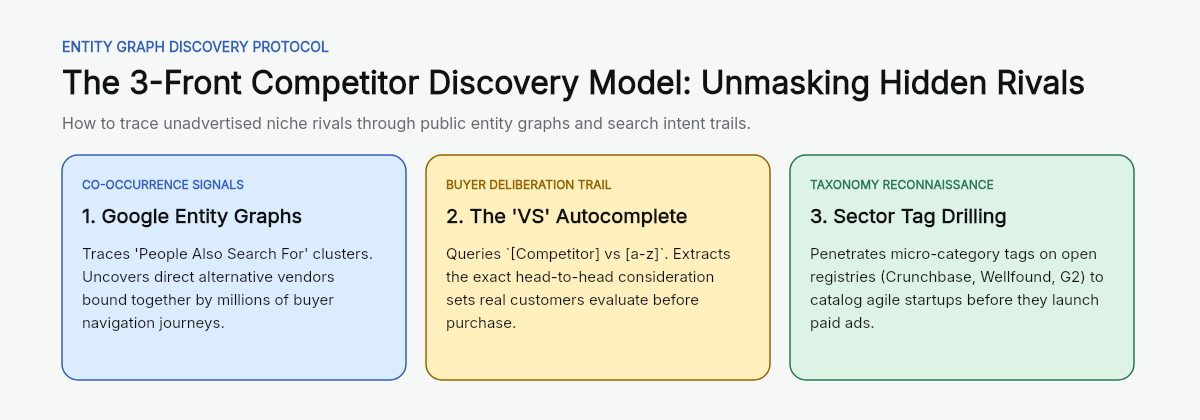
Tactic 1: Trace "People Also Search For" to Expose Organic Entity Networks
Search algorithms do not operate as rigid phone books; they map out billions of aggregate buyer journeys.
When prospective customers research a solution, they evaluate multiple related vendors within a single browsing session. Search engines quietly cluster these co-visited brands into linked entity networks.
- How to execute:
- Search for one established, direct rival whose name you already know;
- Scroll down to the bottom of the search results page to inspect the "People Also Search For" module (or the related entities panel);
- Identify an unfamiliar company name from that cluster and click through;
- Repeat this drill three times down the rabbit hole.
- The analytical takeaway: You will quickly uncover a network of low-profile, active providers that real buyers compare side-by-side every day.
Tactic 2: Leverage the "VS" Autocomplete Hack to Intercept Buyer Consideration Sets
Many operators assume they know who their rivals are, but what truly matters is who prospective buyers compare them against right before checkout.
Search engine autocomplete suggestions reflect real historical query volume—they document customer hesitation in real time.
- The query pattern:
In Google, YouTube, or Reddit search bars, type:
"[Competitor Name] vs "(be sure to leave a trailing space after 'vs') - Analyze the prompt list: The top four suggestions represent the direct alternatives buyers actively weigh before finalizing a purchase decision.
- The alphabetical sweep:
To build an exhaustive index across a niche, step through the alphabet: type
"[Competitor] vs a","[Competitor] vs b", and so on. In less than five minutes, every rival holding authentic search volume will surface.
Tactic 3: How to Audit AI Engine Recommendations (ChatGPT, Perplexity, Google AI Overviews)
Querying AI engines for company discovery research similar companies is fast, but unvetted outputs carry substantial risks. As documented by enterprise researchers and AI platform engineering teams, generative models synthesize historical crawl data, making them prone to recommending defunct vendors or conflating enterprise software with lean consumer tools.
Use this three-step verification filter to turn AI search from a hallucination hazard into a sharp competitive analysis asset:
               [Auditing AI Search Engine Recommendations]
 ─────────────────────────────────────────────────────────────────────────────
  Common AI Blind Spot      Quick Verification Check       Strategic Action to Take
 ─────────────────────────────────────────────────────────────────────────────
  1. Recommending Defunct   Inspect copyright footer and   Don't discard! Search forums for why
     or Dead Projects       recent 30-day social updates.  it shut down to capture stranded users.

  2. Conflating Enterprise  Prompt AI for starting prices  Filter out six-figure tools; isolate
     Titans with SMB Tools  and target customer tiers.     rivals sharing your exact price band.

  3. Hallucinating Non-     Mandate direct official URLs   Follow the links directly to analyze
     Existent Capabilities  for active pricing pages.      live feature packages without manual digging.
 ─────────────────────────────────────────────────────────────────────────────
1. Screen for Inactive or Defunct Vendors
- The underlying issue: Large language models often recall startups that generated heavy tech press coverage two years ago but have since exhausted their runway.
- How to verify: Visit the suggested URL and confirm the copyright year is current, and check whether their public communication channels have posted within the past 30 days.
- How to capitalize: If a recommended competitor has closed its doors, search community discussions for
"[Competitor Name] alternative". Displaced customers actively looking for a replacement are your highest-converting sales prospects.
2. Separate Enterprise Titans from Direct Peers
- The underlying issue: If you run a nimble fifty-dollar monthly utility, AI engines will frequently group your product alongside enterprise platforms like SAP or Salesforce simply because they share broad category tags.
- How to verify: Add a concrete constraint to your prompt: "Include the starting monthly price and state whether each option targets individual operators, SMBs, or enterprise accounts."
- How to capitalize: Exclude platforms with annual minimums and focus your benchmarking entirely on competitors fighting for the same tier of buyer budget.
3. Mandate Primary Citation and Pricing URLs
- The underlying issue: Conversational interfaces can summarize product specifications with convincing fluency, occasionally attributing non-existent capabilities to a competitor.
- How to verify: Use live-retrieval engines (like Perplexity or search-enabled ChatGPT) with explicit instructions: "Provide direct links to the official pricing page for each recommended company."
- How to capitalize: Treat the AI engine as an accelerated navigation assistant. By jumping straight to live pricing tiers, you skip manual web crawling and evaluate competitor packaging immediately.
Tactic 4: Inspect Category Taxonomy Tags Across Open Registries
Beyond general search engines, public business databases offer structured taxonomies that group emerging ventures by specialized market tags:
- Wellfound and Crunchbase Open Directories:
- Find an early-stage peer, open their profile, and inspect their Industry Taxonomy Tags (e.g., "Creator Monetization", "Headless Commerce");
- Click the tag to browse all early-to-growth-stage companies registered within that micro-vertical.
- G2 and Capterra Alternatives Grids:
- Navigate directly to an incumbent's "Alternatives" tab to evaluate customer satisfaction scores mapped across four-quadrant market grids.
Summary: Clarity on Your True Rivals Is Half the Battle
Building a durable commercial venture is difficult when your competitive benchmarks are distorted.
By combining Google's organic entity graphs, real-world comparison queries, and disciplined verification of AI search suggestions, you can map your true competitive arena in minutes. Understanding exactly who customers compare you against enables your team to craft precise value propositions that win real-world business.
Sources and date notes
- Google Search Central Documentation on Entities (2025–2026):
- Official Engineering Guide: "Understanding Entity Mappings and Search Associations in Google Search"
- Core Finding: Details how search algorithms map related entities and populate "People Also Search For" based on aggregate buyer session journeys.
- Perplexity AI Official Product Blog (Research Integrity & Sourcing):
- Official Documentation: "Building Trust in AI Answers: Why Source Attribution and Direct URL Verification Matter"
- Methodology: Explains how query citations anchor LLM outputs to live web pages and how users can verify factual claims against live source URLs.
- OpenAI Official Help Center & Search Quality Guidelines (2026):
- Official Technical Advisory: "Best Practices for Web Search and Sourcing in ChatGPT"
- Operational Standard: Outlines prompt patterns for fetching verified commercial pricing links and minimizing hallucinated entity attributes.
- MIT Technology Review on AI Fact-Checking in Business Research:
- Investigative Analysis: "Why Commercial AI Search Still Requires Human Verification"
- Strategic Benchmark: Documents the error rate of generative engines when cataloging defunct startups and the necessity of domain verification.
Notice and fair use statement: Search engine documentation, official AI platform blogs, and independent technology reviews referenced herein reflect public technology analysis and consumer research practices. All trademarks belong to their respective corporate entities.
Disclaimer
This article is intended for legal market research, ethical competitor discovery, and public intelligence methodology education purposes only. Readers must comply with web terms of service and search provider usage guidelines.
CTA
Looking to automatically track hidden competitors and map shifting market players without tedious manual searches? Discover how ResearchMaster AI uncovers verified competitive signals across public web data.