If you are an indie founder, boutique e-commerce operator, or growth lead at an emerging software company, you know this exact feeling of financial dread:
"You open up your Google Ads account to estimate keyword costs for your vertical. Broad transactional head terms—like
project management softwareorecommerce analytics—cost between $25 and $45 per single click. You do the basic math: buying a hundred clicks burns thousands of dollars, and most of those visitors are casually browsing without an immediate intent to purchase. You close your laptop feeling defeated: 'The incumbent has two hundred million dollars in venture reserves to torch on paid acquisition. We have a few thousand dollars in working capital. Trying to outspend them on head-term advertising is financial suicide.'"
Yet, if you spend time inside practitioner communities like Indie Hackers, X, or private bootstrapped circles, you notice an unmistakable pattern:
A surprising number of lean teams—operating without outbound sales forces and spending zero dollars on pay-per-click bidding wars—consistently acquire dozens of qualified, high-ticket paying customers every single month.
How do they do it?
They do not compete on broad search volume. Instead, they concentrate their acquisition efforts on one of the highest-converting digital assets on the modern web: the transparent competitor comparison and 'alternative' landing page.
By creating disciplined, objective pages targeting queries like [Incumbent] alternative and [Incumbent] vs [Challenger], agile operators capture high-intent buyers right at the bottom of the purchasing funnel.
Here is a practical, field-tested teardown of how this strategy works, why it converts at four times the industry baseline, and how to execute it legally and ethically without sounding sleazy.
1. The Psychology of the "Alternative" Searcher
In marketing, there is a fundamental law of search behavior: broad query searchers are window shopping; 'alternative' query searchers have their corporate credit cards on the desk.
Benchmark studies across millions of search queries from Ahrefs and SEMrush confirm this dynamic:
- Top-of-funnel informational searches (e.g., "what is market research methods"): average commercial conversion rates hover below 1.5%. The visitor is typically a student writing a paper, an intern compiling definitions, or a casual reader skimming an introductory guide;
- Bottom-of-funnel comparison searches (e.g., "Incumbent alternative" or "Competitor A vs Competitor B"): commercial conversion rates routinely land between 8% and 15%.
Consider what is actually happening in the buyer's mind when they type [Incumbent] alternative into a search engine:
- They have an approved budget: They have already paid for software or services in this exact category (or have internal authorization to purchase one immediately);
- They understand the core workflow: You do not need to educate them on why they need the product category; they already live with the problem daily;
- They are actively suffering friction: The incumbent just raised contract minimums by 40%, introduced mandatory multi-year billing, altered key platform features, or ignored their urgent support tickets for three days straight;
- Their immediate objective is substitution: "Someone show me a focused, reliable alternative that solves my problem without the bloated headaches, and I will enter my payment details right now."
When an active buyer is standing at the digital checkout counter ready to leave an incumbent over poor service, providing an honest, transparent comparison table is the fastest way to earn their trust.
2. Real-World Case Studies: How Challengers Scaled on Transparent Comparison
Case Study A: Fathom Analytics vs. Google Analytics
Virtually every website operator has used Google Analytics. It is ubiquitous and technically free, but Google Analytics 4 (GA4) introduced heavy operational complexity, required intrusive cookie consent banners across international markets, and exposed European businesses to regulatory GDPR scrutiny.
Fathom Analytics, a bootstrapped privacy-first analytics tool, built one of the most effective comparison engines in SaaS history:
- What they did not do: They never claimed to have more reporting features than Google. Claiming a lightweight utility has deeper enterprise capabilities than a tech titan immediately damages credibility;
- What they acknowledged: Fathom openly stated on their comparison page: "If you employ a dedicated team of full-time business intelligence analysts who need to build cross-domain multi-touch attribution funnels, you should stay on Google Analytics."
- What they highlighted: "However, if you run a small-to-midsize business, simply want an uncluttered single-screen dashboard showing where visitors come from, and refuse to clutter your website with annoying cookie banners or risk compliance fines, Fathom installs in three minutes and is fully compliant out of the box."
- The commercial result: That transparent, respectful positioning allowed Fathom to bootstrap to millions in annual recurring revenue without venture backing, driven largely by organic word-of-mouth and comparison search volume.
Case Study B: Ghost vs. Substack and WordPress
Open-source publishing platform Ghost took a quantitative approach when positioning against WordPress and Substack:
- Against Substack's 10% take-rate: Ghost built an interactive pricing calculator. When an independent publisher scales to $10,000 per month in paid subscriber revenue, Substack takes $12,000 annually in platform fees. Ghost pointed out that on their hosted platform, the creator pays a flat hosting fee of a few hundred dollars a year, saving over $10,000 in pure take-home margin;
- Against WordPress's maintenance overhead: Ghost highlighted that WordPress frequently requires fifteen separate plugins for SEO, newsletters, and security, creating constant update conflicts. Ghost positioned itself as a clean, unified publishing engine with zero plugin bloat.
- The commercial result: High-earning independent publications looking at verifiable mathematical differences migrated their entire email lists over to Ghost without requiring a hard outbound sales pitch.
3. The Anatomy of a High-Converting Comparison Page
Building an effective comparison page does not mean publishing a biased matrix where your product receives fifty green checkmarks and your rival receives fifty red crosses. Savvy buyers see through artificial bias instantly.
High-converting pages rely on three core structural pillars:
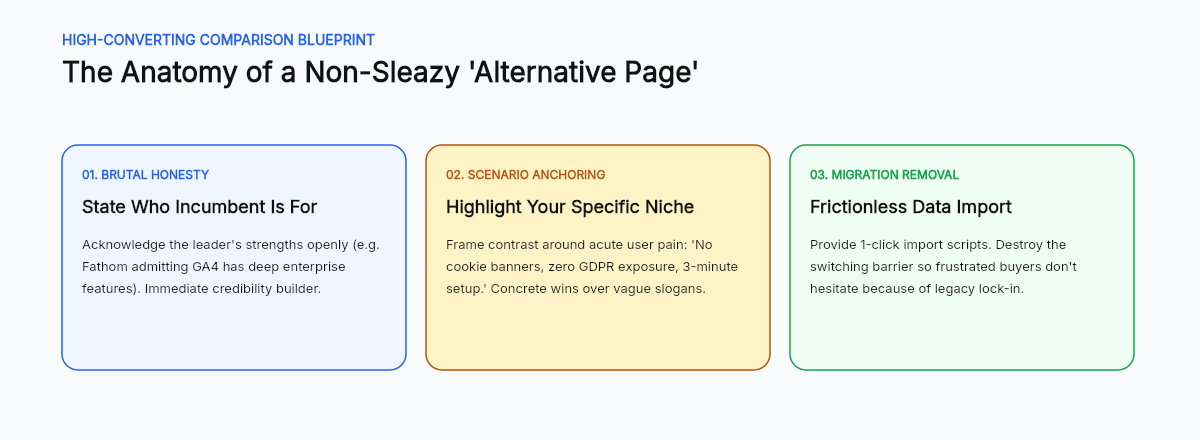
Pillar 1: Brutal Honesty (State Who the Incumbent Is Best For)
Near the top of your comparison page, include a prominent callout:
"When should you choose Competitor?""If your enterprise employs more than 500 team members, mandates complex role-based access controls across dozens of sub-departments, and requires dedicated account managers, Competitor remains the established market choice."
This counterintuitive concession has a powerful psychological effect. Modern buyers are accustomed to aggressive sales pitches. When a company acknowledges an incumbent's legitimate strengths, the reader immediately trusts the claims that follow.
Pillar 2: Scenario-Anchored Contrast (Highlight Your Specific Niche)
Next, define the exact context where your solution excels:
"When should you choose our platform?"
- Avoid vague, generic buzzwords like "We are more intuitive and user-friendly";
- Anchor the contrast around tangible operational pain points: "You do not have to schedule a 30-minute qualification call with an account executive just to see our pricing; our plans start transparently at $29/month." Or: "You do not need two weeks of engineering setup; connect your data in four clicks."
Pillar 3: Frictionless Data Migration
The number one objection preventing an interested buyer from switching platforms is data switching friction: "I have accumulated three years of customer records inside the incumbent tool. Switching sounds great, but migrating all that historical data manually sounds like a logistical nightmare."
Successful challenger brands eliminate this barrier directly on the comparison page:
- Provide automated import scripts: One-click CSV upload or direct OAuth API synchronization that imports historical data in minutes;
- Offer assisted white-glove onboarding: "Subscribe to our annual plan, and our engineering team will handle your complete data migration within 24 hours at zero charge."
Removing switching friction unlocks immediate conversions from buyers who were otherwise resigned to enduring incumbent headaches.
4. The Legal and Compliance Guardrails: How to Compare Competitors Safely
Many founders worry that naming a rival on their website will trigger intellectual property lawsuits or cease-and-desist letters.
Under United States federal law (specifically the Federal Trade Commission's Policy Statement Regarding Comparative Advertising, 16 CFR § 14.15) and fair competition standards in common-law jurisdictions, naming competitors in truthful comparative advertising is fully legal and explicitly encouraged by regulators. Public comparison enhances consumer choice and discourages monopolistic lock-in.
However, protecting your business requires adhering strictly to three operational guardrails:
               [Comparative Advertising Compliance Checklist]
 ─────────────────────────────────────────────────────────────────────────────
  Rule                 Requirement                     Operational Standard
 ─────────────────────────────────────────────────────────────────────────────
  1. Verifiable Facts  All pricing and feature claims  Must be verifiable on the rival's
                       must be documented.            public website or published documentation.

  2. Date Tagging      Include explicit timestamps.    State: "Competitor data recorded on
                                                       [Month, Year] and subject to change."

  3. Brand Disclaimers Acknowledge registered marks.   State: "All trademarks and registered
                                                       names belong to their respective holders."
 ─────────────────────────────────────────────────────────────────────────────
- Stick strictly to factual metrics: Compare public pricing tiers, publicly documented API limits, and explicit platform terms. Never invent unverified rumors or make subjective assertions regarding a competitor's financial stability;
- Include an explicit timestamp: Feature matrices change constantly. Documenting the date of your audit shields your business from claims of intentional misrepresentation if a competitor updates their tiers;
- Maintain a professional tone: Critique architectural choices, pricing structures, and workflow limitations—never attack individual founders, executives, or engineering staff.
5. Integrating Comparison Assets with Modern Research Tools
Maintaining accurate comparison pages across several competitors requires disciplined tracking. Product pricing tiers, feature packages, and terms of service shift throughout the calendar year.
Leading growth teams treat competitors analysis as an ongoing operational habit rather than a one-time copywriting sprint:
- Log monthly snapshots of competitor pricing tables and changelogs using structured market research tools;
- Monitor unvarnished customer feedback across community discussions (such as Reddit and X) to ensure your comparison points address the actual frustrations buyers are experiencing today;
- When an incumbent announces an abrupt price increase or depreciates a popular legacy tier, update your comparison page within 24 hours to capture the resulting spike in alternative search volume.
Summary: Niche Honesty Is the Ultimate Growth Moat
Challenger brands do not need to replace multi-billion-dollar incumbents across every market segment.
Incumbents are bound by the demands of their largest enterprise accounts. In optimizing for enterprise contracts, they inevitably leave mid-tier operators, lean teams, and specialized use cases underserved.
When you build a transparent, respectful comparison page, you extend a welcoming hand to buyers tired of legacy complexity. By presenting an honest accounting of where you shine, you build a resilient, highly profitable customer acquisition engine that outlasts any paid advertising budget.
Sources and date notes
- Federal Trade Commission (FTC) Comparative Advertising Policy:
- Official Regulatory Code: "Statement of Policy Regarding Comparative Advertising (16 CFR § 14.15)"
- Core Principle: Confirms that truthful, non-deceptive comparative naming of competitors is encouraged under federal policy to promote commercial transparency.
- Ahrefs Search Intent & Funnel Economics Research (2025–2026):
- Industry Analysis: "Why 'Alternative' and 'VS' Queries Deliver 4x Industry Average Conversion Rates"
- Methodological Takeaway: Documents that commercial purchasing intent peaks when prospective buyers evaluate side-by-side comparison tables immediately prior to checkout.
- Fathom Analytics Public Growth Engineering Playbook:
- Case Study Documentation: "How We Built Our Google Analytics Alternative Engine"
- Operational Benchmark: Explains the transparent positioning architecture and privacy contrast framework that generated over 30% of organic customer acquisition.
- Harvard Business Review (Competitive Positioning in Niche Markets):
- Strategic Study: "Comparative Positioning for Challenger Brands: Honesty as a Differentiator"
- Strategic Takeaway: Demonstrates that acknowledging incumbent enterprise strengths significantly improves landing page credibility and overall customer conversion.
Notice and fair use statement: Regulatory policy statements, search engine intent research, and SaaS growth case studies referenced herein reflect public domain marketing analysis and consumer research practices. All respective trademarks belong to their corporate owners.
Disclaimer
This article is intended for digital marketing education, competitive positioning methodology, and legal comparative analysis workflow evaluation purposes only. Businesses must adhere to regional comparative advertising standards and intellectual property guidelines.
CTA
Looking to audit competitor positioning and uncover high-converting alternative search opportunities with verified evidence? Explore how ResearchMaster AI maps actionable competitive signals across the public web.