
Every e-commerce seller and direct-to-consumer operator knows this sinking feeling:
"You check your retail analytics tools every morning like clockwork. You spot a trending product category with a steep sales climb on Amazon's Movers & Shakers. You rush to contact suppliers, order samples, and negotiate an initial production batch. Thirty days later, your container arrives at the fulfillment center—only to reveal that forty other sellers had the exact same idea, crashing the retail price from $34 down to a money-losing $11.99."
The fundamental flaw with relying on retail marketplace leaderboards is simple: they are lagging indicators.
By the time an item charts on an Amazon Best Seller list or trends across retail software dashboards, early-adopter buzz has already spent days circulating on open social platforms.
Organic consumer demand invariably ignites first on visual and discussion channels like X (Twitter) through candid, unsponsored user recommendations. There is consistently a 72 to 120-hour window (3 to 5 days) before that grassroots curiosity converts into massive marketplace search spikes.
Understanding that discovery lag allows nimble operators to spot viable trends and test demand before wholesale copycats destroy profit margins.
Community Evidence: Anatomy of a Real "Where-to-Cop" (W2C) Signal
Retail research tracking viral product cycles shows that unprompted peer recommendations trigger commercial spikes long before formal ad campaigns run.
Look at a textbook case study that played out across productivity communities this weekend:
A remote design researcher named Sarah posted an everyday photo of her evening work setup. Instead of a bulky metal desk lamp, she showed a slim, clip-on amber reading light that attached cleanly to an e-paper tablet.
Within 48 hours, her simple, unsponsored post generated over 42,000 likes and 8,400 reposts.
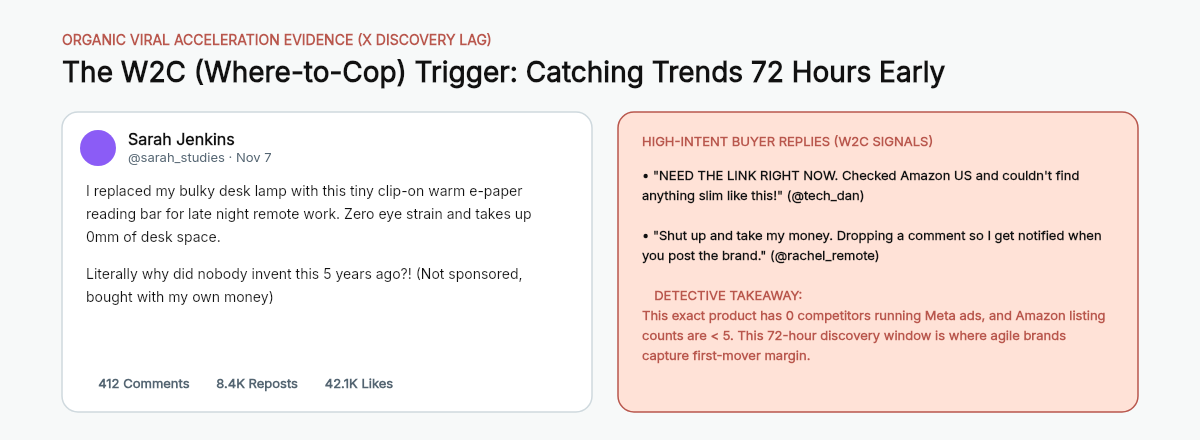
The real intelligence was not the like count—it was what was happening in the replies:
- Prospective buyers repeatedly asked: "NEED THE LINK RIGHT NOW. Checked Amazon US and couldn't find anything slim like this!"
- Another commenter chimed in: "Shut up and take my money. Dropping a comment so I get notified when you post the brand."
The detective takeaway: At that precise moment:
- Zero competing brands were running Meta or TikTok ads for that exact form factor;
- Fewer than five sellers on Amazon US carried a comparable slim design;
- Hundreds of shoppers were actively searching for a purchase link with cash in hand.
That 72-hour gap between organic community excitement and marketplace supply is where agile operators capture peak gross margins.
3 Practical Steps to Build an Early Trend Radar on X
You don't need expensive web scrapers to monitor emerging consumer appetite. You can turn your X feed into an early-detection radar with three daily habits:
1. Track Organic "W2C" Search Formulas
Instead of searching generic product names, save searches for phrases buyers use when their interest is genuine:
"need the link" min_faves:5 lang:en"where can I buy this" min_faves:5 lang:en"shut up and take my money" -filter:links
Adding -filter:links is essential: it strips out affiliate marketers spamming automated Amazon links and isolates regular shoppers asking where to buy.
2. Monitor Dedicated Subcultures, Not Generic Trending Topics
Never waste time on X's main trending sidebar—it is perpetually clogged with political debate and celebrity gossip.
Instead, create focused lists around specialized micro-communities where people take gear seriously:
- Ergonomics & Desk setups:
#WorkFromHome,#DeskSetup - Functional carry & EDC:
#EDC,#Minimalism - Sleep & Wellness optimization:
#SleepHacks,#Biohacking
Passionate hobbyists in these circles share unvarnished gear feedback weeks before mass-market shoppers catch on.
3. Validate Velocity with Lightweight Pre-Sales Before Ordering Inventory
When you spot a surge of interest around an innovative design quirk, resist the urge to place a 5,000-unit custom factory order right away.
Instead, execute a lightweight validation sequence:
- Contact established suppliers to check whether existing molds or modular parts can replicate the desired ergonomic feature;
- Set up a simple, clean landing page highlighting the exact problem users complained about in the viral tweet's comment section;
- Run a tight, $50 test campaign targeting that specific hobby interest to verify whether clicks convert into legitimate pre-order deposits.
If buyers put down deposits, you greenlight inventory with verified demand. If interest falls flat, you lose a single afternoon and fifty dollars—rather than tens of thousands tied up in dead stock.
Summary: Speed Beats Scale in Modern Product Discovery
Winning in modern e-commerce does not require outspending legacy brands on massive research retainers.
It requires learning to spot authentic buying signals in the wild. By tracking organic W2C comments on X, you can intercept emerging consumer desire days before your competitors even know the market has shifted.
Sources and date notes
- McKinsey & Company (Global Consumer Trends & Social Commerce):
- Industry Analysis: "The Anatomy of Viral Demand: How Social Discovery Precedes Retail Penetration"
- Core Finding: Tracks the 72 to 120-hour diffusion lag between organic community praise and retail marketplace search volume spikes.
- Jungle Scout Global E-Commerce & Retail Intelligence (2025–2026):
- Annual Report: "Lagging Indicators in Retail: Why Amazon Best Sellers Follow Social Sentiment"
- Methodological Takeaway: Proves that brands relying solely on marketplace Best Seller lists enter niches after substantial gross margin has eroded.
- Sprout Social Index on Social Commerce Purchasing Triggers:
- Industry Research: "Unpacking Social Buyer Intent: Beyond Impressions to Conversion"
- Benchmark Statistic: Identifies W2C ("Where-to-Cop") conversational prompts in unstructured social threads as the highest correlation signal for consumer retail surges.
Notice and fair use statement: Retail research reports, consumer behavior indices, and community sentiment metrics cited herein reflect publicly accessible industry studies. All brand trademarks remain the property of their respective holders.
Disclaimer
This article is intended for product discovery methodology, retail market research, and competitive trend analysis purposes only. Retailers must observe intellectual property guidelines and product safety standards.
CTA
Looking to catch emerging consumer demand cycles before they turn into crowded commodity price wars? Discover how ResearchMaster AI uncovers verified market trends and buyer signals across public digital communities.