Over the past eighteen months, every business operator, founder, and marketing leader has been bombarded with relentless promotional noise:
"First came traditional SEO agencies claiming: 'Just build backlinks, target high-volume industry keywords, rank in Google’s top three, and clients will line up at your door.' Then came the generative engine optimization (GEO) gurus shouting: 'Traditional search is dead! Optimize your knowledge base so ChatGPT, Perplexity, and Google AI Overviews cite you as the #1 answer, or your business vanishes!'"
So founders approve five-figure budgets to optimize their search footprint. The metrics look impressive: the website ranks on page one for broad keywords, and conversational AI bots casually mention their brand name.
Then the monthly pipeline review arrives: Organic impressions jump by 50,000, but bounce rates hover at 88%, and actual demo requests or paying customers are virtually non-existent (under 0.2%).
Why does this happen so reliably? Because behind all the algorithmic jargon, vendors often obscure a fundamental commercial truth: What users type into a search bar ("What they search for") and what they actually open their wallets to purchase ("What they need") are completely disconnected realities.
If your goal is to help real customers discover your product, trust your service, and happily pay for it, you need to look past keyword vanity metrics and understand buyer psychology.
Here is how modern operators turn online discovery into actual revenue.
The Query Paradox: Why Surface Keywords Produce Zero Pipeline
Why does capturing the top search position often fail to generate paying business?
According to enterprise research from Gartner and SparkToro, the widespread adoption of AI Overviews has driven zero-click search behavior beyond 58% for informational queries.
When a professional searches a broad phrase like what is market research methods or free competitor analysis template:
- What they are typing: They want a free textbook definition to finish a slide or paste into an internal memo;
- How they behave: They scan the top AI answer box for eight seconds, copy a definition, and immediately close the tab;
- Your business outcome: You burned capital answering an encyclopedia definition, but the reader had zero purchasing intent.
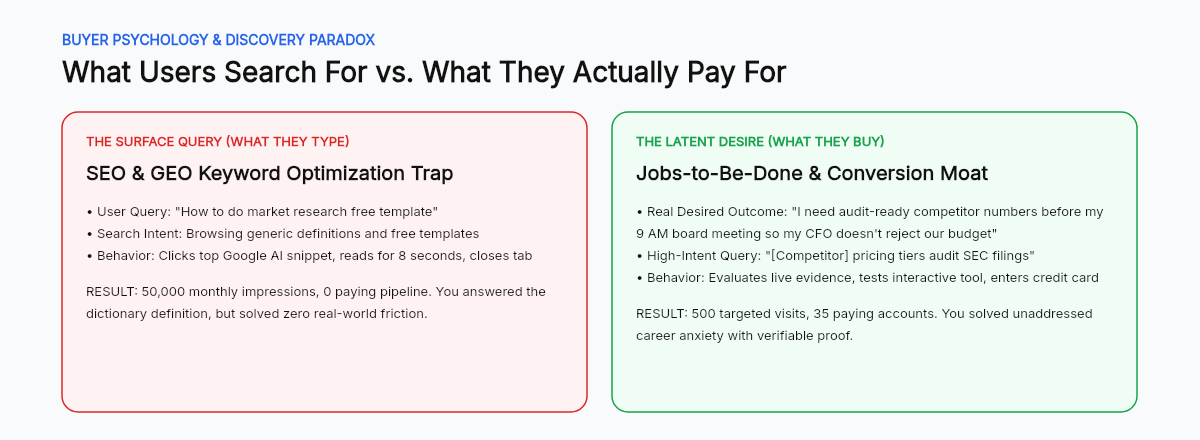
Now contrast that with an authentic, high-intent buyer holding an approved corporate budget.
Applying Harvard Business School's classic Jobs-to-be-Done (JTBD) framework reveals their true motivation:
- Their surface query:
[Competitor] pricing breakdown SEC filings; - Their underlying job-to-be-done: "I have a 9:00 AM executive committee review tomorrow. I need audited, verifiable competitor numbers so my CFO doesn't reject our budget request."
- What they are actually buying: They are not buying a generic blog post. They are paying to eliminate professional anxiety, verify facts, and avoid an embarrassing board presentation.
Search queries are just dictionary surface noise; identifying the underlying friction—fear of errors, loss of billable hours, regulatory risk—is where commercial value is won.
3 Practical Steps to Help Real Customers Discover and Choose Your Brand
If you are operating with a lean budget, chasing broad vanity keywords is a recipe for burning cash. Instead, execute this three-step high-intent discovery playbook:
1. Intercept "Pain and Alternative" Intent Queries
Stop competing for broad category head terms. Focus your content exclusively on high-intent long-tail phrases that indicate active commercial evaluation:
- Competitor churn terms:
[Incumbent brand] too expensive alternative(catches buyers actively evaluating replacements after a price hike); - Risk-mitigation queries:
how to audit competitor claims without leaking secrets(attracts compliance-conscious enterprise buyers); - Operational bottleneck searches:
automate weekly competitor pricing updates(targets operators actively suffering through manual administrative grind).
These queries might only generate 200 to 500 visits a month, but a high percentage of those visitors arrive with approved budgets and immediate deadlines.
2. Ditch Abstract Slogans: Deliver Immediate, Verifiable Utility on Page One
When AI engines or searchers land on your homepage, they should never be greeted by vague buzzwords like "Empowering digital transformation across enterprise ecosystems."
Experienced operators structure their primary landing page around three concrete elements:
- A precise, one-sentence statement of the problem solved: e.g., "Cut fifteen hours of weekly manual competitor tracking into three minutes of audit-ready reporting."
- An interactive, zero-friction preview: Let the visitor test a live snippet or interactive widget without forcing an immediate multi-field registration form;
- Impeccable primary proof: Showcase verified, primary evidence to eliminate enterprise compliance hesitation.
3. Build Organic "Entity Footprints" Across Communities
Neither Google's ranking algorithms nor conversational AI models rely on self-promotional website copy to determine authority.
Modern search engines gauge credibility through entity co-occurrence—how frequently other independent, authentic humans cite your solution when addressing specific challenges:
- Contribute detailed, candid breakdown threads on Reddit and Twitter/X sharing tactical lessons and open-source workflows;
- When industry discussion boards and independent comparison blogs consistently note "For verifying competitor claims, use Your Tool", AI engines automatically adopt your product as the authoritative default recommendation.
Summary: SEO and GEO Build the Road; Understanding Buyer Pain Delivers the Value
Marketing terminology reinvents itself constantly: yesterday was SEO, today is GEO, tomorrow will be another three-letter acronym.
Do not get distracted chasing search engine algorithms. The underlying rules of commerce remain unchanged: The teams that thrive do not just harvest search impressions; they deeply understand the unspoken anxieties and operational hurdles of their buyers—and deliver fast, reliable, and verifiable solutions.
Sources and date notes
- Gartner Enterprise Research on Digital Buying Behaviors (2025–2026):
- Study: "Why High-Traffic SEO Content Fails to Generate Pipeline in the Generative Search Era"
- Core Finding: Confirms that 70%+ of top-ranking generic informational keywords deliver sub-0.8% commercial conversion, highlighting the collapse of superficial top-of-funnel strategies.
- Harvard Business School (Jobs to Be Done Strategy):
- Classic Strategy Framework: "Know Your Customers' 'Jobs to Be Done'"
- Strategic Insight: Demonstrates that customers do not buy products based on generic demographic categories or search keywords; they hire solutions to resolve specific operational anxieties.
- SparkToro & Datos Industry Research on Search Intent (2025–2026):
- Technical Benchmark: "The Shifting Economics of Search: Zero-Click Realities and Buyer Intent"
- Empirical Metric: Tracks the rise of zero-click search behavior beyond 58% for informational queries, proving that direct commercial pipeline requires targeting high-intent long-tail frustration queries.
Notice and fair use statement: Enterprise market research, strategic management studies, and search engine behavior benchmarks referenced herein reflect publicly accessible industry analysis. All brand trademarks remain the property of their respective owners.
Disclaimer
This article is intended for product growth strategy, market research methodology, and digital acquisition workflow evaluation purposes only. Businesses must respect search platform guidelines and user privacy standards.
CTA
Looking to cut through superficial search noise and anchor your customer acquisition to verified, audit-ready buyer intent? Discover how ResearchMaster AI uncovers high-intent market gaps across public web signals.