
Open any technology feed or venture capital report today, and you will encounter a surreal disconnect.
On one side, foundational artificial intelligence lab executives take global stages to unveil autonomous agents, lightning-fast inference pipelines, and reasoning architectures. Behind the curtain, however, quarterly financial disclosures tell a sobering story: billions of dollars in cloud infrastructure and cluster depreciation burning away with no clear timeline to baseline profitability.
On the other side of the fence sits the frontline operator: the bootstrapped software engineer, the lean SaaS founder, and the digital product builder. For this group, the problem is not building. In 2026, spinning up a full-stack web application, orchestrating complex prompt routing, and churning out 500 pages of cleanly formatted documentation takes hours rather than quarters.
Instead, the modern software crisis is existential discovery:
"You build a clean, genuinely useful utility. You connect your model provider's API. You push to production and announce it to the world. Then, reality sets in. The open web is already drowning in an ocean of 10,000 functionally identical 'AI co-pilots.' The first three pages of Google search results are dominated by algorithmic content mills churning out synthetic reviews. You spend your modest marketing budget on paid search or social ads, and your dashboard lights up with 3,000 signups. But within 48 hours, you realize 90% of them were scrapers, bot traffic, or free-tier freeloaders who consumed your costly API tokens without ever pulling out a credit card. Your net conversion rate is 0.28%, and your cloud bill is higher than your monthly subscription revenue."
When code has zero barrier to entry, synthetic content and commoditized wrappers flood every public discovery channel. Professional buyers and everyday consumers have developed an acute, defensive allergy to generic artificial intelligence marketing.
If open search engines are broken, where do serious buyers actually look for tools? And how are profitable indie teams cutting through the noise without multi-million-dollar advertising budgets?
As digital researchers tracking underground traffic migrations across developer ecosystems, we spent the past month analyzing community discussions, web traffic audits, and real customer acquisition playbooks. Here is what is actually happening beneath the hype.
1. The Root Cause: Why Zero Marginal Cost Production Broke Open Web Discovery
To fix distribution, operators must first understand why the traditional growth playbook collapsed so abruptly.
For two decades, the go-to-market playbook for internet software was predictable: identify a target keyword, write comprehensive content, rank on the first page of Google, capture top-of-funnel searchers, and convert a fraction into free trials.
Generative models obliterated this economic equilibrium in three compounding waves.
Traditional Search Funnel:
[User Search Query] ──> [Authentic Independent Review] ──> [Informed Purchase Decision]

Current AI Slop Reality:
[User Search Query] ──> [Automated AI Content Farm] ──> [Synthetic Hallucination] ──> [Buyer Skepticism & Page Abandonment]
1.1 The "Zombie Internet" and the Collapse of Search Trust
When writing a grammatically flawless, keyword-dense 2,000-word article cost $250 in freelance fees, publishers had an economic incentive to prioritize editorial quality. When large language models reduced that cost to $0.003, affiliate spam operations automated programmatic publishing at industrial scales.
Vertical software wikis, software comparison portals, and niche product directories became contaminated almost overnight. Investigative tech publications like 404 Media documented this phenomenon as the transition from an organic web into a "Zombie Internet"—an algorithmic feedback loop where synthetic bots publish AI-generated reviews to capture automated web crawlers.
The consequence for everyday buyers has been devastating: trust in public search results has collapsed.
According to longitudinal search behavior studies by SparkToro founder Rand Fishkin, over 50% of Google queries now result in zero clicks. Modern buyers see AI Overviews, sponsored ad blocks, and generic content mills, and immediately close the tab. The classic approach of using broad market research methods to target high-volume informational keywords now delivers vanity traffic with virtually zero commercial intent.
1.2 The Free-Tier Vanity Trap and Negative Gross Margins
In traditional software, serving a non-paying user costs fractions of a cent in database compute. In AI-powered software, every interaction carries variable model token fees.
Lean teams deploying generous free tiers quickly discover that vanity traffic is financially toxic. When public web channels flood an application with tire-kickers who ask 50 complex questions and leave forever, the founder is effectively subsidizing third-party compute. Without rigorous market analysis of customer readiness before launch, software builders burn working capital on users who will never convert.
2. Community Receipts: What Real Builders and Enterprise Buyers Are Saying
To understand why traditional acquisition channels are failing, you do not need Wall Street equity research. You only need to read the unfiltered post-mortems of developers and tech leads on primary forums like Hacker News and Reddit.
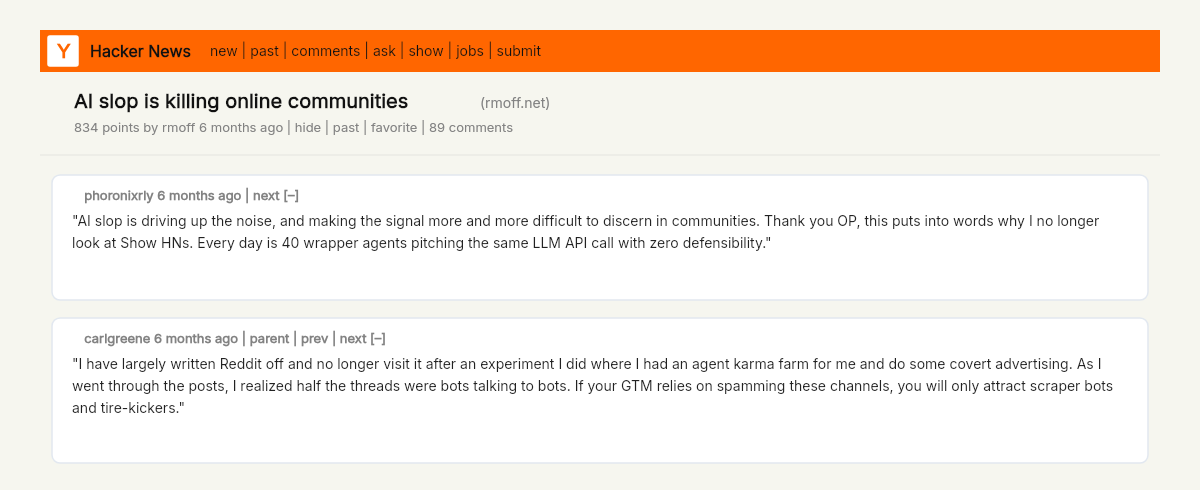
On Hacker News, an extensive technical discussion titled "AI slop is killing online communities" (Item #48053203) struck an immediate nerve across the engineering world, garnering over 830 points and dozens of detailed testimonials:
Consider the direct words of verified engineers navigating this environment:
Developer @phoronixrly on the collapse of discovery platforms:"AI slop is driving up the noise, and making the signal more and more difficult to discern in communities. Thank you OP, this puts into words why I no longer look at Show HNs. Every day is 40 wrapper agents pitching the same LLM API call with zero defensibility."
Founder @carlgreene on the contamination of public social channels:"I have largely written Reddit off and no longer visit it after an experiment I did where I had an agent karma farm for me and do some covert advertising. As I went through the posts, I realized half the threads were bots talking to bots. If your GTM relies on spamming these channels, you will only attract scraper bots and tire-kickers."
These quotes highlight the psychological moat modern software faces: buyers have erected a fortress of skepticism.
If your product landing page looks like a generic Tailwind template, features vague promises of "10x productivity," and hides its core technical mechanics behind marketing fluff, technical buyers will dismiss it within three seconds. They assume it is just another disposable wrapper designed to extract a quick monthly fee before disappearing.
3. The Playbook: How Modern Challenger Brands Build Defensible Discovery
If broad public search and automated social distribution are broken, how are profitable products breaking through?
The teams thriving in late 2026 are not outspending enterprise incumbents on Google Ads. Instead, they are executing an entirely different go-to-market architecture based on Private Trust Graphs, Verifiable Proof, and Workflow Anchoring.
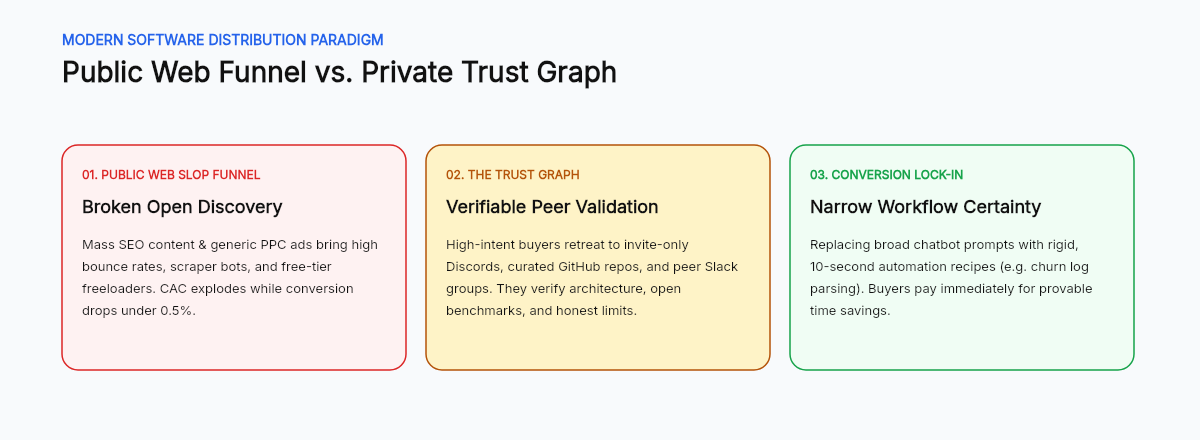
Pillar 1: Abandon the Public Web Funnel for Private Trust Graphs
When public search engines become unreliable, human recommendations retreat into gated, high-trust spaces:
- Specialized Slack & Discord Ecosystems: High-intent corporate buyers and senior engineers spend their working hours inside invite-only community hubs (e.g., dedicated infrastructure channels, specialized growth networks, and localized developer groups). When a founder has spent six months answering technical edge cases honestly in a Discord group, a single organic recommendation from a peer carries more closing power than 50,000 algorithmic impressions.
- Curated Technical Newsletters: Serious practitioners subscribe to vetted, independent substacks and engineering digests that maintain strict editorial standards. Earning coverage from an authentic practitioner who rigorously evaluates tools builds instant, durable credibility.
- GitHub Repositories as Proof-of-Work: When an indie team publishes an open-source evaluation benchmark, an MCP integration script, or a transparent diagnostic CLI on GitHub, technical decision-makers inspect the code directly. Clean code is the ultimate antidote to marketing slop.
Pillar 2: Replace Corporate Slogans with "Brutal Transparency"
In an ecosystem saturated with overpromises, honesty is a radical competitive differentiator.
Modern agile brands conduct thorough competitive analysis and use their findings to be disarmingly candid on their pricing and product pages:
- Explicit Disqualification: State who the tool is not for immediately below the hero header. If your solution is built for solo operators handling PostgreSQL migrations, explicitly state: "If you are a 500-person enterprise requiring SOC2 compliance and Okta SSO, do not buy this; you should use Datadog." This instantly signals maturity and integrity.
- Publish Failure Modes and Limitations: Instead of pretending your AI system is omniscient, publish documented error rates and explain how your fallback mechanisms work. A team that transparently documents when its parser struggles earns ten times more trust than one claiming 99.9% automated perfection.
- Transparent Head-to-Head Comparisons: Rather than vague feature matrices with checkmarks, agile teams run detailed competitor research to compare latency, token usage, and real-world costs side-by-side with industry incumbents.
How to Frame Honest Product Positioning:

Conventional Marketing (Ignored):
"The ultimate all-in-one AI platform to streamline your entire business workflow effortlessly."

Brutal Transparency (Converts):
"A specialized Node script that audits orphaned Stripe subscriptions and exports clean CSVs in 12 seconds. No chat interface. No monthly seat minimums."
Pillar 3: Kill the Open-Ended Chat Box; Anchor to Narrow Workflows
The fastest way to kill conversion on a software product is dropping the user into an empty text prompt and asking: "How can I help you today?"
Empty prompts demand mental effort from exhausted buyers. Furthermore, general-purpose conversational interfaces are easily replicated by frontier labs with every minor model update.
Profitable tools replace conversational uncertainty with narrow, deterministic execution:
- Instead of "AI market research assistant," build a tool that accepts a competitor's domain name, scrapes their public changelog over 12 months, and outputs a five-bullet feature roadmap delta.
- Instead of "AI customer support engine," build a utility that monitors webhook errors from Shopify checkout failures and generates a pre-filled Slack alert for inventory managers.
When a product eliminates a specific, painful operational chore in under 30 seconds, buyers do not hesitate to enter their credit card details. They are not buying artificial intelligence; they are buying guaranteed time recovery.
4. The Checklist: Auditing Your Product Against AI Slop Fatigue
Before launching your next product iteration or marketing campaign, run your distribution strategy through this practitioner audit:
| Diagnostic Question | High Risk (Slop Vulnerability) | Defensible Moat (Trust Driven) |
|---|---|---|
| Discovery Channel | 80%+ reliance on programmatic SEO and cold email blasts | Distribution anchored in developer Discords, GitHub tools, and verified peer referrals |
| Product Interface | Open-ended conversational prompt box | Deterministic 1-click workflow with structured inputs and exportable outputs |
| Pricing Model | Open-ended free tier with unmetered API calls | Reverse trial or credit-card upfront with transparent per-unit unit economics |
| Competitive Stance | Generic claims of "faster and cheaper than everyone" | Rigorous competitor analysis with explicit disqualification of mismatched buyers |
| Technical Proof | Polished mockups and decorative landing page animations | Public GitHub benchmarks, verifiable architecture logs, and reproducible tests |
A professional market research analyst evaluates software investments not by initial traffic spikes, but by the ratio of customer acquisition cost to gross margin retention. If your product relies on vanity metrics generated by automated bots, your unit economics will collapse under real-world pressure.
Summary: Authenticity and Focus Are the Only Enduring Moats
The rapid commoditization of generative code generation has not made software entrepreneurship easier. In reality, it has shifted the battleground from basic software engineering to the far more demanding disciplines of customer empathy, deep market intelligence, and uncompromised personal integrity.
Foundational artificial intelligence labs will continue to spend staggering sums on hardware clusters and model training runs. Big technology conglomerates will continue to bundle generic chat features into every existing enterprise suite.
For the independent builder and challenger team, competing on raw parameter size or brute-force content volume is a fool's errand. Your unfair advantage lies in doing what giant algorithmic engines cannot:
- Stop adding to the noise: Refuse to deploy low-quality programmatic content farms that degrade your brand's reputation.
- Engage as a transparent practitioner, not a salesperson: Share your architecture decisions, document your technical failures, and contribute real utility to focused communities.
- Lock your product into a single indispensable workflow: Solve one acute operational headache with undeniable precision.
When the open web is engulfed in an endless tsunami of synthetic slop, the builder who offers clear, verifiable truth will always command a loyal, paying audience.
Sources and date notes
- Hacker News Community Discussion: AI Slop Is Killing Online Communities (Item #48053203), tracking community erosion, developer filtering mechanisms, and the decay of open Show HN discovery, accessed November 2026.
- 404 Media Investigative Report: Facebook's AI Spam Isn't the 'Dead Internet': It's the Zombie Internet, documenting programmatic synthetic content production and the degradation of open web platforms, accessed November 2026.
- SparkToro Market Insights by Rand Fishkin: Fewer Than Half of Google Searches Now Result in a Click, analyzing zero-click search behavior and open web visibility decay, accessed November 2026.
- Kagi Search Technical Documentation: SlopStop: Community-Driven AI Slop Detection in Modern Web Search, evaluating organic index contamination filters and searcher backlash against content farms, accessed November 2026.
Data and community quotes cited in this article were verified from publicly accessible developer forums and industry benchmark studies conducted between 2024 and late 2026.
Disclaimer
This analysis is intended for product positioning, software distribution strategy, and market research methodology reference only. Software teams, engineers, and founders should conduct independent unit-economic audits and customer discovery before altering pricing structures or go-to-market architectures.
CTA
Struggling to separate authentic market signals from AI-generated noise? Discover how ResearchMaster AI tracks verifiable competitor moves, community friction, and validated buyer intent without relying on synthetic vanity metrics.