The useful question is not simply which U.S. events are coming up in 2026. It is which moments give a brand a credible reason to join a conversation, and which ones deserve research before a team commits time or budget.
The strongest 2025 signals point to a familiar pattern. Live sports can still create unusually broad shared attention. Fandom events create active communities rather than passive viewers. Retail moments create intent, but only when the content makes a decision easier. Cultural events can support a more considered brand story, provided the connection is genuine.
This guide looks at publicly announced U.S. dates that remain ahead in 2026. It is a planning reference, not a forecast of reach or a claim of affiliation with any event.
What 2025 made clear
The biggest event moments do not all behave alike. The 2025 Super Bowl, for example, reached an average cross-platform audience of 127.7 million, according to Nielsen. That is evidence of a rare shared-attention moment. It does not mean every brand should treat sports as its social strategy.
Other moments work because they provide a longer runway. A convention gives fans, creators, exhibitors, and media several weeks of anticipation and follow-up. A retail calendar date gives people a reason to compare, shortlist, and buy. A design or arts event can create room for product, place, or craft stories that would feel out of place in a game-day post.
The practical takeaway for market trends analysis is to evaluate an event by the shape of the conversation, not by its name alone.
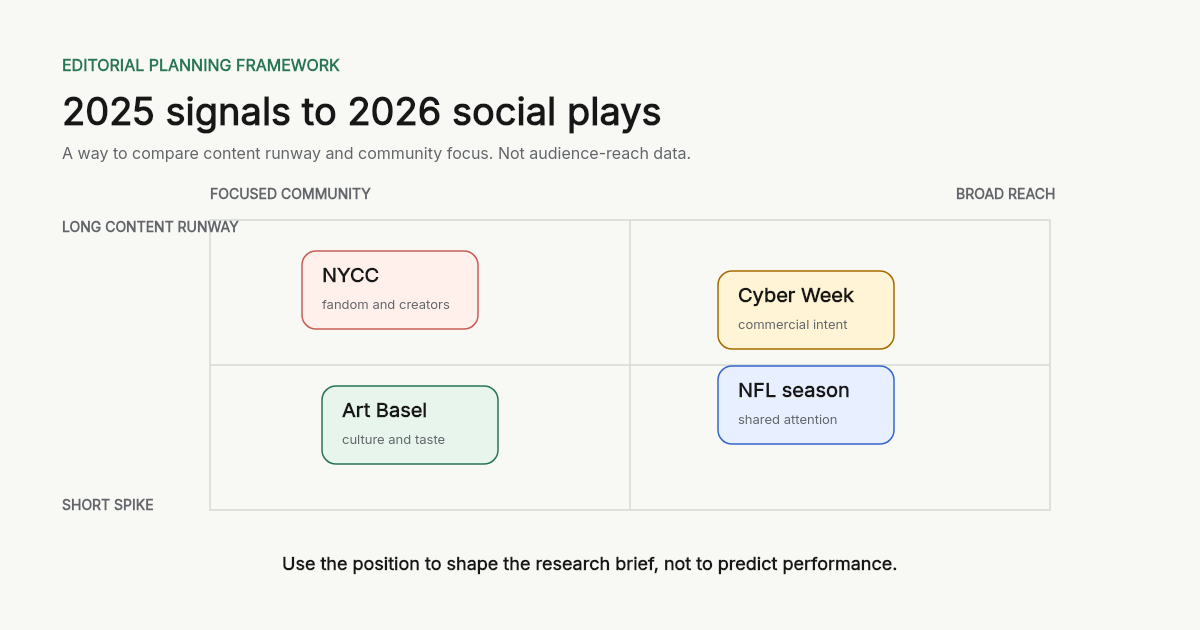
Editorial planning framework only. The positions describe likely content dynamics, not measured social reach or audience size.
U.S. upcoming events to watch in late 2026
NFL season: a broad, recurring attention cycle
The official NFL schedule lists the 2026 season beginning on September 10. For social teams, the useful unit is rarely one game. It is the recurring rhythm of opening week, local rivalries, watch-party behavior, player and fan conversations, and seasonal storylines.
This is most relevant for brands that have a legitimate local, audience, or product connection. A restaurant might research neighborhood watch habits. A consumer app might test a regional creator brief. A B2B company may find that an internal customer community has its own game-day culture. Without that connection, generic sports commentary is usually easy to ignore.
New York Comic Con: high-participation fandom
New York Comic Con is scheduled for October 8-11, 2026, at the Javits Center. Its value is not just attendance. It is the concentration of fandom, creator work, collecting, cosplay, publishing, games, and community-made content around a shared set of interests.
That makes it a useful research point for teams working with enthusiast audiences. Before joining the conversation, study which communities already discuss your category, what terms they use, and which participation boundaries matter. A campaign that treats fandom as a generic visual style will feel thin quickly. A campaign built with creators or real customer communities has a clearer reason to exist.
Black Friday and Cyber Monday: intent needs useful content
In 2026, Black Friday falls on November 27 and Cyber Monday on November 30. These dates do not need an organizer to matter; they are established decision points in the U.S. retail calendar.
The opportunity is not limited to promotion. Buyers are often sorting options, checking compatibility, comparing pricing, or looking for confidence before a purchase. Helpful guides, comparison tools, customer proof, and honest inventory information can serve that need better than another countdown graphic.
For market research analysis, look beyond last year's conversion total. Review the questions customers asked, the products they compared, the objections that held them back, and the competitor messages that appeared at the same time. This turns a seasonal campaign into a better source of customer evidence.
Art Basel Miami Beach: culture, design, and place
Art Basel Miami Beach is scheduled for December 4-6, 2026. It is a more selective opportunity than a major sports or retail moment, but it can suit brands connected to design, hospitality, travel, fashion, collecting, or creative work.
The standard should be higher here. A visual reference alone is not a strategy. Research whether the brand has a credible point of view, a relevant audience in the city, or a partnership that adds something to the experience. The most useful content may be an informed local guide, a maker story, or a small program that helps people discover work, rather than a superficial event reference.
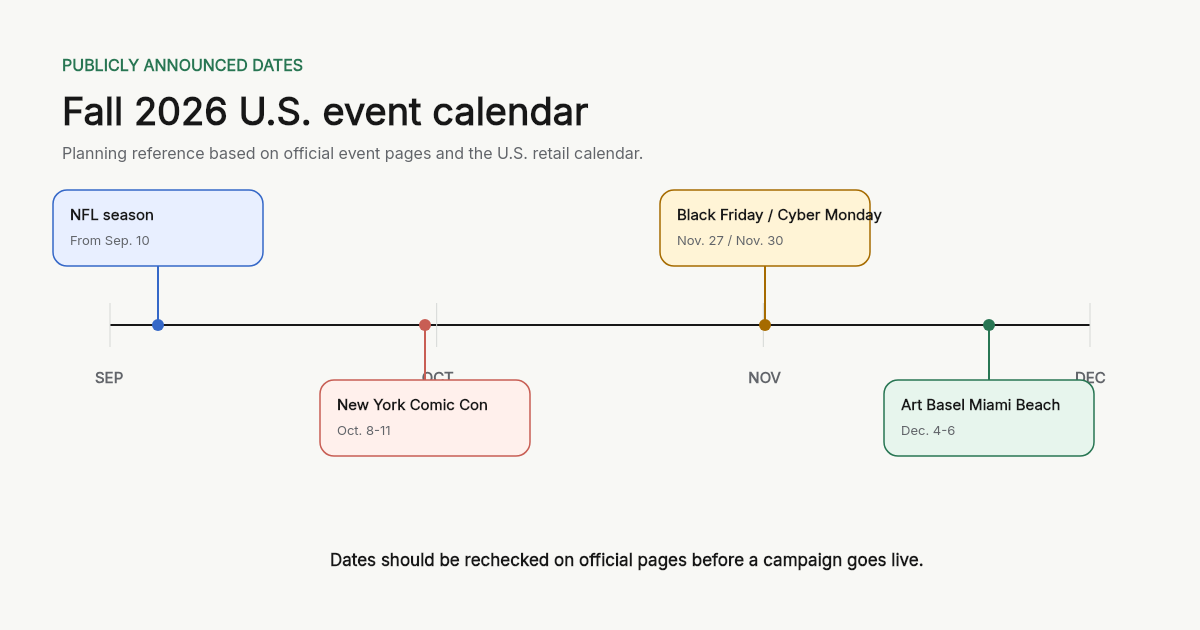
Dates are based on official event pages and the U.S. retail calendar. Recheck them before publishing or buying media.
Turn anticipation into a research brief
An event calendar is a starting point, not a strategy. Before choosing a moment, ask four questions:
- Audience fit: Is there a specific customer group that already cares about this moment?
- Content runway: Is there something useful to say before, during, and after the date?
- Commercial path: Does the content support a real customer task, such as discovery, comparison, purchase, or retention?
- Participation boundaries: Can the team join without implying sponsorship, using protected marks, or borrowing someone else's creative work?
These questions keep an event plan grounded. They also help explain why a smaller community moment can be more valuable than a much larger event with no relationship to the brand.
A practical workflow with ResearchMaster AI
ResearchMaster AI can help turn an event idea into a source-backed working brief. Start with the official event page, then add past campaign materials, relevant social posts, competitor examples, customer feedback, and internal notes. The goal is not to generate a themed post on demand. It is to establish what the audience cares about, what has already been overused, and where the brand can contribute something useful.
Use market data analysis to keep operational signals separate from opinion: dates, event rules, product availability, regional demand, campaign performance, and audience behavior should not be treated as the same kind of evidence. A research workflow can then label confirmed facts, reasonable inferences, and open questions for a human reviewer.
For a team building several seasonal plans, that evidence can be shared as a report, a concise brief, or presentation-ready output. The underlying work remains important: verify primary sources, respect intellectual-property rules, and make the final editorial decision with the people who know the audience.
Final view
The late-2026 calendar offers several different kinds of opportunity: broad recurring attention around the NFL season, active participation around New York Comic Con, purchase intent during Cyber Week, and a selective cultural context around Art Basel Miami Beach. None is automatically right for a brand.
The teams most likely to get useful results will begin with fit, evidence, and a contribution to the audience. That is where a small amount of disciplined event research can be more valuable than trying to appear in every major conversation.
Sources and date notes
- Nielsen: Super Bowl LIX draws 127.7 million viewers, published February 2025. Used as a 2025 shared-attention signal.
- NFL schedules, 2026 season schedule. Accessed September 9, 2026.
- New York Comic Con, October 8-11, 2026, Javits Center, New York. Accessed September 9, 2026.
- Art Basel Miami Beach, December 4-6, 2026. Accessed September 9, 2026.
- Black Friday and Cyber Monday dates are calculated from the 2026 U.S. Thanksgiving calendar: November 27 and November 30, respectively.
This article uses public dates and general planning observations. It is not affiliated with, endorsed by, or sponsored by the NFL, New York Comic Con, Art Basel, or their organizers. Names are used only to identify the public events discussed.