
Every analyst, consultant, and market researcher who spends significant time investigating emerging verticals has experienced a bizarre moment of digital disorientation recently:
"You receive an assignment to size up an obscure niche market—say, specialized industrial resins or automated cold-chain shelving. You fire up your search engine, and the top three results look impeccably authoritative. They all claim the sector hit $4.2 billion in 2025 and is projected to reach $9.8 billion by 2032 at an exact 12.8% CAGR. The formatting is pristine. The bullet points are crisp. Even competing blogs cite the identical figure. But when you try to locate the original methodology—the sample size, the survey cohort, the field auditor—you hit a ghost trail. Site A links to Site B; Site B quotes Site C; and Site C turns out to be an programmatic content farm generated in ninety seconds by an uncalibrated language model running on an automated script."
This isn't an isolated headache for digital hobbyists. Over the past 48 hours, a widely discussed investigative report highlighted by European tech journalists and technical forums shed light on a troubling pattern: thousands of community databases, technical wikis, and vertical reference sites are being flooded by uncontrolled batches of unverified synthetic content—widely dubbed "AI slop".
When autonomous content engines churn out thousands of hallucinated summaries to capture long-tail search impressions, blind trust in first-page web aggregations becomes dangerous. Building corporate strategy or capital allocation on unverified web sweeps is building on quicksand.
To keep your research intact, let's explore why synthetic drift occurs, how recursive data loops pollute common sources, and how leading intelligence teams enforce data hygiene.
The Technical Anatomy: Why Web Sourcing Faces Recursive Model Collapse
To protect your strategic deliverables from synthetic data drift, you first need to understand the structural loop corrupting open web references:
                  [The Vicious Cycle of Synthetic Data Drift]
 ───────────────────────────────────────────────────────────────────────────────
  Era               Data Transmission State          Downstream Impact on Research
 ───────────────────────────────────────────────────────────────────────────────
  • Human Era       Field surveys, primary audits,   Verified methodology, verifiable
    (Pre-2023)      SEC 10-K filings, interviews.    sample sizes, clear statistical bounds.

  • Automated Rush  Programmatic farms publish       Tens of thousands of synthetic
    (2024–2025)     millions of SEO articles.        reports filled with hallucinated metrics.

  • Web Ingestion   Crawlers ingest synthetic        Hallucinated figures become consensus
    (2026)          articles to retrain LLMs.        signals across search snippets.

  • Terminal Risk   Analysts paste unvetted scrapers Strategic decks misinform executive
    (Present Day)   directly into boardroom decks.   capital allocation and M&A pipelines.
 ───────────────────────────────────────────────────────────────────────────────
In peer-reviewed research published in Nature, computer scientists demonstrated that training artificial intelligence recursively on synthetic text causes "model collapse"—a degenerative mathematical phenomenon where rare truths vanish and statistical artifacts compound.
When automated publishing tools scrape one another without human-in-the-loop validation, they manufacture artificial consensus. An ungrounded projection generated as pure text continuation can bounce across three secondary blogs until a search crawler indexes it as accepted fact.
If your competitive intelligence team relies on basic browser copy-pasting or generic chat interfaces without primary source auditing, you risk presenting algorithmic fiction as strategic insight.
Three Telltale Signatures of Synthetic AI Slop in Market Intelligence
Spotting automated web noise doesn't require deep cryptographic forensic software. Sophisticated analysts look for three common behavioral giveaways:
1. The "Ghost Methodology" (Clean Numbers with Zero Lineage)
Legitimate market sizing and consumer survey initiatives always document their constraints. A real research agency details respondent demographics, geographic weights, survey intervals, and margin of error.
Synthetic content farms invariably bypass this legwork. They present precise figures—such as "83.4% of procurement officers"—while omitting who was polled, which quarters were measured, or which entity underwrote the field study.
2. Circular Citation Traps
When vetting an unfamiliar competitive metric, trace the hyperlinked breadcrumb trail backwards through three hops:
- If hopping through the references leads in an infinite loop back to an anonymous SEO aggregator with no corporate physical footprint, or dead-ends at a generic landing page, you are looking at synthetic web debris.
3. Chronological Anachronisms
Because large-scale text remixing draws from disparate historical snapshots, automated articles regularly trip over timeline coherence. You will often spot an article labeled "2026 Market Outlook" citing statutory compliance guidelines or product lines that were decommissioned years earlier.
The Solution: A Three-Tier Data Defense Framework for Modern Research Teams
Forward-thinking research and corporate strategy groups don't abandon web-based discovery; instead, they modernize their techniques of market survey and screening protocols.
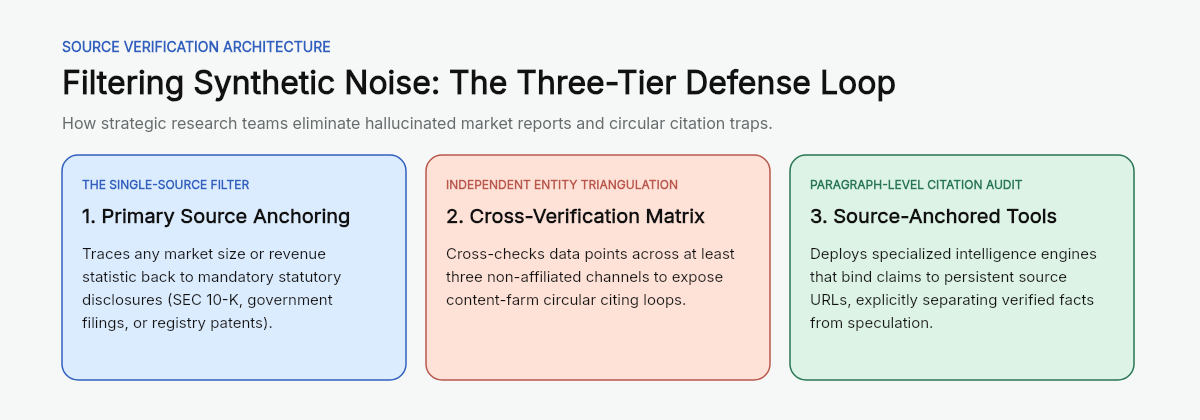
Tier 1: Primary Source Anchoring
Establish a firm baseline across your team: no metric enters a client deliverable or executive briefing unless anchored to primary legal, financial, or regulatory filings.
- For publicly traded rivals, cross-reference revenue and unit sales against official quarterly disclosures (SEC Forms 10-K and 10-Q).
- For regulatory and trade benchmarks, inspect the docket numbers in official governmental gazettes.
- If a market projection appears solely on third-party aggregators without primary attribution, flag it explicitly as unverified secondary commentary.
Tier 2: Independent Triangulation Matrix
When assessing private company traction or emerging market spend where formal filings are unavailable, mandate evidence from at least three disconnected observation planes:
- First-party disclosures or recognized trade associations;
- Unvarnished practitioner discussions in practitioner communities (such as technical subreddits, specialized Discord channels, and verified peer buyer forums);
- Authoritative independent intelligence databases (such as verified regulatory filings or peer-reviewed institutional analyses).
If figures across these independent vectors diverge sharply, document the delta transparently rather than averaging contradictory numbers to force artificial consensus.
Tier 3: Evidence-Linked Market Intelligence Tools
Retire unstructured conversational bots for high-stakes intelligence gathering. Generic conversational models are designed to generate pleasing, fluent prose, making them susceptible to smoothing over missing data with convincing fabrications.
Modern strategy teams deploy specialized market intelligence tools and purpose-built market research tools that enforce sentence-level source anchoring. By pairing automated synthesis with immutable web archive snapshots, researchers can verify every competitive claim down to its original paragraph.
Summary: In an Ocean of Synthetic Noise, Traceability is the Ultimate Edge
Generative computing has driven the marginal cost of text production to zero, but it has made provable fact verification and source lineage exponentially more valuable.
Undocumented secondary claims and automated content aggregations are declining in reliability. The competitive advantage in modern industry analysis belongs to teams equipped with disciplined evaluation habits—turning rigorous verification into their strongest strategic moat.
Sources and date notes
- Eurogamer Investigative Report (November 2026):
- Investigative Article: "AI fan wikis riddled with errors are muddying the waters of digital culture"
- Core Empirical Findings: Documents the widespread degradation of community reference sites and public wikis as automated scraping and generation tools inject unvetted claims into indexed search results.
- Nature Publishing Group (Peer-Reviewed Academic Finding):
- Scientific Research: "AI models collapse when trained on recursively generated data" (Nature 631, pp. 755–759)
- Foundational Finding: Formally demonstrates how recursive consumption of ungrounded synthetic text degrades informational variance and precipitates systemic model failure.
- Gartner Enterprise Research on Sourcing Integrity (2026):
- Research Advisory: "Protecting Corporate Intelligence from Synthetic Web Drift: Sourcing Standards for Strategic Decisions"
- Operational Framework: Highlights multi-vector cross-verification and verified evidence anchoring as essential compliance standards for modern corporate intelligence units.
Notice and fair use statement: Investigative reports, academic papers, and enterprise frameworks referenced herein reflect publicly available documentation and methodology guidelines. All registered marks and product designations remain the property of their respective holders.
Disclaimer
This article is intended for competitive intelligence methodology evaluation, information security auditing, and market research workflow planning purposes only. Data authenticity risks and synthetic content generation rates fluctuate across web indexing engines and domain verticals.
CTA
Looking to insulate your strategic planning from synthetic web noise and hallucinated sources? Explore how ResearchMaster AI binds every market claim to verified, audit-ready primary evidence.