AI has become part of shopping, but it has not replaced the shopper's judgment.
VML's Future Shopper 2026 study found that 82% of consumers have used AI. Yet the same study found that 58% cross-check AI-generated product recommendations before buying, and 33% would not allow AI to make purchases on their behalf.1 That combination matters more than the headline adoption number.
Consumers are using AI to compress research time. They ask it to compare laptops, summarize reviews, interpret specifications, and narrow a confusing category. But many still want proof before they spend money. The gap between using AI and relying on AI is where ecommerce, retail, and consumer research teams should focus.
The difference between adoption and reliance
Many reports collapse AI shopping into a single metric: "Do consumers use AI?" That question is too broad to be useful.
The more useful question is where a shopper is in this sequence:
- Exposure. The brand appeared in an AI answer, sponsored module, or shopping assistant.
- Use. The shopper asked AI to compare options, summarize evidence, or build a shortlist.
- Reliance. The shopper trusted the answer enough to buy, sign up, or act without additional checks.
Those three stages have different business meanings. Exposure can inflate a report. Use shows research intent. Reliance gets closer to revenue.
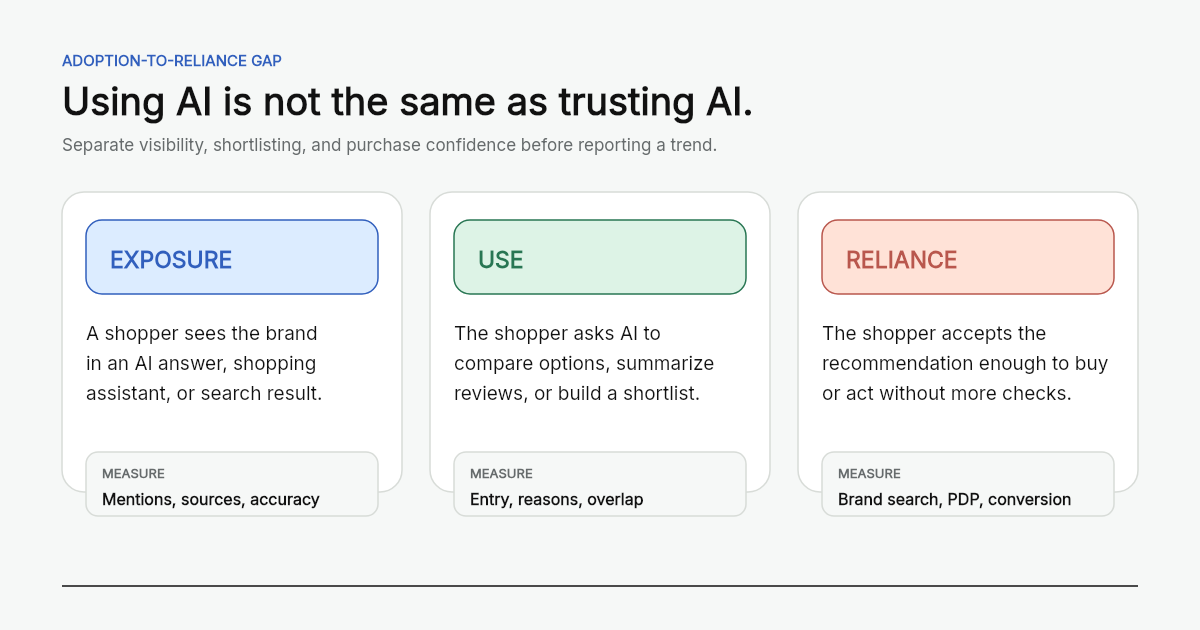
The important metric is not whether a brand appears. It is whether the recommendation survives the shopper's own verification process.
The data points to confidence, not abandonment
VML's research, based on 28,000 consumers across 17 countries, describes a market where AI use is common but conditional.1
| Signal | What it means |
|---|---|
| 82% have used AI | AI has entered everyday consumer behavior. |
| 58% cross-check AI-generated product recommendations | AI is a research input, not the final authority. |
| 49% say AI-generated product imagery reduces brand trust | Synthetic presentation has a trust cost. |
| 48% skip content they believe was made with AI | Poorly disclosed AI content can suppress engagement. |
| 53% worry AI shopping tools are commercially influenced | Shoppers suspect ranking may be paid. |
| 55% say sponsored search results make it harder to find the best products | Commercial signals can create decision friction. |
| 33% would not allow AI to buy for them | Autonomous purchasing remains a boundary. |
Read together, the numbers describe a confidence gap. Consumers are not rejecting AI. They are deciding where AI belongs in the purchase journey.
This is also why "AI shopping is growing" is an incomplete sentence. Discovery is growing. Comparison is growing. Prompt-based research is growing. Autonomous purchasing is not growing at the same speed.
Shoppers set different trust boundaries by purchase risk
A shopper may let an AI assistant identify cheap replacement filters, but hesitate when the same assistant recommends a laptop, car part, supplement, or high-ticket service. The difference is consequence.
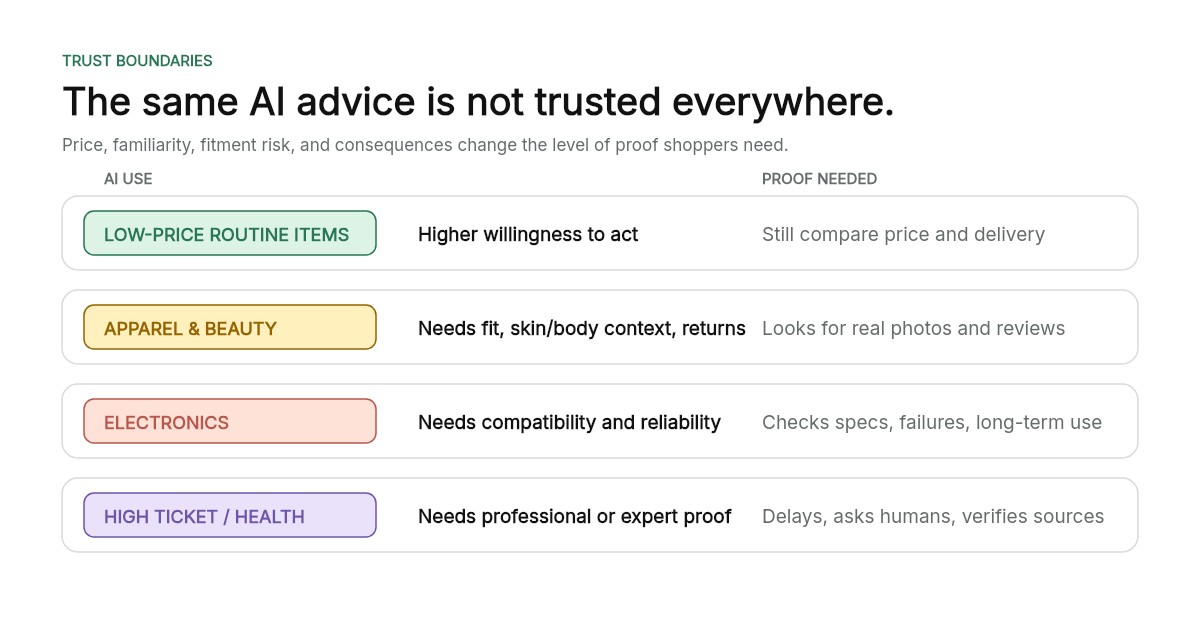
The proof needed before purchase changes with price, fitment risk, familiarity, and consequences.
For low-price, repeatable products, a quick AI answer may be enough. For apparel and beauty, shoppers need fit, skin tone, body type, and return-policy context. For electronics, compatibility and reliability matter. For high-ticket or health-related purchases, shoppers often delay, ask humans, or look for official documentation.
That means a single "trust in AI" score hides the most useful insight. Teams should ask: trust for what task, at what price, from which brand, and with what evidence?
Public discussion shows the same friction
Survey data gives scale. Public discussion gives language. Both are useful when kept separate.
In one Hacker News discussion about shopping with AI, a user wrote that they had used ChatGPT and Claude to cross-shop products ranging from HVAC systems to car modifications and exercise equipment. They described AI tools as okay for recommendations that could be researched further, but "TERRIBLE" at confirming fitment or providing the confidence needed to go from "this is interesting" to "checking out in a shopping cart."2
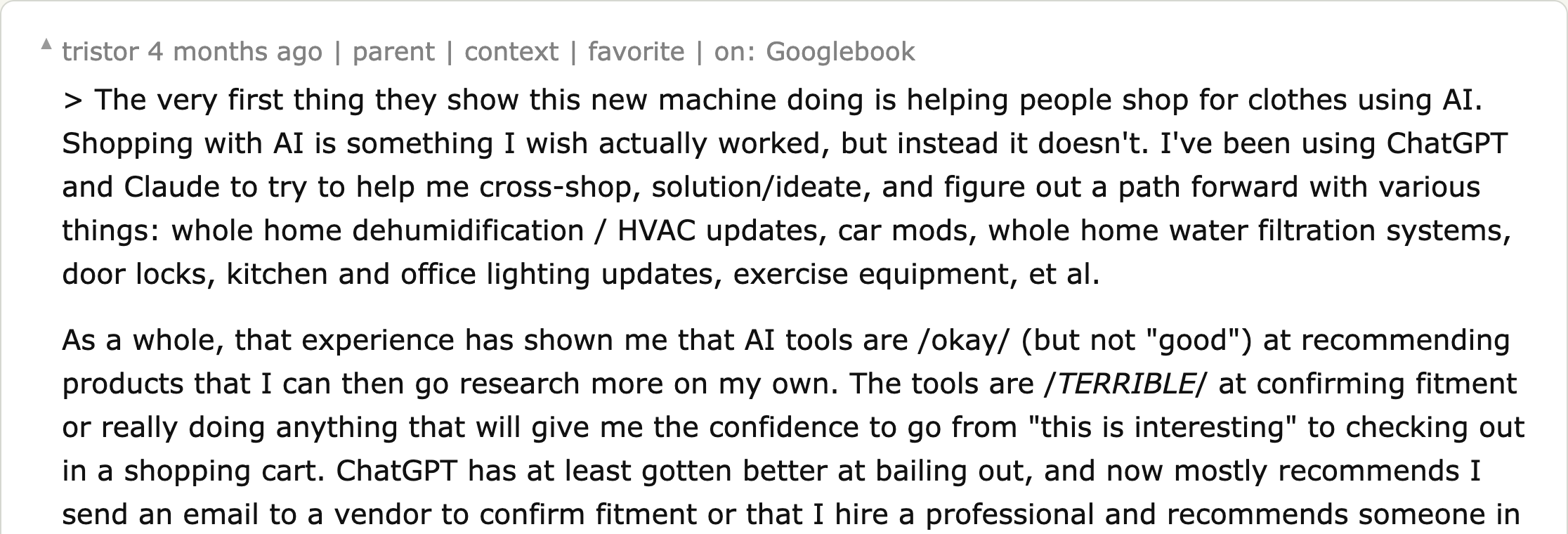
Source: Hacker News comment by tristor, accessed September 23, 2026.2 Used as a qualitative signal, not a representative sample.
That comment is useful because it identifies the exact break point. AI can generate plausible options, but the shopper still needs compatibility, installation, warranty, sizing, or fitment evidence before checkout.
Commercial suspicion appears in public discussion too. Another Hacker News commenter asked whether a product recommendation inside an AI answer could be paid placement: "It says 'Buy X from Acme'. Is that paid product placement? Who knows?"3

Source: Hacker News comment by bradley13, accessed September 23, 2026.3 Used as a qualitative signal, not a representative sample.
These comments are not market statistics. But they show the same pattern found in survey data: shoppers may appreciate faster discovery, yet they remain alert to missing context and commercial influence.
Sponsored exposure makes measurement harder
VML found that 53% of consumers worry AI shopping tools are commercially influenced, and 55% say sponsored search results make it harder to find the best products.1
That creates a measurement problem. If an AI answer contains a paid placement, an organic mention, a user-generated review, and a competitor comparison, those are not equal signals. A brand can be:
- cited as an organic source;
- mentioned in an AI summary;
- included in a sponsored module;
- recommended with the wrong price or specifications;
- excluded from the shortlist entirely.
Each outcome should be reported separately. Treating all of them as "AI visibility" turns a research question into a vanity metric.
Gartner's B2B research shows a similar pattern in a different context. In a survey of 645 B2B buyers, buyers used an average of seven information sources during a recent purchase, and 45% used GenAI. But 69% turned to sales reps to validate AI-generated insights.4 Gartner also found that 51% of buyers said they were more likely to encounter misleading information from GenAI.4
The buyer type is different, but the lesson transfers: faster access to information does not automatically produce confidence. Validation remains part of the decision.
Measure the journey, not one prompt
AI shopping research should connect what the model says to what the shopper does next.
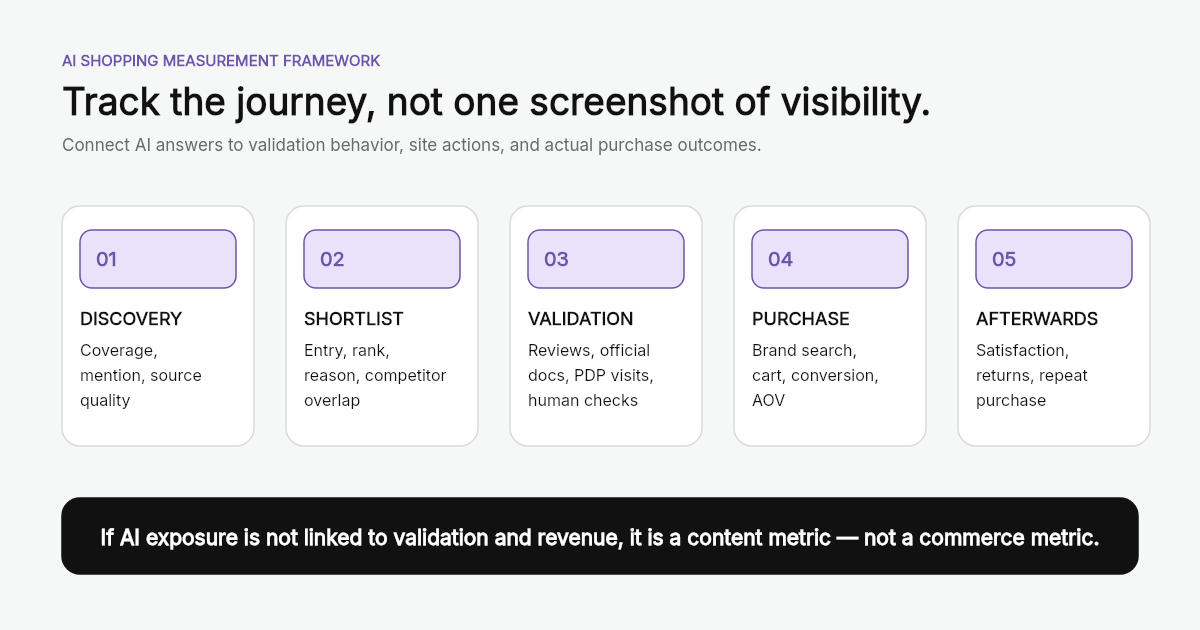
Use the journey as the reporting frame, not one screenshot of AI visibility.
| Journey stage | Shopper question | Metrics to collect |
|---|---|---|
| Discovery | "What options exist?" | AI answer coverage, brand mentions, source quality, competitor overlap |
| Shortlist | "Which ones fit me?" | Shortlist entry, ranking, recommendation reason, price context |
| Validation | "Can I trust this?" | Review clicks, official documentation visits, PDP sessions, community checks |
| Purchase | "Should I buy now?" | Brand search, cart adds, checkout completion, revenue, discount dependence |
| Post-purchase | "Did I choose well?" | Satisfaction, returns, repeat purchase, complaint themes |
If your report stops at brand mentions, it misses the most important part of the decision.
Ask better research questions
"Do you trust AI shopping advice?" is too broad. A shopper may trust AI for routine replenishment and distrust it for a $2,000 purchase.
Better questions include:
- What was the last product you researched with AI?
- What did the AI recommend, and why?
- What did you click, read, or check after that answer?
- Did the recommendation mention limitations or alternatives?
- Did you see anything that made you suspect advertising?
- What proof would make you buy without asking a human?
- What proof would make you abandon the recommendation?
These questions separate research behavior from preference and confidence. They also reveal the evidence shoppers need before they move from interest to purchase.
Run a small AI shopping panel
Teams can start with a repeatable test instead of a large annual study.
- Build 30-50 prompts based on real purchase questions.
- Group them by price range, product risk, brand familiarity, and buyer intent.
- Include discovery, comparison, objection, pricing, and after-sales questions.
- Run the same prompts across the AI tools your buyers use.
- Save the full answer, model or version, date, links, and sponsored modules.
- Mark every brand and competitor appearance as organic, paid, unclear, or inaccurate.
- Compare the AI output with brand search, PDP visits, cart adds, and completed purchases.
After one cycle, you will know more than whether your brand appears. You will know which claims are stable, which answers omit important context, and where validation behavior begins.
What brands should change
Replace adjectives with decision evidence
Phrases like "premium quality," "trusted by customers," and "best-in-class" do not help a shopper choose. Specific comparisons do:
- who the product is for;
- who should choose an alternative;
- compatible sizes, models, or environments;
- what happens after installation or purchase;
- warranty, returns, service, and support;
- how claims are supported.
Make validation easier
Shoppers will verify anyway. If the evidence is hard to find, they will rely on third-party summaries, marketplace reviews, or community threads. Give them the useful proof where they can inspect it: specifications, compatibility notes, limitations, return terms, and representative customer scenarios.
Be careful with AI-generated presentation
VML's finding that 49% of consumers say AI-generated product imagery reduces brand trust should make marketing teams pause.1 AI can help explain options, but synthetic imagery or synthetic-seeming reviews can create the impression that the brand is hiding something.
Separate paid from organic
If an AI shopping surface includes sponsored placement, label it clearly. If your own reporting mixes paid and organic appearances, stop. The two create different expectations and different risks.
Common mistakes
Treating usage as trust
A shopper can use AI ten times and still verify every recommendation. Usage measures research effort, not confidence.
Treating mention as recommendation
AI may mention a brand while describing its limitations, placing it in the wrong category, or recommending a competitor first.
Treating one prompt as a benchmark
Small prompt changes can alter the product set, ranking, and caveats. Use a panel of prompts over time.
Ignoring the validation layer
The most valuable signal is often what happens after the AI answer: the review read, the PDP visited, the support question asked, or the cart abandoned.
The practical takeaway
AI shopping is growing because it solves a real problem: buyers want to reduce research time. But shoppers have not handed over the purchase decision.
They still check whether the recommendation fits their constraints. They still look for evidence beyond the answer. They still distinguish between useful synthesis and commercial persuasion.
For research teams, that means measuring exposure, use, validation, and purchase separately. For brands, it means making the proof behind a recommendation easier to inspect.
The brands that win the next phase of AI shopping will not simply be the ones most often mentioned by AI. They will be the ones whose claims survive the shopper's verification process.
Sources and date notes
Demand note: Google Trends showed U.S. interest in "AI shopping" with a 30-day average score of 51 and related interest in "AI shopping assistant" at 85 during the reviewed period.5 VML's Future Shopper data showed the adoption-to-reliance gap described above.1 Hacker News comments were used only to illustrate public reasoning and skepticism.23
Disclaimer
This article discusses public research and community discussion. It does not predict the performance of any platform, brand, or campaign. VML and Gartner findings reflect their stated methodologies and samples; Hacker News comments are individual opinions and should not be treated as representative consumer data.
CTA
If you need to connect AI answers, shopper validation, and revenue evidence in one research workflow, use ResearchMaster AI to organize sources, preserve citations, and turn scattered signals into a traceable report.
Footnotes
- PR Newswire / VML, "Business AI Race Is Outpacing Consumer Reality, VML's Future Shopper Report Finds," September 17, 2026, English, https://www.prnewswire.com/news-releases/business-ai-race-is-outpacing-consumer-reality-vmls-future-shopper-report-finds-302881166.html . Future Shopper 2026 drew on research with 28,000 consumers across 17 countries. ↩ ↩2 ↩3 ↩4 ↩5
- Hacker News, comment by tristor, accessed September 23, 2026, English, https://news.ycombinator.com/item?id=48122437 . Used as a qualitative public-discussion signal, not a representative sample. ↩ ↩2 ↩3
- Hacker News, comment by bradley13, accessed September 23, 2026, English, https://news.ycombinator.com/item?id=48305409 . Used as a qualitative public-discussion signal, not a representative sample. ↩ ↩2 ↩3
- Gartner, "Gartner Survey Finds 69% of B2B Buyers Turn to Sales Reps to Validate AI-Generated Insights," May 20, 2026, English, https://www.gartner.com/en/newsroom/press-releases/2026-05-20-gartner-survey-finds-sixty-nine-percent-of-b-two-b-buyers-turn-to-sales-reps-to-validate-ai-generated-insights . The survey covered 645 B2B buyers and was conducted from August through September 2025. ↩ ↩2
- Google Trends, "AI shopping," United States, accessed September 23, 2026, English, https://trends.google.com/trends/explore?date=today%201-m&geo=US&q=AI%20shopping ↩