As direct-to-consumer (DTC) brands and expanding software startups enter overseas markets, a costly new blind spot is emerging: predatory research agencies and fake brand review services.
On the professional market research forum r/Marketresearch, a business founder recently shared a warning that resonated across the community:
"I recently paid a firm for a brand review but they’ve ghosted me completely... Their FAQs say the review timeline is 45 days, but that’s a long time to wait with zero communication. Is this a reputable service?"1
That experience is becoming all too common. Across social media platforms like TikTok, LinkedIn, and Instagram, self-proclaimed "market research boutiques" promise comprehensive product audits, competitive landscape analyses, and creator endorsements.
Yet after collecting upfront fees, many of these entities either vanish entirely or hand over a generic, AI-generated slide deck built on fabricated survey numbers.
Hiring an external research partner is supposed to reduce strategic risk. If your procurement process fails to catch red flags early, you end up paying thousands of dollars for flawed data that can derail your entire product launch.
Here is a practical, five-step due diligence checklist to help brand buyers vet external market research agencies and safeguard their budget.
The 5 major red flags of a predatory agency
Before sending a deposit or signing a statement of work (SOW), pause immediately if the agency exhibits any of these warning signs:
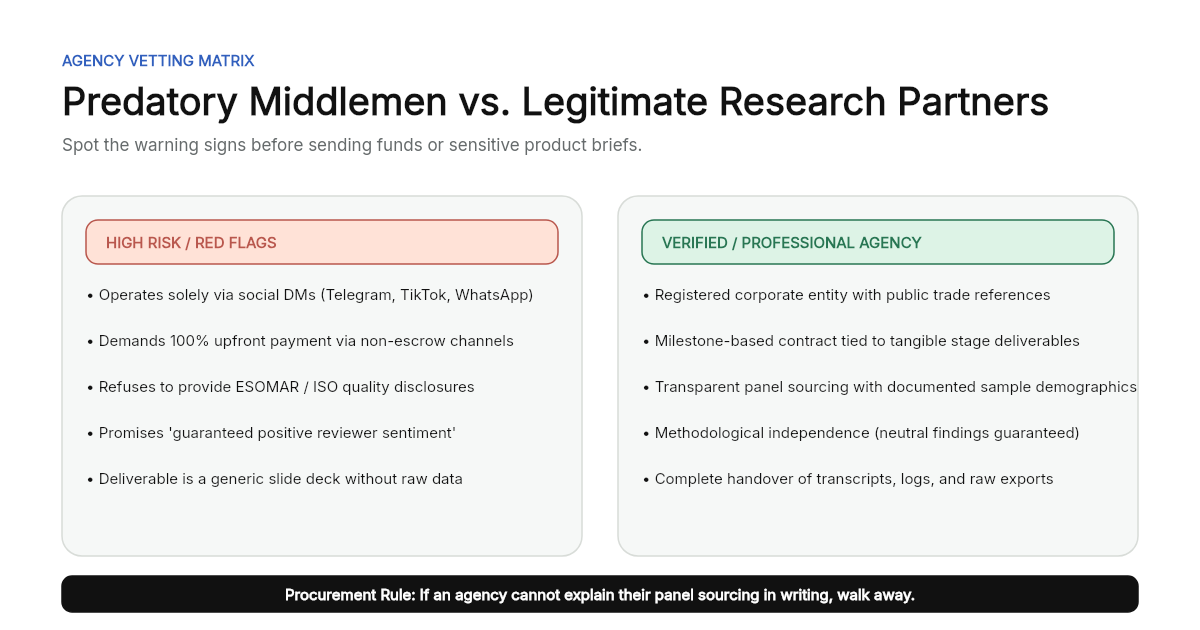
Source: ResearchMaster Agency Governance and Procurement Framework, September 2026.
- They communicate exclusively through social DMs or free email
Legitimate agencies maintain registered domains, corporate email addresses, and verified company registrations. If an account executive insists on conducting business exclusively through Telegram, WhatsApp, or TikTok direct messages, treat it as high risk. - They demand 100% upfront payment
Reputable research firms structure contracts around delivery milestones. Demanding full payment upfront via non-refundable wire transfers or personal payment links is a primary indicator of a fly-by-night operation. - They guarantee 100% positive sentiment
Real market research is an objective discovery process designed to uncover customer objections and competitive vulnerabilities. If an agency promises that "every reviewer will rate your product 5 stars," they are selling paid reviews, not market research. - They cannot explain their panel provenance
When asked how they recruit and verify human survey respondents, fraudulent middlemen offer vague platitudes like "we have our own private proprietary network." - The deliverable is only a summary slide deck
If an agency refuses to provide anonymized raw survey exports, respondent timestamps, or unedited interview transcripts, there is no way to verify whether the data was actually collected from real buyers.
The 5-step agency due diligence checklist
To ensure you partner with a credible research team that delivers defensible data, run every candidate agency through these five gates:
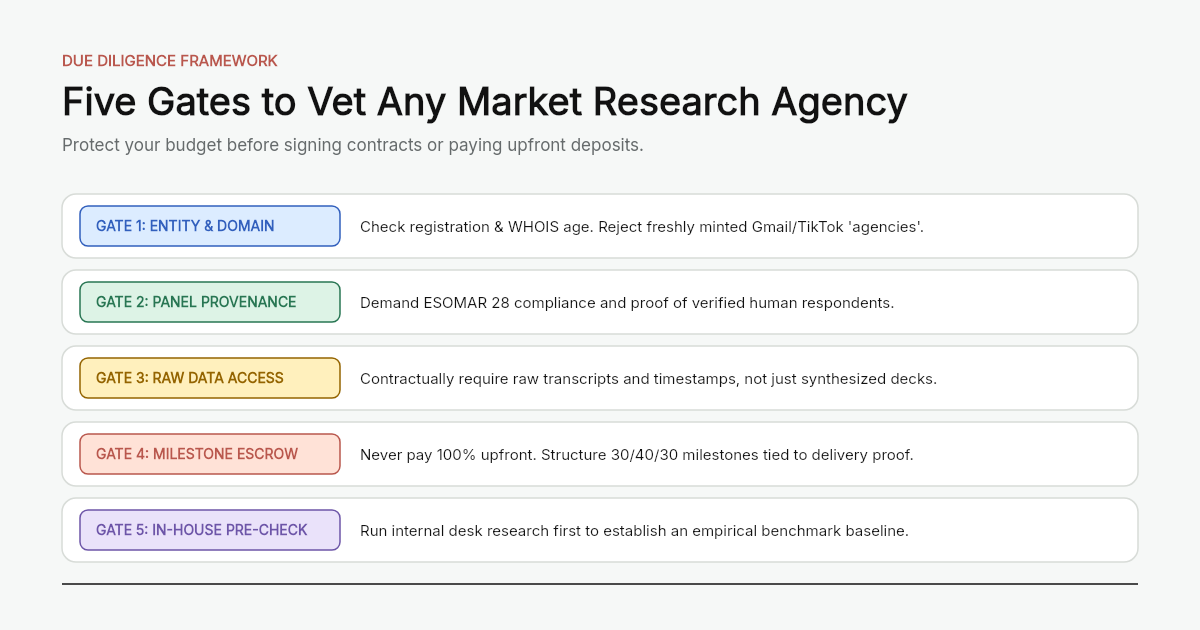
Source: Professional Market Research Compliance and Audit Guidelines. Designed for brand strategy and procurement leads.
Gate 1: Verify corporate registration and domain age
- What to check: Ask for the agency’s official corporate registration number, tax identification, and certificate of commercial liability insurance.
- Verification tip: Run a simple WHOIS lookup on their website domain. If a firm claims "over a decade of Fortune 500 experience" but their domain was registered four months ago, walk away.
Gate 2: Demand ESOMAR 28 compliance documentation
- The industry benchmark: The European Society for Opinion and Marketing Research (ESOMAR) publishes the 28 Questions to Help Buyers of Online Samples.2 This document is the global standard for assessing online research quality.
- Questions to put in writing:
- "What automated mechanisms do you use to detect click-farms and duplicate survey takers?"
- "How do you verify the geographic and demographic identity of respondents?"
- "What is your policy for replacing invalid responses or speeders?"
- What to expect: Established panel providers (such as Dynata, YouGov, or Toluna) provide standardized compliance disclosures immediately. Shady brokers will struggle to answer basic sampling terminology.
Gate 3: Lock raw data and transcript handover into the contract
- The common trap: Low-quality agencies often generate high-level summary decks using generic LLM prompts, presenting fictional buyer personas as empirical field research.
- The contractual safeguard: Include an explicit clause in the SOW requiring delivery of:
- Full de-identified raw quantitative data (CSV or Excel) with complete respondent completion times and timestamps.
- Full qualitative interview transcripts and audio/video recordings with indexed decision moments.
- Why this matters: Contractually mandating raw data delivery deters disreputable vendors before you spend a dime.
Gate 4: Structure payments into 30 / 40 / 30 milestone escrow
- Milestone 1 (30% on kickoff): Covers initial research design, screener drafting, and audience quota setup.
- Milestone 2 (40% on mid-point check): Released only after reviewing soft-launch survey data (the first 10% of responses) or the first three completed interview transcripts to verify quality.
- Milestone 3 (30% on final sign-off): Paid only after your internal team has cleaned, audited, and approved the raw data and final synthesis.
Gate 5: Establish an in-house baseline first
- The best defense: The easiest way to get taken advantage of by an agency is to commission research with zero baseline understanding of your space.
- What to do first: Spend two days conducting preliminary desk research:
- Map competitor pricing, public feature matrices, and recurring customer complaints on G2 or Capterra.
- Pinpoint the exact empirical questions you need an external panel to answer (e.g., "Why are enterprise buyers abandoning our trial after day 14?").
- The outcome: When you enter negotiations with verified baseline numbers, you can instantly distinguish genuine market researchers from opportunistic sales reps.
The practical takeaway
Hiring an external market research partner is an investment in clarity. If an agency cannot provide transparency into their own operations, they will never provide transparency into your market.
Keep this simple procurement principle in mind:
- If they cannot document their respondent verification in writing, they do not have a credible panel.
- If they guarantee positive findings, they are not delivering research.
By enforcing clear milestone contracts and demanding raw data provenance, you protect your company’s capital and ensure your product roadmap is guided by authentic customer evidence.
Sources and date notes
Notice and fair use statement: Public community posts and industry benchmarks cited in this guide reflect real-world commercial dilemmas and established research governance standards. References are provided solely for technical evaluation, educational risk analysis, and procurement best practices. Trademarks belong to their respective owners.
Disclaimer
This article provides general commercial risk-management and research procurement guidance. It does not constitute formal legal counsel or contract guarantees. Organizations should review major international service agreements with qualified legal and procurement professionals.
CTA
Want to establish verified competitor intelligence and market baselines in-house before committing to expensive agency retainers? Explore ResearchMaster AI to run fast, source-backed market research reports in minutes.
Footnotes
- Reddit r/Marketresearch, "is Menace Academy a reputable review service", September 28, 2026, English, https://www.reddit.com/r/Marketresearch/comments/1wsmz2d/is_menace_academy_a_reputable_review_service/ ↩
- ESOMAR, "28 Questions to Help Buyers of Online Samples: Quality & Sourcing Guidelines," accessed September 2026, English, https://events.esomar.org/what-we-do/code-guidelines/28-questions-to-help-buyers-of-online-samples ↩