Most small teams do not need a forty-page research report before they launch. They need a disciplined way to answer one question: should we keep spending time and money on this idea?
That question gets lost when founders jump straight into surveys, competitor screenshots, or market-size charts. Better market research starts with a decision, then uses evidence to reduce uncertainty. The U.S. Small Business Administration describes market research as a way to combine customer behavior and economic trends to confirm and improve a business idea while reducing risk.1
This checklist is for a new service, product, location, customer segment, or pricing model. It assumes limited time and budget. It will help you decide whether to proceed, adjust, or stop.
Start with the decision, not the data
"Research the market" is too vague. A useful research brief fits in one sentence:
We will decide within four weeks whether to offer service/product to buyer. If we see continue signal, we will next investment. If we see stop signal, we will change or pause.
For example:
- A coffee-shop marketing service might ask whether 20 local stores will pay $199 per month for reviews, menus, and social posts.
- A B2B service might ask whether operations managers will move from spreadsheets to a $300 monthly workflow.
- A home-services business might ask whether high-end homeowners in one postal code will pay for a premium design consultation.
Write down the continue, adjust, and stop signals before you collect data. Otherwise, almost any positive comment can feel like permission to proceed.
Describe the buyer's context
Demographics are a starting point, not the answer. "Women aged 25-45" or "small business owners" is too broad to guide pricing, messaging, or sales.
Describe the moment the problem becomes expensive:
| Question | More useful answer |
|---|---|
| Who pays? | The owner, not an employee who merely feels the pain. |
| When does the problem appear? | Eight weeks before opening a second location. |
| What do they do now? | Handle it themselves, hire a freelancer, or postpone it. |
| What does it cost them? | Six hours per week, missed inquiries, or inconsistent quality. |
| What outcome would they pay for? | More qualified leads, fewer refunds, less owner time, or a launch deadline met. |
| What blocks the purchase? | Uncertain results, unclear process, seasonal cash flow, or a bad previous experience. |
This buyer-context map also tells you where to research. If the trigger is opening a second location, study owners who have already done that. If the trigger is a poor hire, read posts about hiring and training, not generic industry reports.
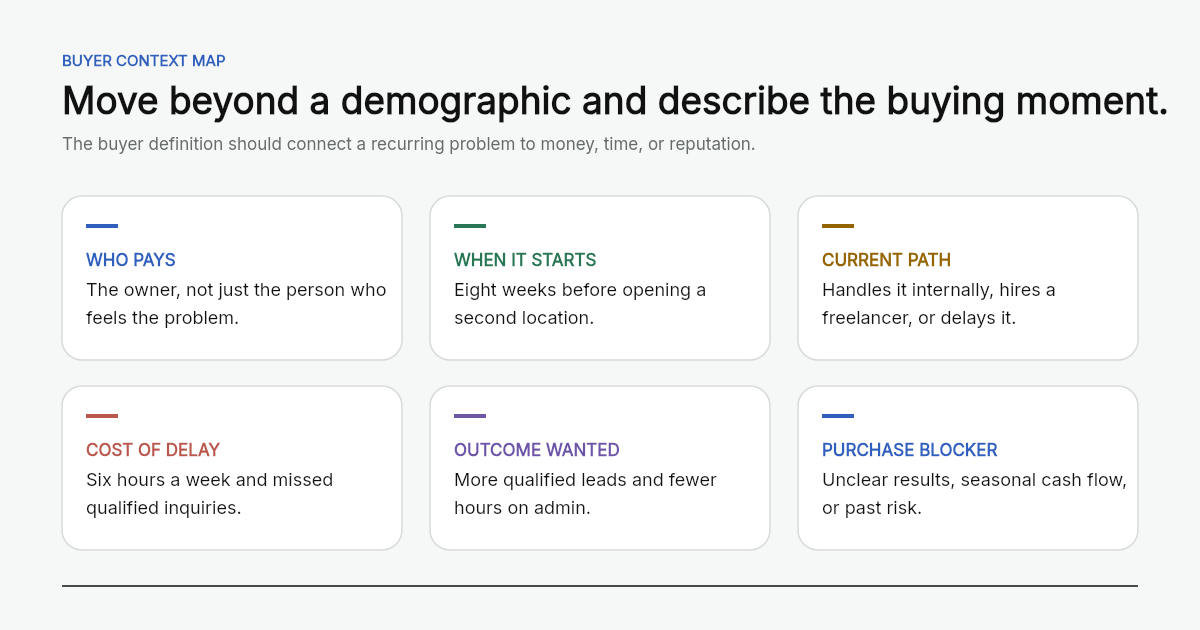
A useful buyer definition connects the pain to a moment when money, time, or reputation is at stake.
Use public evidence to form hypotheses
Public evidence will not tell you exactly why your buyer will pay. It can help you form better hypotheses before you spend time on interviews.
Start with six questions:
- Is demand visible?
- How large is the reachable market?
- Where are buyers located?
- How many alternatives already exist?
- What do alternatives cost?
- What do buyers praise or complain about?
The SBA recommends checking demand, market size, economic indicators, location, market saturation, and pricing.1 Existing sources are efficient for those broad questions, while direct research is better for specific customer objections and buying criteria.1
For small business market research, use sources that reveal behavior rather than claims:
| Source | Look for | Avoid concluding |
|---|---|---|
| Google Trends and search suggestions | Language buyers use and changes in interest over time | That search interest equals purchase intent |
| Reddit, Quora, and industry forums | Repeated problems, workarounds, and objections | That one subreddit represents the whole market |
| Reviews on G2, Capterra, app stores, or marketplaces | Missing outcomes, onboarding issues, and support complaints | That every complaint is a purchase reason |
| Competitor pricing pages | Package structure, target customer, and feature boundaries | The competitor's actual margins or renewal rates |
| Job posts | Growth areas, tools in use, and internal resource gaps | That a company will buy your solution |
If you serve the U.S. market, the SBA lists free data sources such as NAICS, Census Business Builder, demographic data, income data, consumer spending, and trade statistics.1 If you serve another region, replace those sources with local official statistics, industry associations, and marketplace data.
At the end of this step, write three assumptions:
- The buyer most likely to pay is who.
- They want outcome, not merely feature.
- They can probably pay range because evidence.
Study competitors and the do-nothing option
Competitive analysis is not a feature table. Customers compare your offer with every way they could solve the problem, including doing nothing.
Study three groups:
- Direct competitors sell a similar outcome.
- Indirect alternatives solve the problem with different tools, staff, or processes.
- Doing nothing is often the real competitor, especially when the pain is annoying but not urgent.
For each alternative, record the customer-visible promise, price model, proof, common complaints, and reason a buyer might still choose it.
| Alternative | Promise | Buyer might still choose it because | Your differentiation must answer |
|---|---|---|---|
| Agency | Done-for-you delivery | Buyers want fewer vendors and predictable execution | Speed, transparency, or specialist expertise |
| Freelancer | Flexible and lower-cost | Budget is limited or scope is small | Reliability, process, or risk reduction |
| Internal team | Full control and company context | Data privacy or collaboration matters | Time saved, verification, or specialist methods |
| Spreadsheet | Free and familiar | The problem has not yet become urgent | Clear cost of delay and better decisions |
Your goal is not to beat every alternative on every dimension. Choose one buyer, one expensive problem, and one reason to switch that is easy to demonstrate.
Interview before you survey
A survey is useful when you already know the options and need to measure preference. Interviews are better earlier, when you are still learning why the problem has not been solved.
Five to ten conversations can reveal patterns. They cannot prove market size, and you should not report them as if they were a random sample. But they will often show whether you are solving a real purchase decision or a mild inconvenience.
Find people who have recently experienced the problem:
- Founders or owners in relevant communities.
- People asking questions in Reddit, Facebook, or LinkedIn groups.
- Reviewers who mention a competitor's limitation.
- Referrals from your target industry.
- Visitors who request early access.
Ask about the past, not the future:
- "When did you last deal with this?"
- "What did you try first?"
- "Who approved the purchase?"
- "What did that solution cost in money or time?"
- "What made you stop using it?"
- "What almost prevented you from buying?"
Avoid asking, "Would you buy this?" People are often polite. Their past behavior is more useful than their prediction.
After each interview, record:
- The exact words they use for the problem.
- What they already tried.
- What they bought, built, or postponed.
- The reason they chose that path.
- Whether your idea changes a decision they already make.
Repeated phrases are useful for landing-page headlines and sales calls. They are also warning signs when everyone says the problem is interesting but nobody has spent money on it.
Test willingness to pay early
Interest and intent are not the same. A positive reply, an email signup, or a social-media like is a weak signal. A booked call, signed proposal, deposit, pre-order, or renewal is stronger.
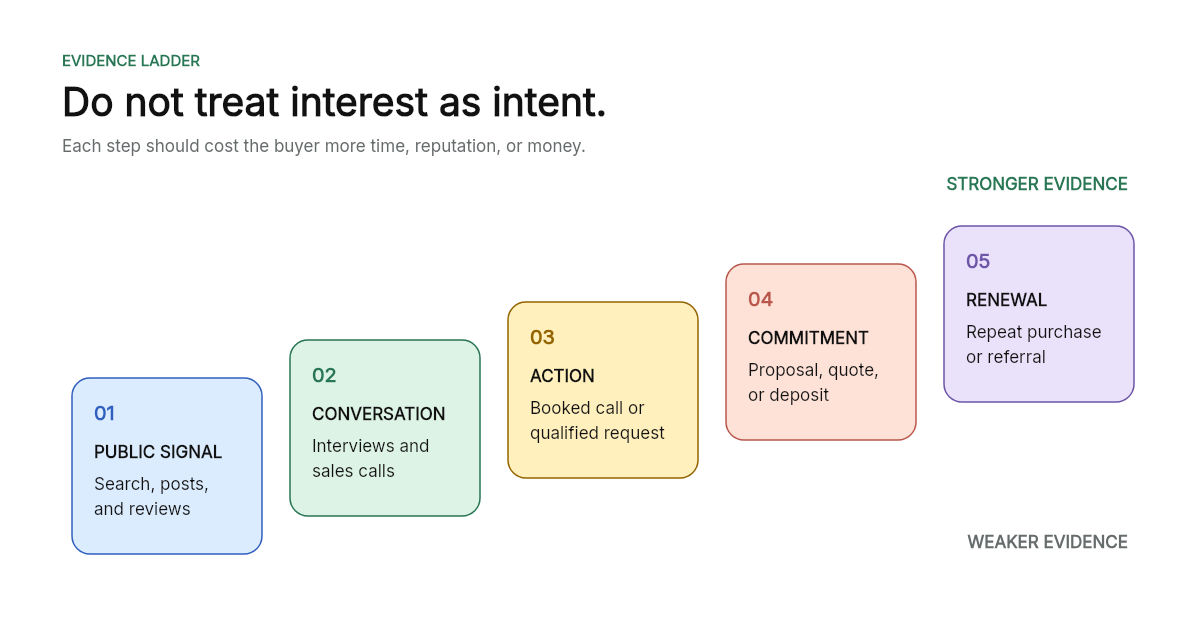
Move up the ladder before you treat an idea as validated.
Choose the cheapest test that exposes a real commitment:
| Test | What it tests | Stronger signal | Watch out for |
|---|---|---|---|
| Landing page with pricing | Message clarity and interest | Email plus a qualification answer | Generic traffic can inflate results |
| Search or social ad | Whether your promise attracts the buyer | Click-through from a narrow audience | Clicks are not willingness to pay |
| Discovery call | Budget, timing, and decision process | They bring the decision-maker | Polite interest can fill your calendar |
| Proposal or quote | Fit, price, and delivery expectations | Revision and follow-up questions | Do not count every "looks good" as a sale |
| Deposit or pre-order | Real commitment | Money and signed terms | Make refund and delivery terms explicit |
| Manual service for three customers | Delivery quality and repeat use | Renewal or referral | Do not automate before the outcome works |
For example, if you want to sell AI-assisted research briefs to law-firm marketing teams, a landing page can promise a one-page weekly brief covering competitors, regulations, and customer-language changes. The page can show the price, deliverable, source policy, and first available date. Then measure the full sequence: qualified visits, email submissions, booked calls, signed proposals, and prepayments.
Size the market conservatively
Small teams do not need an elaborate top-down market model before testing. A simple, explainable estimate is enough.
Use this formula:
reachable buyers × expected conversion rate × average annual value
Suppose a city has 2,000 independent coffee shops. You can realistically reach 25% through maps, walk-ins, referrals, and local groups. If 3% buy in year one, that is 15 customers. At $199 per month, annualized revenue is about $35,820.
That number is not a forecast. It is a decision tool. If the reachable revenue cannot cover delivery, acquisition, and your time, one of four things has to change:
- Serve a higher-value customer.
- Raise the price and prove more value.
- Change the offer to reduce delivery cost.
- Expand geography only after one area works.
Keep assumptions visible. A conservative estimate you can explain beats a large market number you cannot defend.
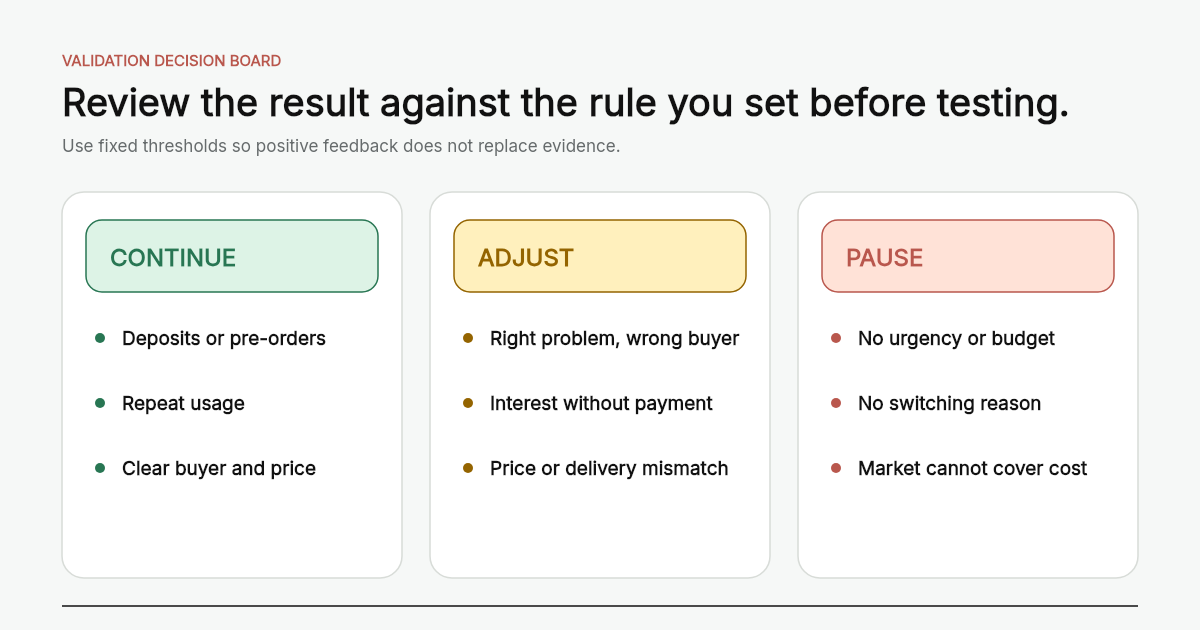
Use fixed thresholds before you review the results, not after.
Avoid five common traps
Asking only friends and family
Friendly encouragement can tell you whether the idea is understandable. It rarely tests willingness to pay, urgency, or switching costs.
Treating interest as validation
Many buyers will say an idea is "interesting." Look for evidence that they have already spent time, money, or political capital on the problem.
Making competitors the entire study
Competitors show what the market accepts. Customer interviews and real purchase tests show why buyers switch.
Ignoring the buying process
A user may love the product while the owner, accountant, operations manager, or insurer blocks the purchase. Identify who must approve the decision.
Waiting for certainty
Research reduces risk; it cannot eliminate it. Once evidence supports a small next step, take it.
A seven-day starting plan
If you have no research budget, use this sequence:
| Day | Work | Output |
|---|---|---|
| 1 | Write the decision statement, buyer context, and stop rules | One-page research brief |
| 2 | Collect search, review, forum, and public-data signals | Three buyer assumptions |
| 3 | Analyze direct, indirect, and do-nothing alternatives | Competitive comparison |
| 4-5 | Interview five to ten recent problem-owners | Evidence-backed buyer language |
| 6 | Launch a landing page, quote test, or pre-sale page | One measurable commitment path |
| 7 | Review results against continue, adjust, and stop thresholds | Next action and owner |
If the result is unclear, narrow the buyer or make the test more concrete. Do not lower the stop rule just because the first week produced encouragement.
Where AI helps
AI can speed up source collection, summarize reviews, organize competitor pages, cluster forum language, and draft interview guides. It is less reliable when the question depends on confidential internal data, current customer economics, or local market context that is not in the sources.
A practical split:
- Use AI for breadth: collect sources, group complaints, summarize public information, and prepare comparison tables.
- Use people for judgment: define the decision, challenge assumptions, talk to buyers, approve evidence quality, and decide whether to continue.
- Keep provenance: save the source, date, query, and evidence behind every material claim.
If you are starting from a blank page, our guide to starting market and industry research with AI gives a broader workflow. For competitor work, these competitive analysis prompts show how to turn signals into strategy. And if you are choosing a tool, compare options with a source-verification checklist.
The short answer
Market research for a small business is not about collecting every available fact. It is about choosing the next decision with less guesswork.
Define who pays, what makes the problem urgent, which alternatives they already use, and what evidence would make you continue or stop. Then test with real conversations and a real commitment path.
That process takes discipline, but it is usually cheaper than building the wrong thing.
Sources and date notes
Demand note: Google Trends showed U.S. interest in "how to do market research" with a 30-day average score of 26 and a peak score of 100 during the measured window. Related queries included "how to do market research for a business plan" and "how to do market research for a startup." Reddit posts also showed owners asking how to validate market size, demand, competitors, pain points, and willingness to pay.234 These are demand signals, not statistical proof.
Disclaimer
This article provides general business-research guidance, not investment, legal, tax, or accounting advice. Examples are simplified. Market size, conversion rates, prices, and outcomes vary by industry, location, execution, and competition.
CTA
If you want to turn scattered sources into a source-backed research brief, use ResearchMaster AI to organize evidence, verify claims, and prepare decisions faster.
Footnotes
- U.S. Small Business Administration, "Market research and competitive analysis," accessed September 22, 2026, English, https://www.sba.gov/business-guide/plan-your-business/market-research-competitive-analysis ↩ ↩2 ↩3 ↩4
- Reddit r/Marketresearch, "How to do the market research," September 19, 2026, English, https://www.reddit.com/r/Marketresearch/comments/1wki8ye/how_to_do_the_market_research/ ↩
- Reddit r/Marketresearch, "Market Research for Residential Architecture Firm & Construction Business," September 8, 2026, English, https://www.reddit.com/r/Marketresearch/comments/1wau607/market_research_for_residential_architecture_firm/ ↩
- Google Trends, "how to do market research," United States, August 21-September 21, 2026, English, https://trends.google.com/trends/explore?date=2026-08-21%202026-09-21&geo=US&q=how%20to%20do%20market%20research ↩