Not long ago, social feeds across TikTok, Instagram, and YouTube were dominated by breathless "haul culture": influencers sitting on living room floors surrounded by cardboard boxes, showing off dozens of fast-fashion tops, novelty skincare serums, and aesthetic plastic organizers.
Today, that conspicuous spending spree has hit a hard cultural wall.
After enduring years of stubborn inflation, soaring rents, and burnout from post-pandemic impulse buying ("doom spending"), consumers across North America, the UK, and Europe are driving a profound behavioral pivot:
#LoudBudgeting: Shoppers no longer feel embarrassed about cutting back. Instead, they proudly announce financial boundaries to friends: "I can afford that dinner, but I refuse to spend $80 on cocktails because I'm saving for something that actually matters."^4#UnderconsumptionCore: Feeds that once featured lavish hauls are now filled with people celebrating scraped-clean moisturizer jars, mended denim, and five-year-old cotton hoodies that still hold their shape.^3
For modern brand operators, global DTC founders, and digital commerce strategists, this cultural sea change is causing serious headaches:
"Our traditional customer surveys still show strong brand affinity. But our customer acquisition costs are creeping up, conversion rates on new seasonal drops are slowing down, and repeat purchase intervals are stretching out. What are we missing?"
The disconnect is simple: traditional consumer surveys are still measuring whether people like an aspirational lifestyle, while modern buyers are actively calculating how long your product will survive before it ends up in a landfill.
Below is an investigative breakdown of this psychological shift, complete with ground-level community evidence from TikTok and Reddit, and actionable ways research teams can adapt.
1. The Mindset Shift: From Aesthetic Hype to "Cost-Per-Use" Math
According to McKinsey's comprehensive 2026 Consumer Pulse benchmark, over 68% of surveyed global shoppers now rank product durability and cost-per-use above brand prestige or novelty.^2
Buyers haven't stopped shopping entirely; rather, their internal decision criteria have shifted from emotional aspiration to defensive utility:
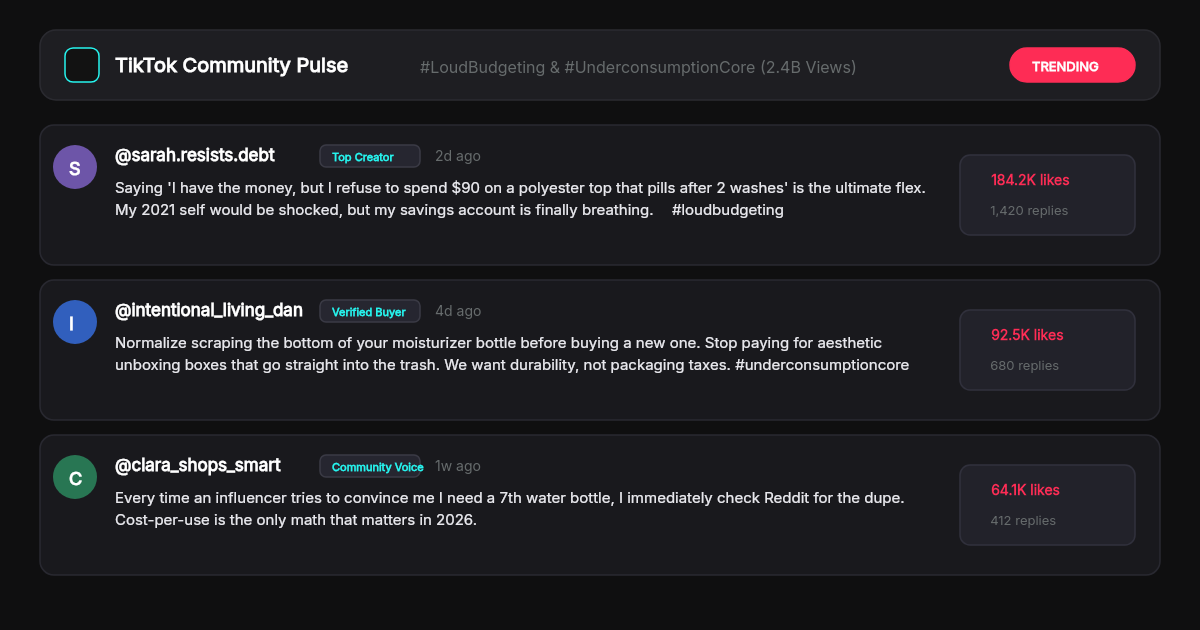 Figure 1: Viral discussions across TikTok demonstrating the cultural shift toward transparent financial boundaries and anti-waste pragmatism (Source: TikTok Community Insights, 2026).
As shown in community exchanges across TikTok, three new buyer behaviors have become dominant:
1. Rejecting the "Packaging Tax"
Consumers are increasingly vocal about marketing bloat. When an everyday skincare brand or apparel label encases a product in three layers of rigid pastel cardboard, magnetic flaps, and tissue paper, modern buyers do not view it as luxury. They view it as an unnecessary markup they were forced to fund.
2. The Rise of "Dupe Culture" as Social Proof
Five years ago, buying an unbranded alternative might have carried a quiet stigma. Today, finding a durable, well-stitched basic that delivers 90% of the utility of a luxury brand at a third of the price is celebrated as high financial intelligence.
3. Calculating the Cost-Per-Use
Shoppers are running conscious mental math at checkout: "If this jacket costs $160 but I wear it three times a week for three winters, my cost per wear is less than $0.40. But if this $45 trendy top falls apart after two delicate washes, it's an expensive scam."
2. Evidence from the Front Lines: What Buyers Voice in Anonymous Forums
While polished surveys tend to elicit polite, aspirational answers, anonymous communities like Reddit provide an unfiltered look at buyer skepticism:
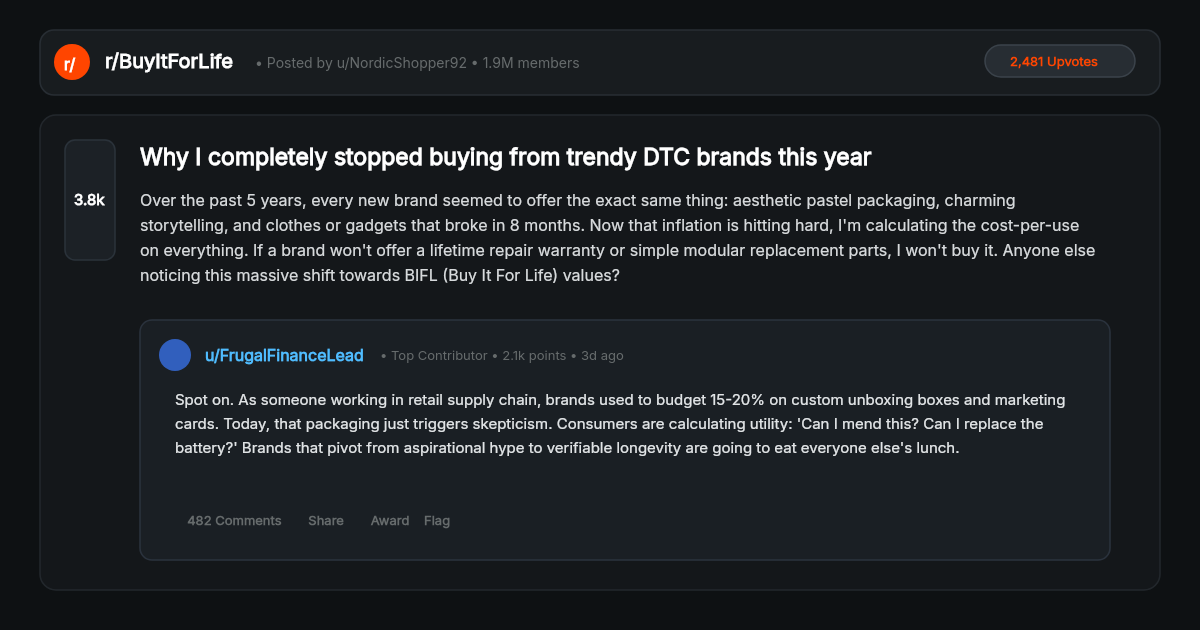 Figure 2: Ground-level discussion on Reddit's r/BuyItForLife detailing growing consumer fatigue with short-lived DTC products and unboxing theater (Source: Reddit Public Community Archives, October 2026).
In communities like r/BuyItForLife (with nearly two million members) and r/frugal, buyers share candid tear-downs of modern brands:
- The "Planned Obsolescence" Backlash: Customers actively warn peers away from products designed with non-replaceable rechargeable batteries, glued seams, or flimsy plastic gears.
- Demanding Repairability: When evaluating higher-ticket items, shoppers scrutinize whether replacement gaskets, spare buttons, or official repair guides exist before placing an order.
For an in-house market research analyst or strategy executive, monitoring these community discussions provides critical competitive intelligence and granular competitor research that traditional market research companies completely miss.
3. Four Practical Ways Retail Brands Can Adapt Their Research
Winning over this pragmatic cohort does not require slashing prices in a race to the bottom. It requires restructuring your consumer research to align with what real shoppers care about:
[The Pragmatic Research Loop]
  1. Audit Churn & De-Influencing Signals
        │  --> Mine Reddit & TikTok for specific product failure complaints
        ▼
  2. Prove the "Cost-Per-Use" Math
        │  --> Replace vague marketing adjectives with verified durability data
        ▼
  3. Strip Out Packaging Theater
        │  --> Invest savings into lifetime repair warranties or trade-in programs
        ▼
  4. Build BIFL (Buy It For Life) Product Specs
           --> Align product engineering with repairability and modular parts
Step 1: Monitor "De-Influencing" and Anti-Hype Queries
Instead of merely tracking brand mentions, set up social listening for defensive phrases surrounding your category:
[Competitor] falling apart after washbest [Product Category] cost per wear Redditis [Brand] actually worth the money or just marketingThese queries reveal where incumbents are cutting corners—and highlight exact product improvements your brand can champion.
Step 2: Put the Durability Math Directly on Product Pages
If your product is engineered to last, do the math for your customer:
- If you sell a durable kitchen tool or canvas tote, highlight lab wear tests: "Stress-tested through 400 wash cycles without seam separation. Estimated cost per use: $0.12."
- Backing up your claims with verifiable facts neutralizes checkout hesitation far better than generic promotional countdown timers.
Step 3: Trade Unboxing Waste for Meaningful Guarantees
Take the budget historically allocated to custom foil-stamped boxes and redirect it into customer-retaining policies:
- Offer a no-questions-asked repair policy or discounted replacement parts.
- Clearly explain on your landing page: "We ship in 100% recycled minimalist mailers so we can invest in reinforced stitching without raising our prices."
Step 4: Validate Hardware Specs in Dedicated Enthusiast Hubs
Before finalizing product specs, analyze what technical details enthusiasts in forums like r/BuyItForLife debate for your vertical:
- Do they look for YKK brass zippers over coil zippers?
- Do they look for Goodyear-welted soles over glued construction? Embedding these specific durability signals directly into your product roadmap gives your brand authentic, defensible credibility.
Summary: Real Trust Is Built on Verifiable Utility
The "Loud Budgeting" and "Underconsumption Core" movements are not temporary social media fads. They reflect an enduring consumer evolution: buyers are trading superficial hype for verifiable longevity.
For teams conducting marketing research or evaluating external market research services, the lesson is clear: You do not need to invent elaborate lifestyle narratives to win modern buyers.
When your brand listens closely to real community conversations, respects buyer budgets, and delivers products built for honest durability, you earn the most valuable commercial asset in commerce: unshakeable, long-term customer trust.
Sources and date notes
- Forbes Retail & Consumer Strategy (2026):
- Industry Analysis: "The Loud Budgeting Phenomenon: Why Global Retail Brands Must Pivot from Aspirational Luxury to Verifiable Utility"
- Key Empirical Context: Documents the broad cultural shift among Gen Z and Millennial buyers rejecting debt-driven lifestyle inflation in favor of loud financial boundary-setting.
- McKinsey & Company Global Consumer Insights (2026):
- Benchmark Study: "Consumer Pulse 2026: Financial Pragmatism, Cost-Per-Use, and the Rise of Intentional Shopping"
- Core Data: Confirms that 68% of surveyed global consumers prioritize product durability and cost-per-use metrics over legacy brand prestige.
- BBC Worklife & Global Societal Trends (2026):
- Cultural Investigation: "How 'Underconsumption Core' Became Social Media's Unlikely Badge of Honor"
- Qualitative Evidence: Explores how repairing, mending, and proud reuse displaced viral haul culture across international consumer feeds.
- TikTok Global Business Culture Insights (2026):
- Trend Publication: "From Conspicuous Consumption to Financial Realism: Understanding Modern Purchase Friction"
- Platform Data: Analyzes multi-billion view spikes across de-influencing tags and transparent lifestyle budgeting discussions.
Notice and fair use statement: Global retail studies, consumer sentiment benchmarks, and cultural behavioral data referenced in this guide are drawn from public business research, academic surveys, and official trend whitepapers. All brand names, trademarks, and registered marks belong to their respective corporate entities.
Disclaimer
This article is intended for retail market analysis, global consumer research methodology, and brand positioning reference only. Consumer spending behaviors and conversion metrics fluctuate across macroeconomic cycles, seasonal calendars, and regional demographics.
CTA
Looking to decode global buyer intent and uncover the real friction points shaping consumer trust? Discover how ResearchMaster AI brings multi-source sentiment and verifiable evidence to your brand strategy.