Every e-commerce brand operator, direct-to-consumer (DTC) founder, and product manager navigating competitive consumer verticals has hit the exact same mental wall:
"You open up Amazon or your category leader's storefront. The top five listings boast forty thousand reviews, glowing 4.6-star averages, studio-grade imagery, and razor-thin margins. You throw your hands in the air: 'Every niche is saturated. How can an agile team with an ordinary budget compete without incinerating cash on price wars?'"
The common pitfall is obsessing over what established winners do right.
When you put on an analytical detective hat and look past the wall of generic 5-star praise directly into the critical review sections and unvarnished social media teardowns, a completely different reality emerges: Even the most entrenched, multi-million-dollar category champions are criticized by thousands of real customers every single week.
Buried inside those complaints are clear unmet desires: "Why does this lid leak after two dishwasher cycles?", "Why are the setup instructions impossible to follow?", "I love the build quality, but the grip slips completely when wet."
In modern commerce, one fundamental rule holds true: your competitor's unresolved flaws are your strongest, self-funding product roadmap.
Here is how modern product strategists mine critical customer reviews to identify untapped market gaps without burning capital on speculative guesswork.
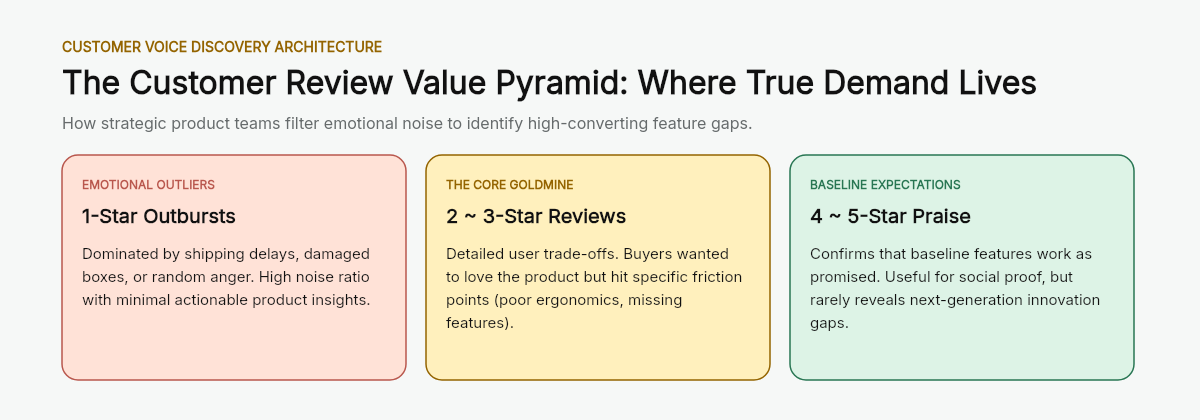
The Review Hierarchy: Why 1-Star Rants Are Noise, but 2-3 Star Feedback Is Pure Gold
When inexperienced teams attempt review mining, they often filter exclusively for 1-star reviews. They immediately run into unhelpful noise: "The delivery driver tossed the parcel over my fence", "Arrived three days late", or "I dislike this shade of beige."
Academic research from Northwestern University's Spiegel Research Center and Harvard Business School highlights a clear behavioral breakdown in online customer feedback:
                 [The Customer Review Value Hierarchy]
 ─────────────────────────────────────────────────────────────────────────────
  Review Tier         Buyer Psychology            Analytical Utility
 ─────────────────────────────────────────────────────────────────────────────
  • 1-Star Rants      Emotional venting / transit High noise ratio; difficult
                      delays and packaging tears. to convert into engineering fixes.

  • 2 ~ 3-Star        "I genuinely wanted to love ★ The Core Goldmine! Detailed
    Critical Reviews  this, but hit a clear flaw." structural friction and wishlists.

  • 4 ~ 5-Star Praise Baseline expectations met.  Valuable for social proof, but
                                                  rarely reveals product breakthroughs.
 ─────────────────────────────────────────────────────────────────────────────
- The mindset of the 2-to-3-star reviewer: These buyers are not internet trolls. They are your ideal target audience—shoppers who understood the value proposition, paid full price, and desperately wanted the product to work, only to be let down by a specific mechanical or ergonomic limitation.
- They regularly draft 200-word paragraphs detailing their trade-offs: "The motor suction is phenomenal, but because the charging port uses a proprietary pin rather than standard USB-C, I cannot travel with it without carrying an extra adapter. I returned it reluctantly."
- That exact friction point gives you a clear design specification for your own product launch.
3 Low-Cost Fronts to Mine Public Friction Points
You do not need six-figure enterprise sentiment software to run effective consumer research. Leading operators extract actionable product intelligence across three public arenas:
1. Amazon and E-Commerce Critical Review Filters
- The operational workflow:
- Identify the top 5 Best Sellers across your target subcategory;
- Navigate directly to the customer review interface and select the "Critical Reviews" filter (specifically isolating 2-star and 3-star entries);
- Categorize recurring grievances into four structural buckets:
- Material degradation (e.g., "Cracked after three weeks of standard use");
- Ergonomic misfit (e.g., "The handle angle strains smaller wrists");
- Maintenance friction (e.g., "Requires disassembling five fragile parts just to rinse");
- Expectation mismatch (e.g., "Marketed as ultra-quiet, but rattles louder than a blender").
- The rule of thumb: When three separate category leaders share the identical 2-star complaint, you are looking at a structural industry blind spot, not an isolated customer gripe.
2. TikTok Unboxing Teardowns and High-Engagement Comment Threads
On visual platforms like TikTok, buyers actively post unvarnished teardowns under hashtags like #honestreview, #whyireturnedthis, or #productfail.
- The real intelligence lives in the top-upvoted comments.
- If an everyday creator notes an annoying design quirk and a comment reading "If they simply added a non-slip silicone base I would buy this in a heartbeat" garners 1,500 upvotes, user demand is already proven.
3. Community Forum Post-Mortems (Reddit & Specialized Boards)
Across enthusiast communities like r/BuyItForLife, r/mildlyinfuriating, and niche hobby subreddits, experienced users openly dissect long-term durability issues.
- Search queries like
"[Brand] alternative without"or"[Product] broke after"surface candid, long-term feedback that standard web surveys rarely capture.
Closing the Loop: Converting Public Complaints into High-Converting Hooks
Uncovering negative sentiment is only half the battle; the real payoff comes from turning those public critiques into your primary marketing angle:
 [Competitor Critical Review] "The screw-top cap is impossible to open with one hand while driving."
      ↓
 [Engineering Adjustment] Re-tool the opening mechanism into an instant one-touch spring latch.
      ↓
 [High-Converting Ad Hook] "Tired of wrestling with screw-top lids on your morning commute? Meet the one-touch commuter bottle."
- Speak in the customer's authentic voice: Your marketing headlines do not require elaborate copy brainstorms. Quote the exact language buyers use when venting about incumbent alternatives;
- Anchor direct comparison tables: On your product landing page, contrast legacy market shortcomings against your purpose-built fix (Legacy design: 2-handed twist cap prone to spills; Our design: Instant 1-touch seal);
- Institutionalize feedback tracking: Leverage modern market research methods and structured competitor research to log sentiment changes over time, ensuring your product stays ahead of shifting market trends.
Summary: True Market Empathy Starts in the Review Column
Successful product development rarely happens in an isolated boardroom whiteboard session.
The most reliable market signals live inside the unfiltered review columns of incumbent products. When you listen to what everyday buyers are frustrated by—and engineer straightforward, reliable fixes—you build products that stand out in crowded markets.
Sources and date notes
- Northwestern University Spiegel Research Center (Consumer Review Dynamics):
- Empirical Research: "How Online Customer Reviews Impact Sales and Purchase Decisions"
- Methodology Finding: Confirms that critical 2-star and 3-star reviews contain significantly higher informational density regarding design ergonomics than 1-star emotional complaints.
- National Retail Federation (NRF) Annual Consumer Benchmark (2025–2026):
- Industry Analysis: "Consumer Returns in the Retail Industry: Sizing and Reasons"
- Core Metric: Highlights that 45%+ of non-defective product returns stem from unaddressed design nuances and misaligned user expectations.
- Harvard Business School Working Knowledge (Voice of Customer Sourcing):
- Strategic Study: "Mining the Voice of Customer in Critical Online Reviews for Product Innovation"
- Practical Impact: Demonstrates that product iterations informed by competitor review mining achieve faster market validation than broad, unprompted consumer surveys.
Notice and fair use statement: Public review dynamics, retail association reports, and academic methodologies referenced herein reflect public consumer research practices. All trademarks and registered names belong to their respective corporate entities.
Disclaimer
This article is intended for product strategy evaluation, public consumer research methodology, and ethical competitive analysis purposes only. Retailers must respect platform terms of service and intellectual property guidelines.
CTA
Looking to transform scattered consumer complaints into actionable, audit-ready product blueprints? Explore how ResearchMaster AI uncovers verified market gaps across public customer feedback.