On business forums like Quora, one question has persisted for years: "How do you carry out market research on a business idea without giving the idea away?" 1 As modern marketing research workflows integrate generative AI, that classic question has resurfaced with greater urgency for founders, every market research analyst, and strategic product leads:
"If I feed our unreleased feature roadmap, target unit pricing, and expansion plans into ChatGPT or Claude to simulate competitor counter-moves, am I inadvertently broadcasting our internal playbook to public multi-tenant clouds?"
The concern is well-founded. Historically, enterprises relied on external market research companies or retained specialized market research services to conduct anonymous competitor benchmarking under strict non-disclosure agreements. Today, in-house strategy teams use AI to conduct high-velocity competitor research and continuous consumer research on their own. But standard consumer AI interfaces often retain prompt histories, log session transcripts, and may use public inputs for continuous training cycles unless explicit enterprise data-protection agreements (such as Zero Data Retention) are activated.2
Caught between data-leak fears and manual fatigue, many research teams either ban AI outright—spending days hand-sifting through SEC filings and review boards—or carelessly paste proprietary pitch decks directly into chatbot windows.
Neither extreme is necessary. Conducting rigorous competitor research with generative AI and protecting company trade secrets are not mutually exclusive. The vulnerability rarely lies in the AI models themselves; it stems from how analysts structure their prompt inputs.
By shifting from "self-centered comparisons" to an Inverted Role Prompting methodology, teams can safely extract competitor vulnerabilities using 100% publicly available signals while keeping proprietary assets strictly behind firewalls.
1. The Three Common "Inadvertent Leak" Prompt Anti-Patterns
Most confidential data leaks during competitive intelligence gathering do not happen through malicious hacks. They happen when well-meaning researchers accidentally embed proprietary assumptions into prompt text. Here are the three most common anti-patterns:
Anti-Pattern 1: The "Revealed Hand" Direct Comparison
- High-Risk Prompt: "We are building an automated B2B customer call audit tool priced at $49/seat launching in Q4. How will Gong and Chorus drop their prices to crush us?"
- The Vulnerability: You just gave the model your exact target price tier, launch timeline, target ICP, and primary product differentiator. Even if the platform claims not to train on your prompts, that text sits in hosted query logs and shared workspace histories.
Anti-Pattern 2: Unsanitized Document Dumps
- High-Risk Prompt: Uploading an entire internal business plan, board pitch deck, or quarterly executive meeting transcript and asking: "Summarize our differentiation against Competitor X."
- The Vulnerability: Unstructured strategy documents frequently contain unannounced partnership discussions, non-disclosure terms, gross margin targets, and key customer churn stats.
Anti-Pattern 3: Inquiring About Narrow Offensive Tactics
- High-Risk Prompt: "What are the exact regulatory loopholes in Competitor Y's European GDPR compliance that our legal team could exploit in an upcoming smear or PR campaign?"
- The Vulnerability: You have exposed your upcoming legal and go-to-market attack vectors in a single prompt.
2. The Core Principle: Inverted Role Prompting
The foundational rule of zero-leakage competitive intelligence is straightforward: Never mention yourself in the prompt.
When a market research analyst structures an audit, they do not need the AI model to know who their employer is, what secret prototype they are testing, or what price they plan to charge. Instead of asking AI to compare Your Product vs. Competitor, instruct the model to act as a neutral forensic auditor dissecting the competitor's external public footprint.
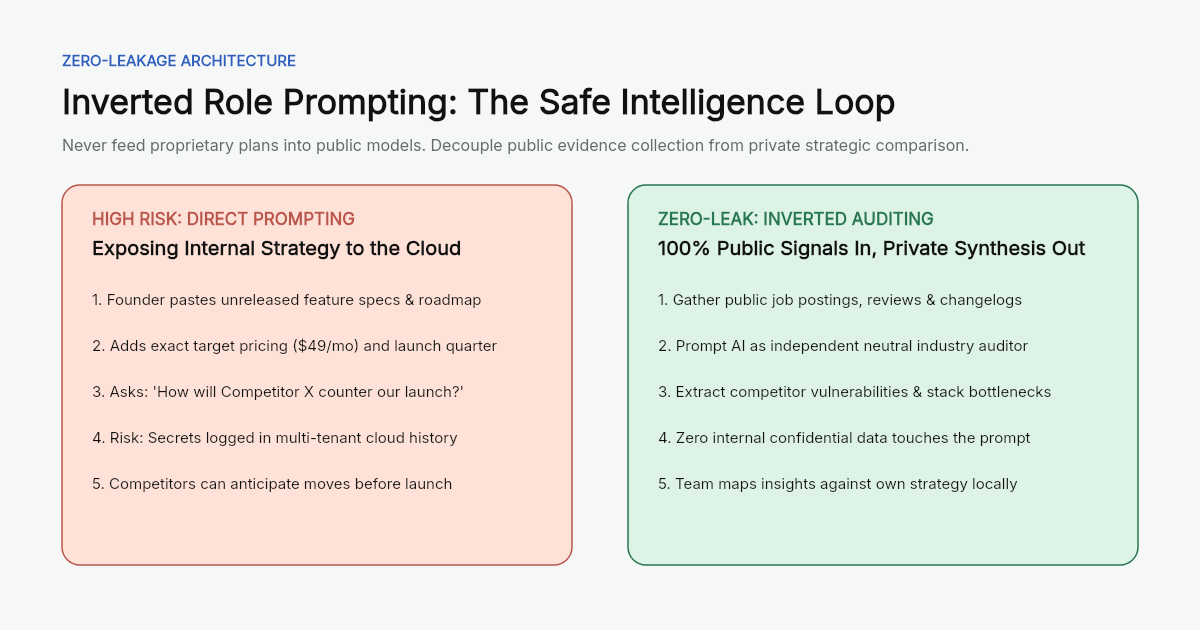 Figure 1: Decoupling public competitor signal extraction from private internal strategy synthesis completely eliminates cloud prompt leakage.
Under this architecture:
- 100% of input tokens are public competitor signals (open web data, archived tiers, customer reviews, engineering postings).
- The model's persona is assigned as an independent industry auditor, reverse-engineering the competitor's operational bottlenecks and unaddressed customer pain points.
- The output provides verified competitor weaknesses, which your human strategy team then maps against your internal plans inside your secure workspace.
3. Four Public Signals That Expose Competitor Moves
Over 80% of actionable intelligence in modern marketing research is already available on the public web. While traditional market research companies charged five-figure fees to manually compile these dossiers, generative AI models excel at pattern-matching and synthesizing these massive, unstructured data streams without requiring any private internal inputs:
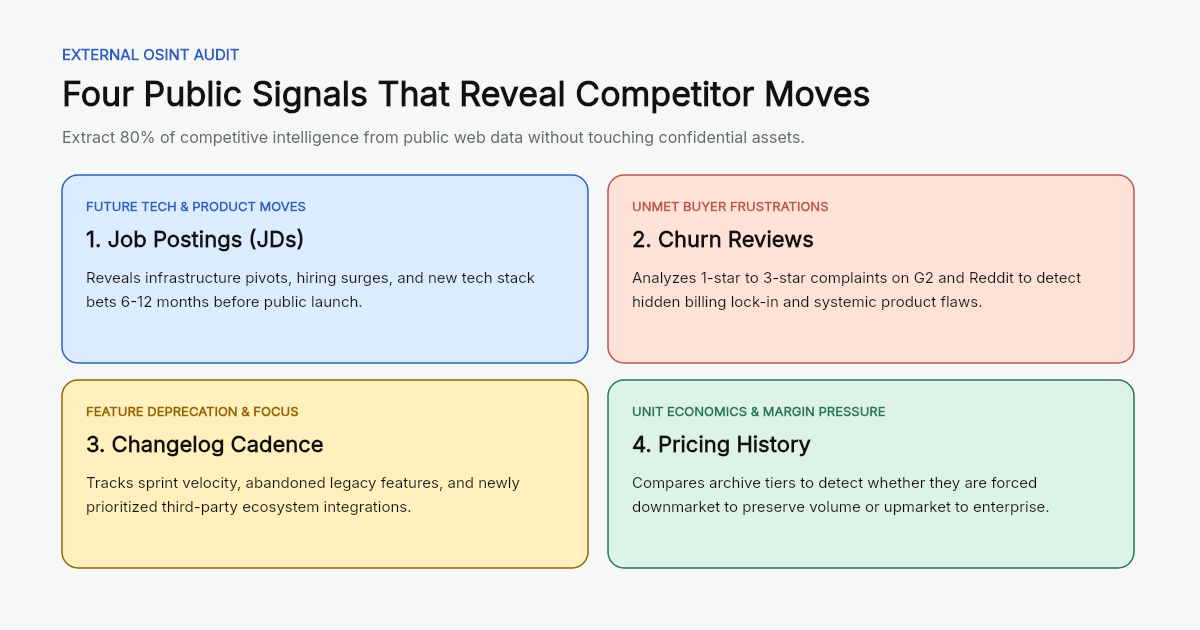 Figure 2: Four public external OSINT data streams strategy teams can feed into AI tools for deep competitor discovery.
Signal 1: Job Postings (JDs) — Reverse-Engineering Infrastructure Pivots
Competitor job listings on LinkedIn or company careers pages reveal technical investments 6 to 12 months before features launch.
- Safe Prompt Template:
"Act as an enterprise software systems architect. Review these three Senior Platform Engineer job descriptions recently posted by Competitor Name. Identify: 1) What specific infrastructure changes or distributed technologies are they actively hiring for? 2) What scalability constraints or legacy bottlenecks do these performance requirements imply? 3) Based on reporting structures, what product capabilities are they heavily investing in over the next two quarters?"
Signal 2: Churn Reviews — Mapping Unmet Buyer Frustrations
Customer complaints on review platforms (G2, Trustpilot, Capterra, Reddit) provide rich consumer research material that details structural flaws rather than superficial bugs.
- Safe Prompt Template:
"Act as a neutral customer experience auditor. Analyze these 40 raw, anonymized 1-star and 2-star buyer reviews for Competitor Name. Categorize the feedback into: 1) Systemic product gaps versus minor usability glitches. 2) Specific triggers that prompted customers to cancel subscriptions or seek alternatives. 3) Recurring feature requests that the company appears unwilling or unable to build."
Signal 3: Release Notes and Changelogs — Measuring Execution Momentum
Release logs reveal which features are thriving, which initiatives were quietly abandoned, and which partner ecosystems are being prioritized.
- Safe Prompt Template:
"Review the past 12 months of changelog entries from Competitor Changelog URL. Summarize: 1) Which product areas received over 60% of engineering releases? 2) Have any previously promoted features experienced reduced release cadence or deprecation? 3) What target customer segment do their recent native integrations serve?"
Signal 4: Archived Pricing and Packaging — Gauging Margin Pressure
Historical pricing snapshots from the Wayback Machine reveal underlying commercial viability and sales efficiency, delivering immediate clarity on their go-to-market posture without having to hire outside market research services.
- Safe Prompt Template:
"Compare Competitor Name's pricing table from 12 months ago with their current tier breakdown. Analyze: 1) Were usage limits reduced or former free-tier capabilities shifted behind enterprise paywalls? 2) Does the restructuring indicate a push upmarket toward enterprise contracts, or a defensive play downmarket to preserve volume? 3) What do the seat-tier transitions imply about their average contract value trajectory?"
4. Establishing a Three-Tier Team Governance Framework
To give every market research analyst, founder, and strategy team confidence, organizations should implement a clear three-tier data classification standard for AI workflows:
| Classification Level | Included Assets | Permitted Tool Environments | Operational Protocol |
|---|---|---|---|
| Tier 1: Fully Public (OSINT) | Competitor websites, job descriptions, public reviews, press releases, SEC filings | Any public or commercial LLM (Claude, ChatGPT, Gemini free or paid tiers) | Zero redaction needed. Strictly forbid entering internal company assumptions or counter-proposals. |
| Tier 2: Sanitized Internal Data | User survey aggregates, product friction metrics, anonymized pricing sensitivity bands | Enterprise instances with Zero Data Retention (ZDR) agreements and signed DPAs | Normalize all metrics (convert revenue numbers to relative indexes; replace brand names with Brand X/Customer Y). |
| Tier 3: Core Trade Secrets | Source code repositories, unpatented algorithms, board minutes, gross margin sheets | Strictly prohibited on public models | Run exclusively on locally hosted models or air-gapped internal server clusters. |
Turning External Signals into Competitive Clarity
Protecting trade secrets does not mean conducting competitor research in the dark or relying solely on legacy agency reports. By adopting Inverted Role Prompting and decoupling public signal harvesting from internal strategic comparison, strategy teams can dissect competitor vulnerabilities at 10x speed while keeping proprietary roadmaps fully secure.
True competitive advantage does not come from hoarding ideas in isolation—it comes from analyzing public evidence with greater clarity, precision, and operational speed than anyone else in your category.
Sources and date notes
Notice and fair use statement: Community discussions, corporate privacy whitepapers, and ethical research frameworks cited in this guide reflect established industry practices and public documentation. References are provided solely for educational, analytical, and operational planning purposes. All product names, logos, and trademarks belong to their respective owners.
Disclaimer
This article is intended for educational, strategic methodology, and operational workflow reference only. Organizations should consult their legal, data compliance, and information security policies prior to deploying generative AI tools on proprietary internal assets.
CTA
Ready to systematize your competitive intelligence workflow without exposing internal secrets? Explore how ResearchMaster AI structures verifiable, source-backed market research from publicly available signals.
Footnotes
- Quora Business Strategy Community, "How do you carry out market research on a business idea without giving the idea away?", Public Knowledge Base, accessed October 2026. ↩
- OpenAI, "Enterprise Privacy and Data Protection Standards: Zero Data Retention (ZDR) Guidelines", accessed October 2026. ↩