If you ask ten founders or marketing managers how often they update their market research, nine of them will give you an awkward answer:
"We did a big customer study when we launched... and we haven't touched it since."
On a popular market research forum on Reddit (r/Marketresearch), a business researcher recently posted about this exact dilemma:
"Annual planning is coming up and I am going through last year's buyer research to see what we can still use. We do not have the budget to redo every interview, but I would like a better reason for reusing the findings than nobody has questioned them yet. What triggers a refresh for you?"1
That one sentence captures the trap so many growing companies fall into. You spend weeks running customer interviews, filling out a buyer persona template, and building a slide deck. Then twelve months go by. Competitors change their pricing, new alternatives pop up on social media, and customer priorities shift. Yet your team is still making product, marketing, and budgeting decisions based on last year's notes.
The good news? You do not need to redo every single customer interview from scratch every year.
You just need to know which parts of your customer research hold their value over time, and which parts expire in a few months. Here is a practical, step-by-step guide to updating your research quickly—without burning your marketing budget.
The simple rule: what stays fresh vs. what expires fast
Think of your market research like groceries. Some items (like canned pantry staples) last for years. Other items (like milk or fresh produce) spoil in days.
If you treat all your research as one big block, you will either waste thousands of dollars re-asking questions your customers answered two years ago, or you will embarrass yourself in front of leadership by quoting last year's competitor pricing.
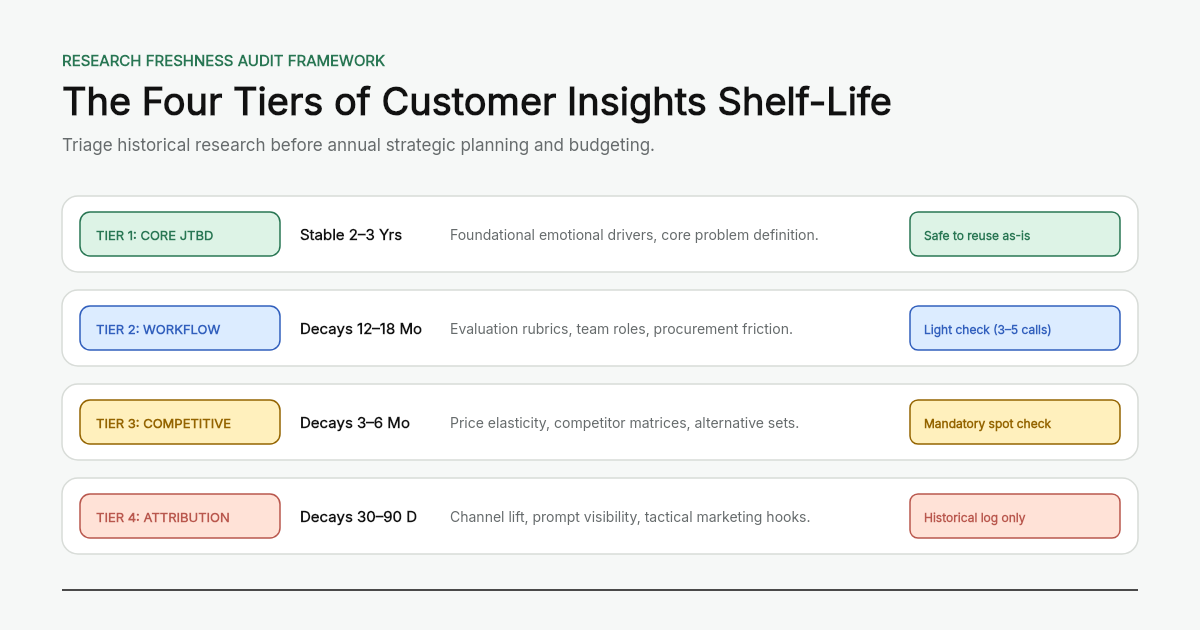
Source: ResearchMaster Customer Research Framework. Shelf-life guidelines for practical business decision-making.
1. The "Pantry Staples" (Fresh for 2 to 3 years)
- What it includes: The fundamental problem your business solves, core customer pain points, and basic emotional motivations.
- Example: If you run an invoice software company, your customers' core desire to "stop spending Sundays doing manual bookkeeping" does not change every six months.
- Action: Keep this in your buyer persona template. You do not need to schedule 20 new interviews to re-prove basic human nature.
2. The "Refrigerated Goods" (Decays in 12 to 18 months)
- What it includes: How your target market evaluates products, who signs off on purchases, and what criteria they use.
- Example: A year ago, a team lead could approve a $200/month software tool on their company card with zero paperwork. Today, with tighter company budgets, the finance department or CFO might require a formal security review.
- Action: Run a quick validation check. Talk to 3 to 5 recent customers to confirm who was involved in the final decision.
3. The "Fresh Produce" (Spoils in 3 to 6 months)
- What it includes: Your competitor analysis template, rival pricing sheets, feature comparison grids, and current customer willingness to pay.
- Example: If your biggest competitor launched a cheaper entry tier or added a free automated feature three months ago, your 2025 pricing study is completely outdated.
- Action: Mandatory refresh. Do not present last year's competitor slides in an annual planning or investor meeting.
4. The "Daily News" (Decays in 30 to 90 days)
- What it includes: Social media ad hooks, click-through rates, keyword rankings, and prompt visibility on AI search engines.
- Action: Never treat this as long-term customer research. Treat it as short-term marketing campaign logs.
4 clear signs it is time to update your market research
You do not need to wait for a calendar reminder to refresh your findings. In real life, real-world events should trigger an update.2 If any of these four things happen, update your notes immediately:
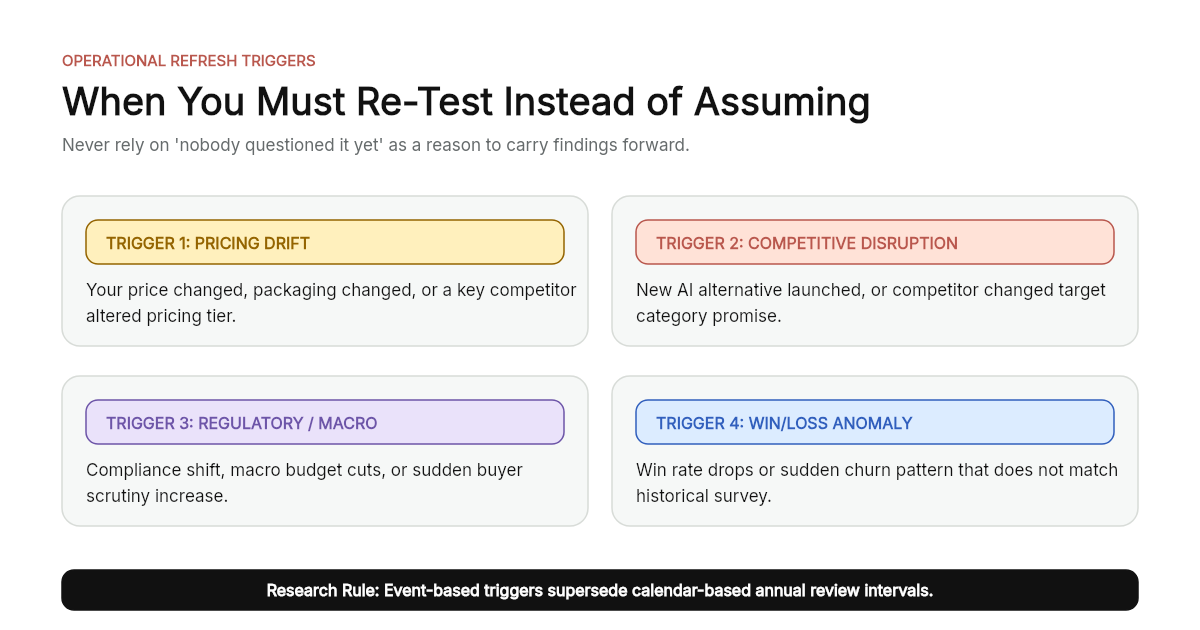
Source: Practical triggers for updating market research. Business events always take priority over calendar schedules.
Sign 1: You changed your pricing or packaging
If you increased your rates, introduced a new subscription plan, or repackaged your core service, your old "willingness to pay" data is dead. You need to know how your target market reacts to the new price point today.
Sign 2: A major competitor changed the game
When a new rival enters the market with a radically simpler offer or a big incumbent cuts their rates, buyers re-calibrate what "good value" looks like. What made your product unique six months ago might now be considered table stakes.
Sign 3: You notice a sudden dip in your win rate
If your sales calls used to close at 30% and suddenly drop to 15%, or if prospects start raising sales objections you have never heard before, the market is talking to you. Customer priorities have shifted faster than your slide deck.
Sign 4: Your target customer's budget got squeezed
When interest rates, inflation, or industry cutbacks hit your buyers, their buying habits change overnight. They stop buying nice-to-have tools and focus exclusively on mission-critical necessities.
The 7-day playbook: how to update your research on a budget
If you don't have $20,000 to hire an agency, you can update your research in just one week by following these five steps:
Step 1: Open your existing buyer persona template and tag it
Take out your existing customer notes and divide them into what is still true (core problems) and what might be outdated (pricing, alternatives, and marketing channels). Highlight anything about competitor pricing in red.
Step 2: Do a 2-hour competitor check
Before talking to customers, do your homework:
- Visit your top 5 competitors' pricing pages and note any changes in tiers, free trials, or packaging.
- Check recent reviews on sites like G2, Capterra, or Trustpilot. Look specifically at 2-star and 3-star reviews from the last 90 days: what are people complaining about right now?
Step 3: Run 5 focused customer interview calls
You do not need 50 interviews. Scheduling five 20-minute conversations with customers who bought (or decided not to buy) in the last 90 days will give you 80% of what you need.
Here are the best customer interview questions to ask:
- "When you realized you needed a solution like ours, what alternative tools or companies did you look at?"
- "What almost stopped you from buying?"
- "Who else on your team had to say yes before you could spend the money?"
- "If our product disappeared tomorrow, what would you replace it with?"
Notice what is missing from that list: never ask "would you pay $X for this feature?" People want to be polite and will say yes. Instead, ask what they actually evaluated and paid for in the past.
Step 4: Update your competitor analysis template
Take what you learned from those 5 calls and your desk research, and update your competitor analysis template. Focus on why customers choose you over the alternative today—not why they chose you two years ago.
Step 5: Deliver a clean one-page summary for your team
Don't bury your leadership team under a 60-page PDF report that nobody reads. Summarize your findings on a single page:
- What is still true: Our customer's core problem has not changed.
- What changed: Competitor A dropped their entry price, so prospects are comparing us on feature X.
- Our action plan: Adjust our starter package messaging and give the sales team a battlecard for Competitor A.
The short answer
How often should you update your market research?
- Keep your core problem notes for 2 to 3 years: Human problems don't change overnight.
- Update your competitor analysis and pricing every 3 to 6 months: The competitive landscape moves fast.
- Trigger an instant review whenever win rates drop or competitors change: Don't wait for the calendar.
When you connect real buyer feedback directly to your pricing and strategy, market research stops being a boring annual chore—and becomes your company's unfair advantage.
Sources and date notes
Notice: Community excerpts and industry examples reflect real-world business practices and public discourse. References are provided solely for educational and architectural evaluation purposes. Brand names and trademarks belong to their respective owners.
Disclaimer
This article provides practical business research frameworks and general guidance. It does not constitute formal legal, financial, or pricing advice. Always evaluate strategic business decisions based on your company's unique operating data, cash flow requirements, and industry environment.
CTA
Ready to turn messy customer feedback, competitor pages, and raw market data into clear, source-backed strategic decisions? Use ResearchMaster AI to automate competitor monitoring and build audit-ready market intelligence reports in minutes.
Footnotes
- Reddit r/Marketresearch, "How do you decide when customer research needs updating?", September 25, 2026, English, https://www.reddit.com/r/Marketresearch/comments/1wq0gie/how_do_you_decide_when_customer_research_needs/ ↩
- Luth Research, "When to Update Your Market Analysis: Essential Timing & Triggers," January 2026, English, https://luthresearch.com/glossary/when-to-update-your-market-analysis/ ↩