If you browse startup forums or search business Q&A communities like Quora, one question surfaces repeatedly across thousands of discussions:
"How much should an early-stage startup spend on market research?"1
The answers founders receive are often divided into two equally dangerous extremes.
On one side, legacy management consultants insist that early ventures should earmark 5% to 10% of their initial funding—often tens of thousands of dollars—to hire external research agencies. On the other side, dogmatic build-first evangelists argue that founders should spend exactly zero dollars, write code immediately, and "see what the market thinks after launch."
Both paths frequently lead to disaster. Paying $20,000 for a generic 60-page analyst report packed with broad macroeconomic TAM calculations will never explain why your first ten target customers will open their wallets. Conversely, building complex software in complete isolation based purely on founder intuition risks wasting six months of engineering burn on a problem nobody is willing to pay to solve.
As practical research practitioners, our baseline rule for early-stage founders in 2026 is simple:
During initial zero-to-one problem validation, your market research expenditure should be strictly capped between $0 and $500.
The purpose of customer research is not academic perfection or decorating pitch decks for investors. Its sole objective is to buy enough confidence to reduce the risk of your immediate next decision.
Here is an operational guide to allocating research capital across startup stages, along with the three-pillar lean stack to validate customer demand under $500.
The research budget ladder: match spend to decision risk
Research budgets should not scale with how much cash you have in the bank. They should scale with the cost of being wrong on your next milestone:
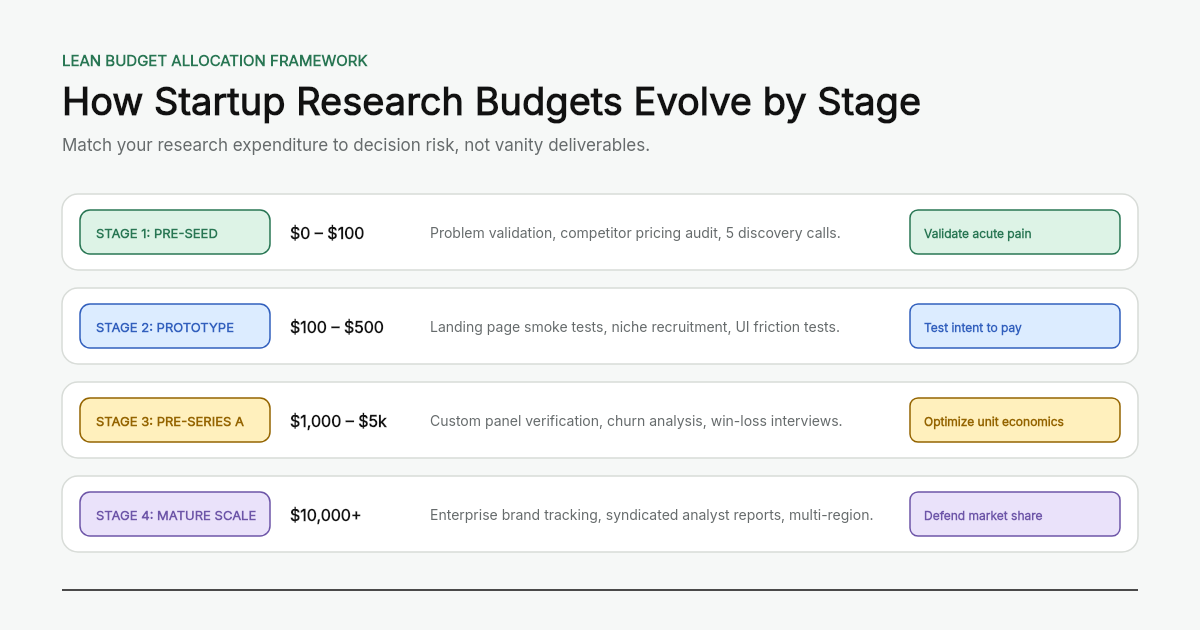
Source: ResearchMaster Lean Startup Research Framework, October 2026. Capital allocation aligned with operational risk.
Stage 1: Pre-Seed and Idea Validation ($0 to $100)
- The catastrophic risk: Spending six months building a solution for a fictional problem that customers tolerate or work around for free.
- Core activities: Competitor pricing audits, public user review mining, and five focused customer discovery interviews.
- Validation goal: Confirm that the pain point is acute, recurring, and already costing the buyer measurable time or money.
Stage 2: Prototype and MVP Testing ($100 to $500)
- The catastrophic risk: Building features that users praise politely during Zoom calls, but abandon when presented with a checkout link.
- Core activities: A single-page smoke test landing page with transparent pricing tiers, small-budget targeted intent traffic, and prototype workflow friction tests.
- Validation goal: Measure concrete intent to pay before engineering the back-end infrastructure.
Stage 3: Commercial Iteration (Pre-Series A: $1,000 to $5,000)
- The catastrophic risk: Scaling customer acquisition before unit economics, churn drivers, and customer lifetime value stabilize.
- Core activities: Targeted panel verification, structured win-loss interviews on lost sales opportunities, and churn cohort analysis.
- Validation goal: Optimize customer retention and eliminate procurement friction.
Stage 4: Mature Scale ($10,000+)
- The catastrophic risk: Missing category-level disruptions or ceding ground to agile market entrants.
- Core activities: Multi-regional consumer panels, ongoing brand health tracking, and syndicated industry research.
- Validation goal: Defend category positioning and track market share expansion.
| Startup phase | Pragmatic research budget | Primary activities | Core validation objective |
|---|---|---|---|
| Stage 1: Pre-Seed / Idea | $0 – $100 | Desk competitor audits, review mining, 5 discovery calls | Validate acute, expensive pain |
| Stage 2: Prototype / MVP | $100 – $500 | Smoke test page, niche user recruitment, UI tests | Test commercial intent to pay |
| Stage 3: Pre-Series A | $1,000 – $5,000 | Custom panel audits, churn analysis, win-loss interviews | Optimize unit economics & retention |
| Stage 4: Mature Scale | $10,000+ | Brand sentiment tracking, syndicated analyst reports | Defend category market share |
The 2026 lean research stack: validate demand under $500
If your startup is operating on limited pre-seed resources, you can stress-test 80% of your primary business assumptions in seven days using this three-pillar framework:
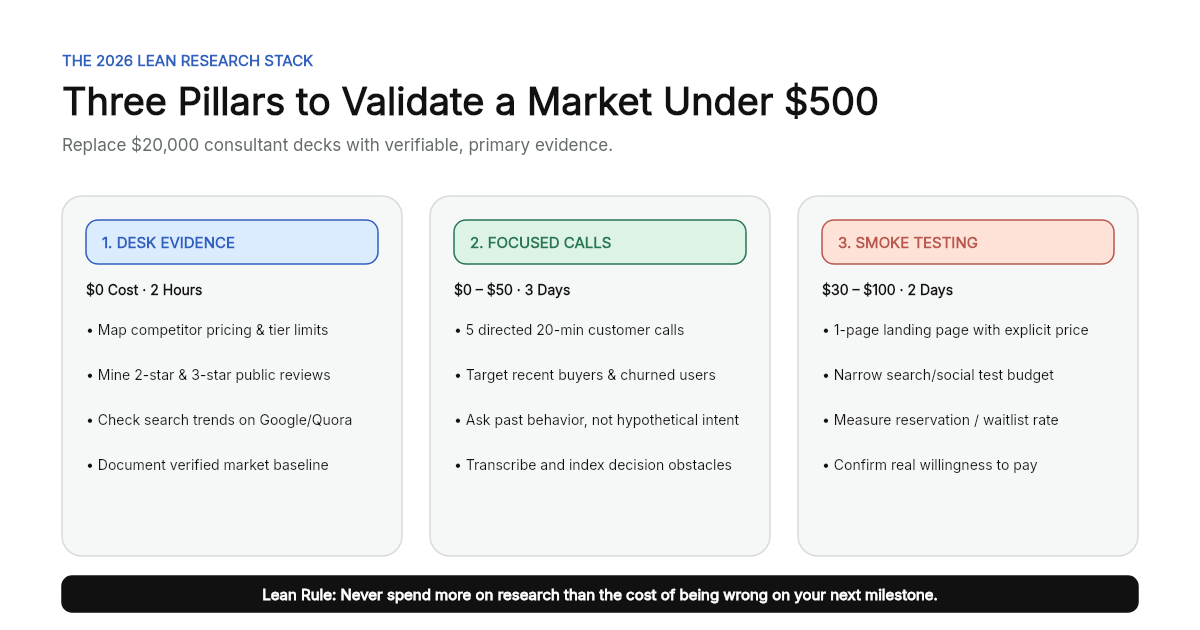
Source: Practical Lean Research Methodology for Modern Startups. Evidence-driven validation on a bootstrapped budget.
Pillar 1: Desk evidence discovery ($0 · ~2 hours)
Before interrupting prospective customers, extract all available public market evidence:
- Map competitor price points and limits: Audit the public pricing pages of the top five direct and indirect competitors. Document their free-tier boundaries, average contract values, and enterprise paywalls.
- Mine 2-star and 3-star public reviews: Visit platforms like G2, Capterra, Trustpilot, or the Shopify App Store. Five-star reviews are often promotional; one-star reviews are typically emotional rants. Two-star and three-star reviews contain high-signal operational gaps: "The product works well, but it lacks feature X, forcing our team to manually export CSVs into spreadsheets." That complaint represents your wedge.
- Verify search demand and community pain: Use Google Search suggestion data, Reddit threads, and Quora queries to document the exact terminology buyers use when describing their frustrations.
Pillar 2: Five focused customer discovery calls ($0 – $50 · 3 days)
Do not blast open-ended, untargeted survey links into general business groups. Generic surveys yield polite, useless generalities. Instead, schedule 20-minute conversations with five buyers who encountered the problem in the last 90 days:
- Examine historical behavior, never hypothetical promises:
- ❌ The wrong question: "If we built a tool that automated workflow X for $50/month, would you buy it?" (Polite respondents will almost always say yes).
- ✅ The right question: "When you ran into this problem last month, what solutions did you try? How many hours did your team spend on it, and what budget did you allocate to solve it?"
- Examine purchasing authority: "Who else in your organization had to sign off before you could expense your current software?"
Pillar 3: Smoke test landing page ($30 – $100 · 2 days)
Qualitative interviews reveal workflow friction; financial commitments reveal demand:
- Build a clean, single-page landing page articulating your target persona, the promised business outcome, and a clearly visible price tag.
- Allocate $30 to $50 in highly targeted search intent or niche community ads.
- Measure the conversion rate of visitors who click "Reserve Access" and submit a verifiable business email address or place a refundable pre-order deposit. If traffic is qualified but zero visitors engage with the price point, the perceived problem is not urgent enough to support commercial viability.
Three expensive research traps to avoid
1. Surveying friends and family
Encouragement from personal networks measures affection, not market validation. Friends and family do not share your customer's operational constraints or financial incentives.
2. Guarding the idea out of fear of imitation
Early-stage founders frequently ask on Quora how to research their market without revealing their concept. In reality, unexecuted ideas possess zero market value. When conducting customer discovery, discuss your buyer's problems, existing tool workflows, and budget bottlenecks. There is no need to disclose your proprietary architecture.
3. Believing market research equals 500 survey responses
Before your product's value proposition is proven, quantitative surveys hide the critical nuances of customer decision-making. Five in-depth interviews that reconstruct authentic purchasing decisions deliver far higher strategic leverage than hundreds of shallow survey ticks.
A 7-day lean validation schedule
| Timeline | Operational focus | Tangible deliverable |
|---|---|---|
| Day 1 | Frame core hypotheses & decision thresholds | One-page research brief with go/no-go criteria |
| Day 2 | Public review mining & competitor pricing audit | Competitor pricing matrix & unmet feature gaps |
| Day 3–4 | Recruit and conduct 5 customer discovery calls | Verbatim buyer pain points & purchase blocker log |
| Day 5–6 | Deploy smoke-test landing page with pricing | Measurable reservation & intent-to-pay metrics |
| Day 7 | Synthesize data and determine strategic direction | Definitive proceed, pivot, or pause decision |
Summary
Returning to the classic Quora question: How much should an early-stage startup spend on market research?
The answer is: Only as much as necessary to inform your next tactical decision.
Avoid draining your runway on agency retainers, but never build in the dark. By combining public desk intelligence, five direct customer discovery calls, and low-cost intent testing, you can validate commercial demand for under $500—giving your company the clarity it needs to build with confidence.
Sources and date notes
Notice and fair use statement: Community excerpts, methodology frameworks, and cost models referenced in this guide reflect established entrepreneurial best practices and public discussions. References are provided solely for educational and operational planning purposes. Trademarks belong to their respective owners.
Disclaimer
This guide outlines general startup validation methodologies and operational budgeting principles. It does not constitute formal financial, legal, or investment advice. Founders must independently assess business risks and adapt validation strategies to their specific industry context.
CTA
Ready to audit competitor pricing, analyze customer review sentiments, and synthesize verified market intelligence without agency overhead? Use ResearchMaster AI to generate defensible, source-backed market research reports in minutes.
Footnotes
- Quora Business & Startup Community, "How much should a startup spend on market research? / Did all start up founders do market research prior to executing their idea?", Public Knowledge Base, accessed October 2026, English, https://www.quora.com/How-much-should-a-startup-spend-on-market-research ↩