
Document ingestion and file processing are consistently among the most expensive components of enterprise AI systems.
Feeding thousands of multi-page invoices, tax filings, legal agreements, and meeting transcripts directly into generative large language models drains token budgets and frequently triggers context-window rate limits. More critically, most operations across these files—sorting forms, tagging clauses, filtering low-quality passages, and segmenting sections—require deterministic categorical decisions rather than creative prose.
Following the release of TypeSafe AI’s Jev on September 15, 2026, developers across global open-source communities began sharing production pipelines built on this new System 1 Model. In the public directory curated by OpenChamber, file and document processing has emerged as one of the highest-leverage categories.1
Below is an architectural review of four real-world document workflows shared by practitioners, highlighting verified performance metrics, code patterns, and practical trade-offs.

Source: OpenChamber Public Builds Index, Jev for files and documents, accessed September 24, 2026. Public posts and screenshots remain the intellectual property of their original authors.
1. High-volume tax filing classification ($0.001 per page)
The problem
Enterprise accounting and tax compliance pipelines regularly handle millions of unstructured scanned receipts, W-2s, and balance sheets. Relying solely on regular expressions is brittle against format drift, while sending every page to a frontier LLM results in unsustainable monthly API bills.
The workflow implementation
Developer @ai_300 shared a deployed tax document classification system combining local OCR with Jev:2
- Classification accuracy: Achieved 100% corpus accuracy across thousands of production tax documents.
- Unit cost: Dropped to $0.001 per page.
- Throughput: Measured at 34× cheaper and 6× faster than their prior generative LLM pipeline.
Document OCR Stream -> Jev Typed Evaluator (`Choice`: Tax vs Invoice vs Other)
                    -> Route to Structured Table Parser
By removing generative token expansion from the classification phase, the system isolates high-confidence extraction only to pages confirmed to hold relevant tables.
Attribution: Case study and metrics derived from public technical demonstration posted by @ai_300 on X (over 11k views). Cited for technical design review.
2. Audio transcript chapter segmentation in 0.5 seconds
The problem
Generating chapter boundaries and show notes for two-hour podcast recordings or executive meeting transcripts often requires feeding 25,000+ words into long-context LLMs. This introduces high latency and frequently causes models to miss subtle thematic shifts.
The workflow implementation
Tatsuhiko Miyagawa, developer and host of Rebuild.fm, shared an automated chaptering pipeline using Jev:2
- Step 1 (Segmentation): Raw unedited transcripts pass through Jev using sliding timestamp windows to evaluate a binary probability:
Did the topic change here?(Noulprimitive). - Step 2 (Execution): The segmentation pass completes in 0.5 seconds at an API cost of $0.01.
- Step 3 (Labeling): Pre-segmented text slices are dispatched in parallel to specialized lightweight agents (such as Claude Code) to generate concise chapter titles.
Decoupling structural segmentation from title generation eliminated the need for continuous whole-transcript context windows.
Attribution: Case study and benchmark data derived from public developer disclosure by @miyagawa on X. Cited for engineering design review.
3. Precision RAG retrieval filtering via calibrated probabilities
The problem
Standard vector retrieval in Retrieval-Augmented Generation (RAG) pipelines retrieves chunks based on geometric cosine distance. Top-$K$ semantic matches frequently retrieve irrelevant or contradictory background context that pollutes the generator’s prompt window.
The workflow implementation
AI practitioner @marlene_zw documented a RAG pre-filter pattern where Jev evaluates retrieved chunks before prompt assembly:2
- For each candidate passage, Jev outputs a multi-variable probability array evaluating relevance: $P(\text{relevant})$, $P(\text{contains_answer})$, and $P(\text{contradicts_query})$.
- High-precision thresholding gates chunk inclusion: if $P(\text{relevant}) < 0.45$, the chunk is automatically dropped.
This filter ensures that generative models only process verified, high-probability context chunks, significantly reducing hallucinations.
Attribution: RAG architecture pattern cited from public engineering discussion by @marlene_zw on X.
4. Bulk spreadsheet and ledger row reconciliation
The problem
Financial analysts and operations teams frequently need to reconcile tens of thousands of messy accounting ledger entries or CSV exports where exact string matching fails due to typos, missing tags, or varying vendor descriptions.
The workflow implementation
Public implementation reports from developers @lieflat_3 and @keithsalins_ demonstrated high-throughput batch evaluation:
- A dataset containing 11,485 rows was processed and classified in 1 minute flat by
@lieflat_3.2 - In accounting reconciliation,
@keithsalins_reconciled 1,000 ledger rows in 33 seconds.2
Because Jev executes discrete probability calculations rather than open-ended string completions, bulk inference requests parallelize cleanly across concurrent worker threads.
Architectural patterns: two high-ROI design paradigms
Evaluating these deployments reveals two dominant design patterns for production document systems:
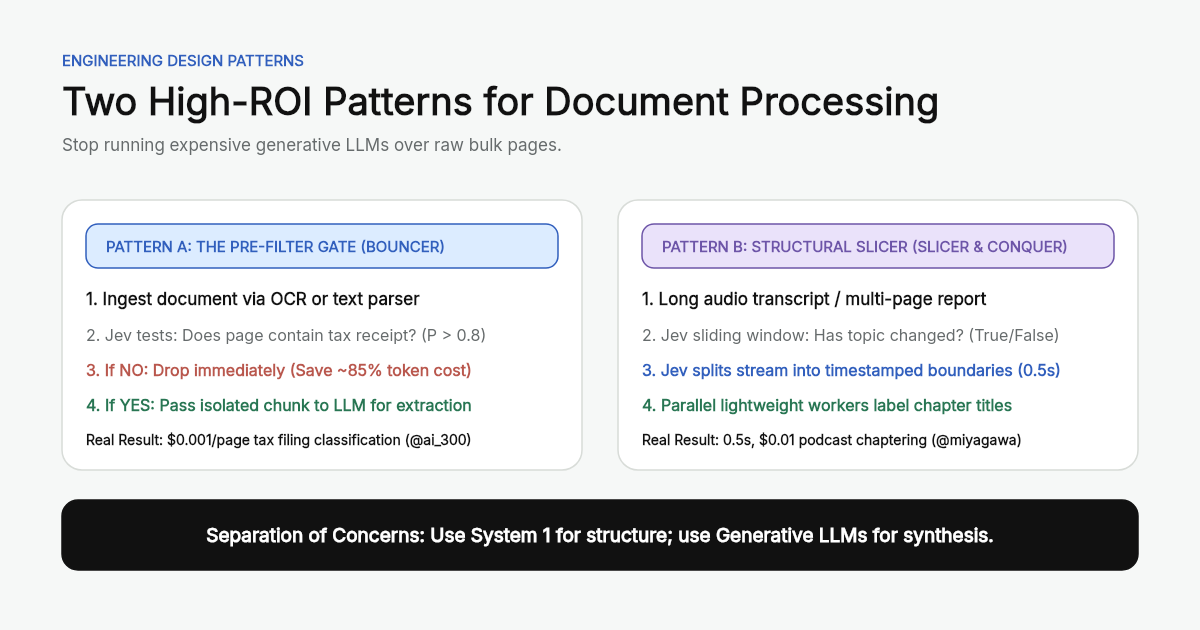
Effective document pipelines separate structural control flow from semantic content generation.
- Pattern A: The Pre-Filter Gate (Bouncer): Position Jev immediately after text extraction to drop 80%+ of irrelevant pages, spam, or headers before paying for generative tokens.
- Pattern B: The Structural Slicer: Use Jev’s sub-second classification to split continuous streams (audio transcripts, logs, PDF books) into clean semantic segments for downstream parallel processing.
Production pitfalls and implementation checklist
Before migrating existing document extraction pipelines, engineering teams should plan for three constraints:
- No native layout awareness: Jev evaluates text, not visual coordinates. Complex spatial reasoning (such as multi-column layouts) still requires specialized document parsers like Docling or layout-aware OCR before classification.
- Schema explicitness: Every decision category must be mathematically bounded in the schema. Jev cannot infer missing labels on the fly.
- Adversarial injection vigilance: When processing untrusted user-submitted files, raw input text must be validated to prevent prompt injection payloads from biasing classification scores.
Summary
Real-world developer adoption confirms that System 1 models provide immediate ROI in document-intensive applications. By offloading classification, triage, and segmentation to dedicated decision models, teams can build faster, more deterministic document pipelines at a fraction of generative LLM costs.
Sources and date notes
Attribution and fair use notice: All trademarks, tweet quotes, and user handles cited in this review belong to their respective creators. Citations and screenshots are included solely for engineering analysis, technical evaluation, and educational workflow demonstration.
Disclaimer
This document details third-party implementations and community-reported benchmarks. Operational throughput, cost reductions, and classification accuracy will vary based on document resolution, OCR quality, API concurrency, and specific schema configuration.
CTA
If your team manages complex document workflows requiring verifiable source attribution and automated intelligence extraction, explore ResearchMaster AI to build reliable, evidence-backed pipelines.
Footnotes
- OpenChamber, "Jev for files and documents: what people built (Daily Feed)," accessed September 24, 2026, English, https://jev.openchamber.dev/use-cases/files-documents ↩
- X / Twitter public posts by @ai_300, @miyagawa, @marlene_zw, @lieflat_3, and @keithsalins_, accessed September 24, 2026. ↩ ↩2 ↩3 ↩4 ↩5