
A growing share of production AI spending is wasted on tasks that never required text generation in the first place.
Software engineers and AI pipeline builders frequently route support tickets, classify documents, score intent, verify guardrails, and gate tool calls by sending unstructured prompts to frontier LLMs. The result is predictable: high latency budgets, unpredictable JSON formatting errors, and inflated token invoices for binary or categorical decisions.
The launch of Jev by TypeSafe AI on September 15, 2026, marks the emergence of an alternative category: the System 1 Model.1 Rather than generating paragraphs token by token, Jev accepts unstructured context alongside a typed schema and directly returns calibrated probabilistic decisions across three primitives: Choice, Score, and Noul (boolean judgments).
Understanding where this model architecture succeeds and where it fails is essential for any engineering team scaling AI infrastructure.
What is a System 1 decision model?
The terminology draws directly from Daniel Kahneman’s dual-process cognitive framework in Thinking, Fast and Slow. System 1 represents fast, intuitive, automated pattern recognition; System 2 represents deliberate, analytical reasoning.
Frontier generative LLMs operate as System 2 engines: they calculate autoregressive probability distributions across vast vocabularies to generate prose, arguments, or code. When developers force these generative engines into strict classification tasks via function calling or JSON schemas, the underlying mechanics remain expensive and generative.
| Architectural dimension | Frontier / Small generative LLMs | Jev (System 1 Model) |
|---|---|---|
| Primary output | Autoregressive token sequence | Typed probability primitive (Choice, Score, Noul) |
| Output contract | Enforced via prompts, grammars, or logit masks | Constrained by construction; 0% schema parsing errors |
| Ideal task profile | Synthesis, code writing, reasoning, open conversation | Routing, filtering, moderation, scoring, classification |
| Median latency | 600 ms – 3,000+ ms | 40 ms – 130 ms |
| Pricing structure | Input and output token tiers | Flat decision pricing (~$0.43 per 1,000 decisions) |

Source: ResearchMaster AI Industry Research Report, Industry Trends and Real-World Usage Scenarios for Jev App, accessed September 24, 2026. Data and findings belong to their respective research publishers.
Independent benchmark findings: speed, cost, and accuracy
Marketing claims around new AI architectures often obscure operational realities. An independent benchmark conducted by ayautomate across 791 labeled decision tasks—comparing Jev against GPT-5.6 Terra, Claude Opus 4.0 Sonnet, GPT-5.4 nano, and Gemini 3.5 Flash-Lite—clarifies the real performance boundaries.2
1. Latency and throughput
Across intent routing and injection screening, Jev demonstrated a 2.0× to 3.6× latency advantage over the fastest small models (GPT-5.4 nano and Gemini 3.5 Flash-Lite). Compared to frontier models, median latency dropped by 7.5× to 12.1×.
Independent testing from gateway provider LiteLLM on a 240-call classification suite corroborated this speedup: Jev 1.13.0 clocked a median classifier latency of 126.81 ms, compared to 688.40 ms for Claude Haiku 4.5—a 5.43× reduction.2
2. Operational economics
For structured routing, token-based pricing becomes prohibitive at volume. LiteLLM reported that Jev’s decision cost was 96.12% lower than Claude Haiku 4.5 across their benchmark.
Against frontier engines like GPT-5.6 Terra, ayautomate measured an operational cost advantage between 17× and 28×, driven by the elimination of output token generation overhead.
3. The accuracy trade-off
Jev is not a blanket replacement for generative models:
- On high-signal, narrow tasks like prompt injection detection and sentiment triage, Jev’s accuracy was statistically indistinguishable from frontier LLMs.
- On high-cardinality tasks—such as 77-way fine-grained customer intent routing—Jev trailed GPT-5.6 Terra by approximately 5 percentage points.
Attempting to use Jev for complex synthetic reasoning will degrade system accuracy. Conversely, using frontier models for simple triage burns budget without delivering quality improvements.
The production pattern: confidence-gated cascades
The most commercially viable deployment pattern for System 1 models is the Confidence-Gated Cascade.
Rather than choosing between a pure Jev pipeline or a pure LLM pipeline, teams deploy Jev as an intelligent first-pass filter ahead of generative models.
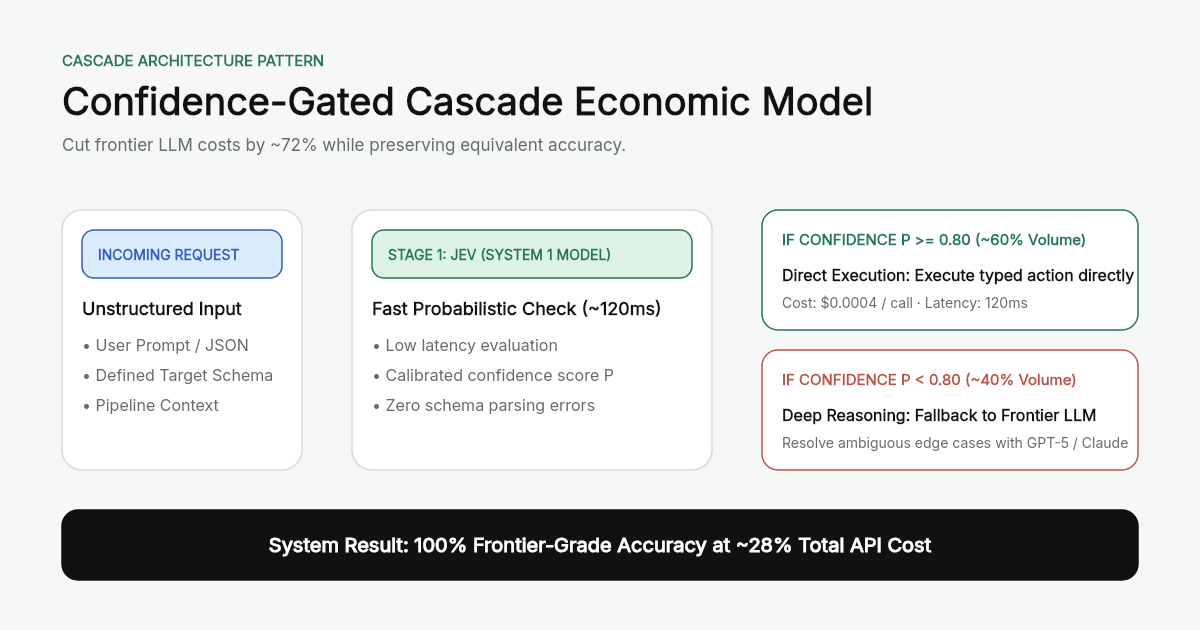
In a confidence-gated cascade, high-probability inputs bypass generative LLMs completely, drastically reducing billable token volume.
How the cascade executes
- First-pass evaluation: Inbound requests enter Jev. Within 120 ms, Jev returns the selected option accompanied by a calibrated confidence probability $P$.
- Threshold branch:
- High confidence ($P \ge 0.80$): In typical enterprise traffic distributions, approximately 60% of requests fall into clear, high-confidence classifications. These decisions execute immediately without touching an LLM.
- Ambiguous edge cases ($P < 0.80$): The remaining 40% of uncertain, complex, or multi-faceted inputs are routed downstream to a frontier reasoning model (such as GPT-5 or Claude).
Economic outcome
In ayautomate’s validation, this hybrid cascade achieved 100% of frontier model equivalent accuracy while consuming only 26% to 28% of the frontier model's baseline operational cost, cutting total pipeline latency in half.2
Known production vulnerabilities and governance limits
Engineering audits have highlighted distinct operational constraints that technical teams must address:
- State injection risks: Research by Penligent AI demonstrated that embedding obfuscated instructions (such as Base64 or ROT13 payloads) inside raw text inputs could alter Jev’s categorical outputs.2 Input sanitization remains mandatory at the edge.
- Probabilistic variance: While outputs conform strictly to typed schemas, decision outputs near the 0.50 probability boundary can exhibit minor non-deterministic variance across repeated invocations.
- Schema rigidity: Jev cannot discover new categories or extract unmodeled entities. Any output must be declared explicitly in advance.
Production decision matrix
| Pipeline requirement | Recommended architecture |
|---|---|
| Support ticket routing and urgency triaging | Jev System 1 Model |
| Drafting personalized customer response emails | Frontier Generative LLM |
| RAG retrieval chunk pre-filtering ($P(\text{relevant}) < 0.5$) | Jev System 1 Model |
| Multi-document comparative analysis and synthesis | Frontier Generative LLM |
| API tool-call parameter validation and gatekeeping | Jev System 1 Model |
| Exploratory data analysis and code debugging | Frontier Generative LLM |
Summary and next steps
The introduction of System 1 decision models represents a necessary maturation of enterprise AI infrastructure. Moving forward, scalable architectures will decouple fast, deterministic classification from deep, contemplative generation.
By implementing confidence-gated cascades, engineering teams can capture sub-150ms response times and 70%+ cost reductions while maintaining institutional-grade accuracy.
Sources and date notes
Attribution and fair use notice: All benchmark metrics, system names, and screenshots referenced in this analysis originate from public technical disclosures, product documentation, and third-party evaluations. Trademarks and copyrights belong to their respective owners. Content is presented solely for educational, technical architecture, and engineering evaluation purposes.
Disclaimer
This document reflects public benchmark data and architectural analysis. Actual production latency, throughput, and accuracy vary based on network topology, schema complexity, payload size, and operational workload distribution.
CTA
Building high-reliability automated research pipelines requires rigorous evidence verification and multi-model orchestration. Learn how ResearchMaster AI implements structured cross-checks and source-backed reporting for enterprise analysis.
Footnotes
- TypeSafe AI, "Jev: System One Model Technical Announcement and API Documentation," September 15, 2026, English. ↩
- ayautomate, "Independent Benchmark: Jev 1.13.0 vs Small and Frontier LLMs Across 791 Decisions," September 2026; LiteLLM, "Jev Classifier Performance and Cost Comparison," September 2026. ↩ ↩2 ↩3 ↩4