We recently tested a simple question with a not-so-simple topic: can an AI tool write a useful research report on the pet supplies market?
At first, ChatGPT looked like the obvious winner.
It produced a readable ChatGPT research report in about 2-3 minutes. The structure was clean, the writing was smooth, and the first draft was good enough to help someone understand the broad shape of the category.
ResearchMaster took much longer. The full pet supplies market research process took around 30 minutes, including analysis and source cross-checking.
That difference matters. But it does not mean one tool is simply "better." It means they are built for different jobs.
If you need a fast draft, ChatGPT is hard to beat. If you need verified market research that can support a real business decision, ResearchMaster is the stronger fit.
Why we used the pet supplies market as the test case
Pet supplies may sound like a straightforward consumer category. It is not.
A serious industry research report needs to look at food, treats, litter, toys, grooming, OTC health products, pet technology, veterinary-linked products, retail channels, regional demand, pricing pressure, regulation, supply chain risk, and investment activity.
A generic report can say "the pet market is growing" and still miss the point.
For a founder, operator, investor, or product manager, the better questions are more specific:
- What parts of the market are actually resilient?
- Is growth driven by volume, inflation, or premium pricing?
- Which categories are recurring, and which are discretionary?
- Do North America, Europe, and Asia-Pacific follow the same logic?
- Which claims are supported by sources, and which are assumptions?
That is where the gap between a quick AI draft and a verified AI market research tool becomes visible.
Where ChatGPT was useful
ChatGPT was useful at the beginning.
It was fast, easy to prompt, and good at turning a broad topic into a first-pass structure. If I were starting from zero, I would use ChatGPT to brainstorm angles, list possible sections, and create a rough outline.
For early-stage thinking, that speed is valuable.
But the output felt more like a starting point than a final research asset. Before using it in a meeting or publishing it externally, I would still want to check the sources, validate the numbers, remove generic claims, and add sharper business judgment.
That is not a failure. It is just the role ChatGPT plays well: fast drafting, not necessarily source-backed decision support.
Where ResearchMaster felt different
ResearchMaster felt slower from the beginning, but the output made the reason clear.
The report did not jump straight into a polished summary. It first defined the market boundary. In the pet supplies report, ResearchMaster treated the category broadly: food, treats, litter, accessories, toys, grooming products, OTC health products, veterinary-related products, pet technology, and the channels attached to those products.
That matters because market size estimates often use different definitions. A report that does not define the market can sound confident while comparing mismatched numbers.
ResearchMaster also separated the analysis into clearer research layers:
| Research layer | What ResearchMaster covered |
|---|---|
| Market size | Global pet care, pet food, U.S. pet industry, and category benchmarks |
| Category performance | Food, treats, litter, hygiene, accessories, OTC health, grooming, and pet technology |
| Regional demand | North America, Europe, Asia-Pacific, Latin America, Middle East, and Africa |
| Channel dynamics | E-commerce, autoship, specialty retail, mass retail, grocery, veterinary, and DTC |
| Competitive landscape | Manufacturers, e-commerce players, specialty retailers, private label, DTC, and veterinary-linked brands |
| Risk factors | Inflation, tariffs, input costs, regulation, labeling, and market access |
| Action plan | Recommendations for manufacturers, retailers, marketplaces, and investors |
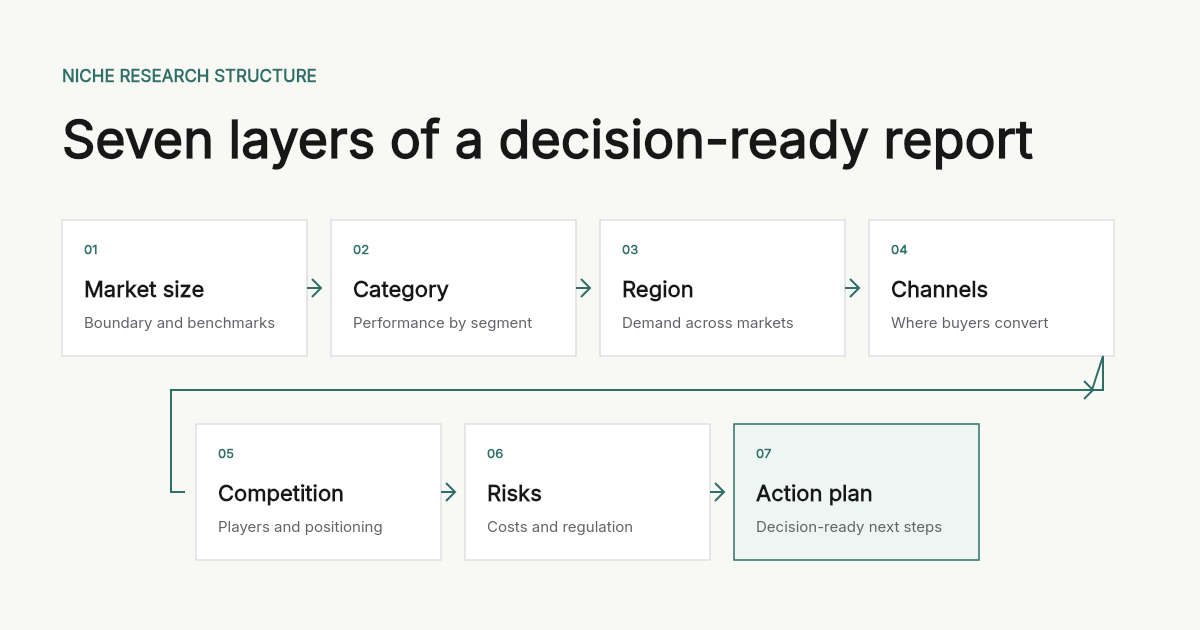
A niche industry report becomes useful when market size, category, region, channels, competition, risks, and actions are analyzed together.
This felt less like "a report generated from a prompt" and more like a research workflow.
The biggest difference: source verification
The most important difference was not the writing style. It was how each tool handled evidence.
ResearchMaster made the source logic visible. The report cited market research firms, industry associations, public company results, trade sources, regulatory sources, and investment commentary.
The pet supplies report referenced sources such as Fortune Business Insights, Ken Research, APPA, FEDIAF, Chewy, Petco, Capstone, Pet Food Institute, and Covington.
That mix is useful because each source answers a different kind of question:
- Market research sources help with sizing.
- Industry associations help with category structure.
- Public company results help with channel behavior.
- Trade and regulatory sources help with risk.
- Investment commentary helps explain where capital is moving.
This is the value of source citations and cross-checking. ResearchMaster is not just trying to find one source that supports a claim. It tries to compare different sources so the final conclusion is more defensible.
ResearchMaster was also more honest about uncertainty
One detail stood out.
The ResearchMaster report did not pretend that a perfect H1 2026 global pet supplies revenue number existed. It explicitly noted that public sources did not provide a single audited global first-half revenue figure across all pet supplies categories.
Instead, it triangulated from full-year forecasts, category projections, Q1 public company results, industry association data, and trade or regulatory sources.
That may sound less dramatic than a single confident number. But it is much more useful.
In real market research, not every answer is clean. A good report should tell you what is known, what is estimated, and what still needs validation.
That is the difference between content that looks complete and research that can survive follow-up questions.
Speed vs. confidence
After using both tools, the trade-off was clear.
ChatGPT gave us speed. ResearchMaster gave us confidence.
For a quick overview, ChatGPT was enough. For a business-facing industry research report, ResearchMaster produced something more useful because it included source verification, clearer market boundaries, cross-checks, and practical recommendations.
The 30-minute wait was not just extra time spent generating text. It was time spent turning scattered information into a more structured, source-backed view of the market.
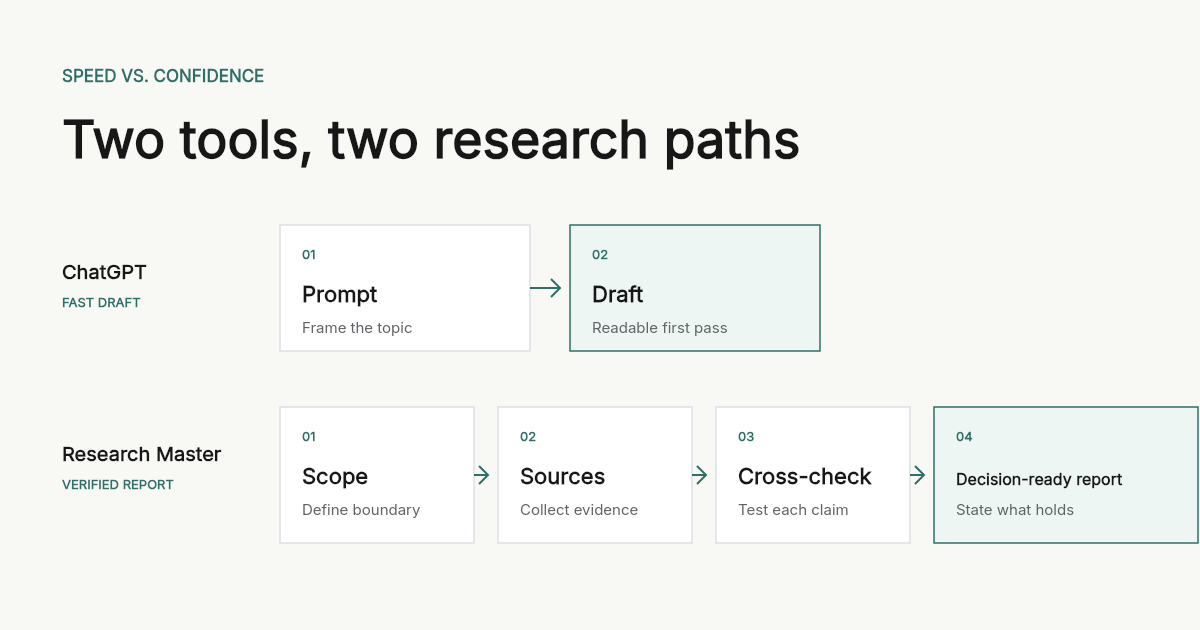
Speed is useful for exploration. Confidence requires a longer path through evidence, cross-checking, and explicit assumptions.
When I would use each tool
I would use ChatGPT when I need to move fast:
| Task | Better fit |
|---|---|
| Brainstorming report angles | ChatGPT |
| Drafting a rough outline | ChatGPT |
| Summarizing a familiar topic | ChatGPT |
| Creating a first-pass narrative | ChatGPT |
I would use ResearchMaster when the output needs to be trusted:
| Task | Better fit |
|---|---|
| Verified market research | ResearchMaster |
| Niche industry research | ResearchMaster |
| Competitor and category analysis | ResearchMaster |
| Source-backed market validation | ResearchMaster |
| Reports for teams, clients, or investors | ResearchMaster |
That distinction is important. ResearchMaster is not trying to be a faster writing assistant. It is designed as an AI market research tool for users who need verified insights from real sources.
Final takeaway
A fast report is useful when you are still exploring.
A verifiable report is useful when you need to make a decision.
That was the main lesson from this pet supplies market research test. ChatGPT helped us get started quickly. ResearchMaster helped us get to a more defensible answer.
For niche industry research reports, the best tool depends on what you need at the end. If you want a quick draft, ChatGPT is the easier choice. If you want source citations, cross-checks, clearer assumptions, and decision-ready analysis, ResearchMaster is the better fit.