If you are assessing the U.S. soybean farming industry, the choice is not simply between a traditional report and an AI report. The more useful question is which part of the research process each one handles well.
For this comparison, we reviewed IbisWorld's Soybean Farming in the US, published in January 2026, alongside ResearchMaster's United States Soybean Farming Industry Competitive Landscape in 2026, generated on September 4, 2026. They are different products with different evidence models, so this is not a model-accuracy contest. It is a practical review of what a team can verify, reuse, and decide after reading each report.
The short answer
IbisWorld is the stronger starting point when you need a consistent industry definition, multi-year data, a standard structure, and established human analysis. ResearchMaster is more useful when you need to combine a report with new public sources, local files, and a specific business question in a short time.
For a high-stakes investment, lending, regulatory, or public market claim, the most defensible workflow is usually both: use IbisWorld to set the baseline, then use ResearchMaster to test, update, and explain that baseline with current evidence. Neither should be treated as a substitute for checking the original sources.
What IbisWorld contributes
A stable definition of the industry
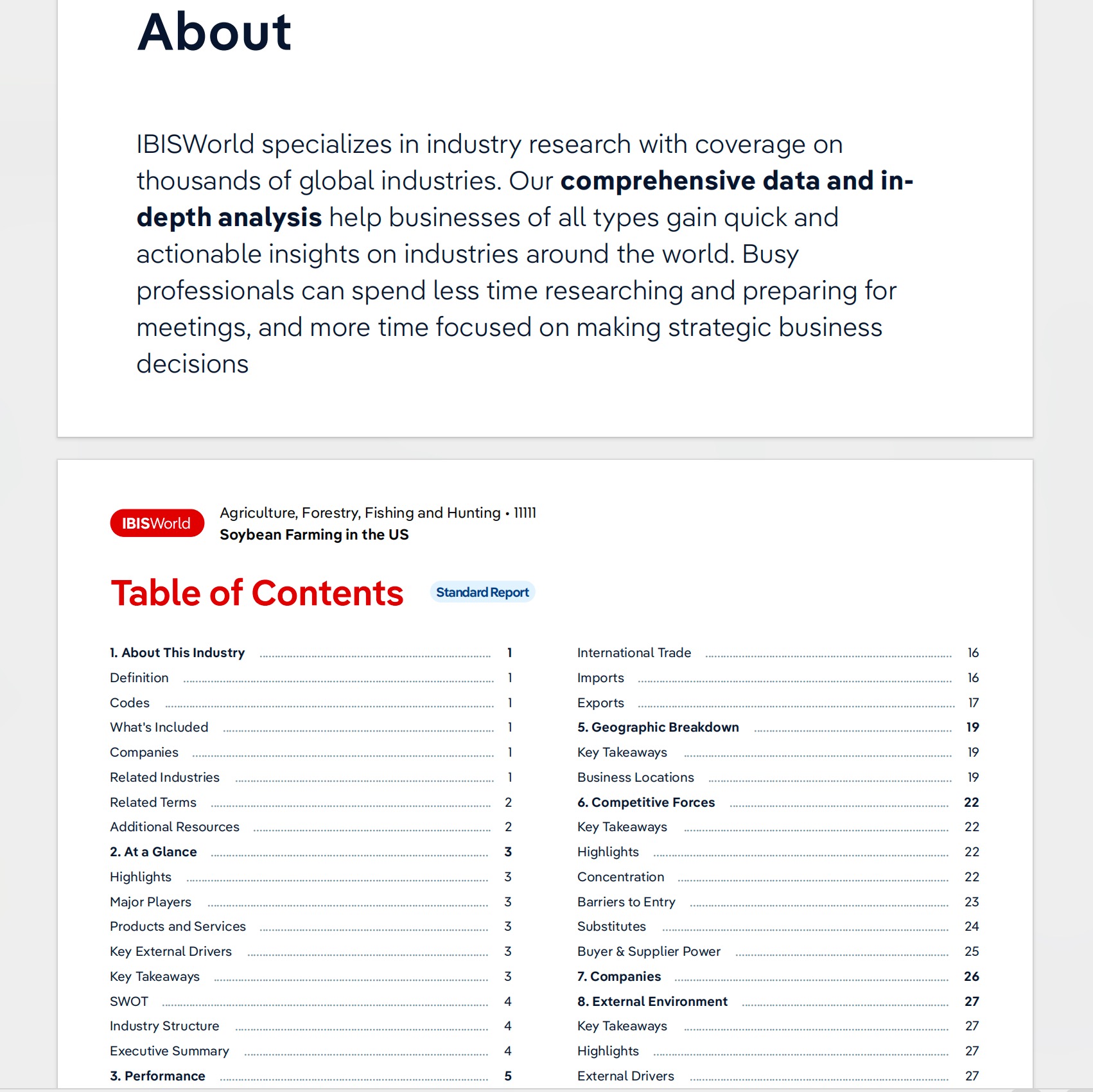
IbisWorld defines the industry as farms that grow soybeans as their main crop, including establishments that sell soybean seed to U.S. farmers. It identifies soybean meal, soybean oil, and soybean hulls as included products, and maps related industries such as corn farming, fertilizer manufacturing, agricultural machinery, and grain wholesaling (IbisWorld, pp. 1-2).
That boundary matters in any market assessment analysis. A market-size figure is not comparable until you know whether it refers to farm production, processed products, exports, or the wider agricultural value chain.
Historical data and a forecast framework
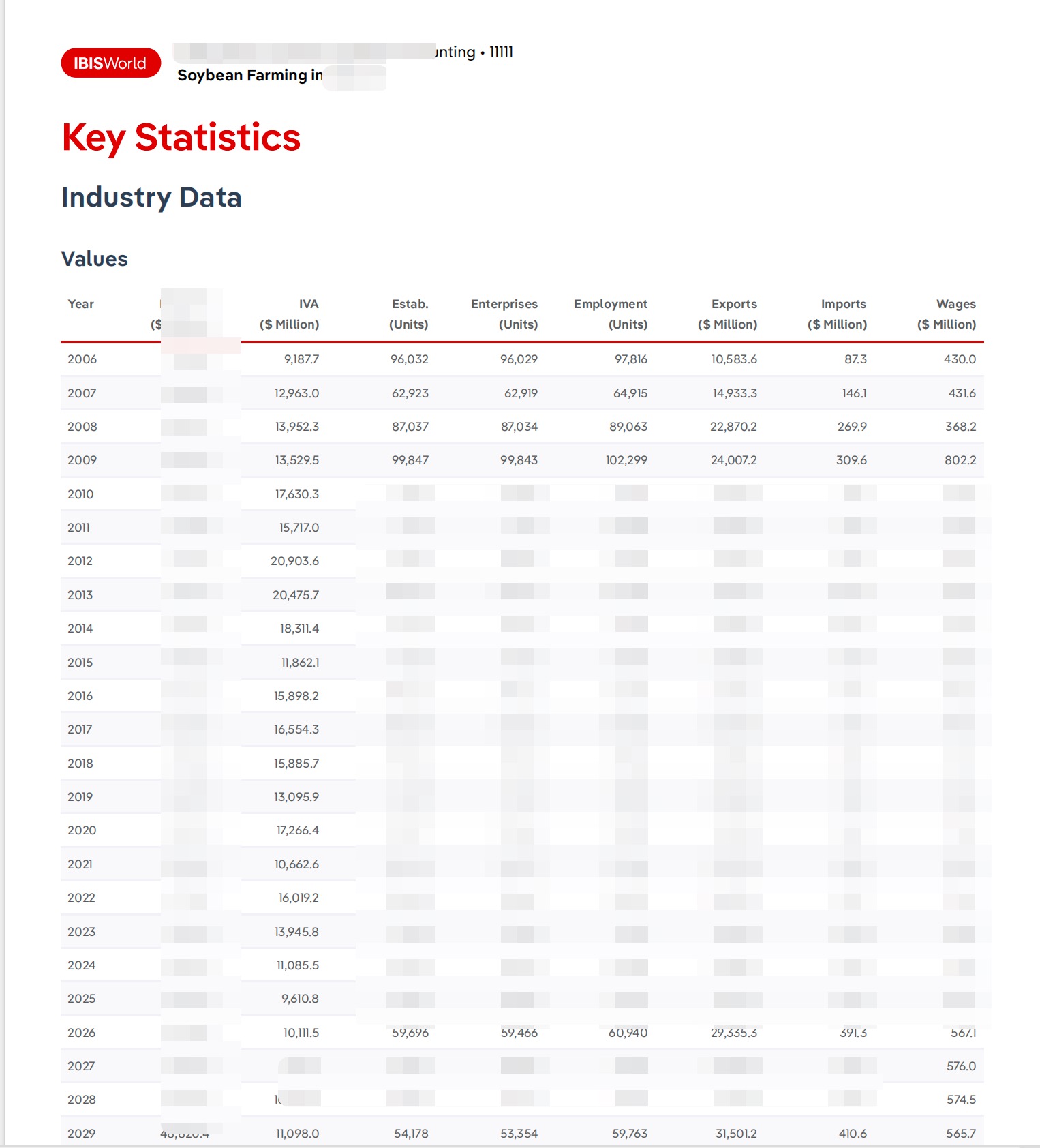
The report's 2026 snapshot estimates industry revenue at $45.7 billion, profit at $7.6 billion, a 16.7% profit margin, 60,940 employees, and 59,466 businesses. It also presents historical and forecast series through 2031, with projected revenue growth of 1.3% a year from 2026 to 2031 (IbisWorld, pp. 3-6, 39-40).
These figures are useful because they sit inside one consistent series. A strategy team can compare years without rebuilding the denominator every time. The trade-off is access: IbisWorld reports generally require a subscription or a quoted plan, and the report itself states that its data, charts, and content are copyrighted.
Context beyond the headline number
IbisWorld links soybean farming to biofuel demand, global soybean prices, subsidies, exchange rates, climate risk, China, and Brazil. It notes that biofuel demand is supporting soybean-oil demand while Brazil's production growth and China's changing import patterns put pressure on U.S. export share (IbisWorld, pp. 3, 7-10).
This is the kind of structured market insights work that helps a reader understand why revenue can remain large while margins are under pressure. It is also where a traditional report's editorial process and industry experience carry real weight.
What ResearchMaster contributes
A question-led research workflow
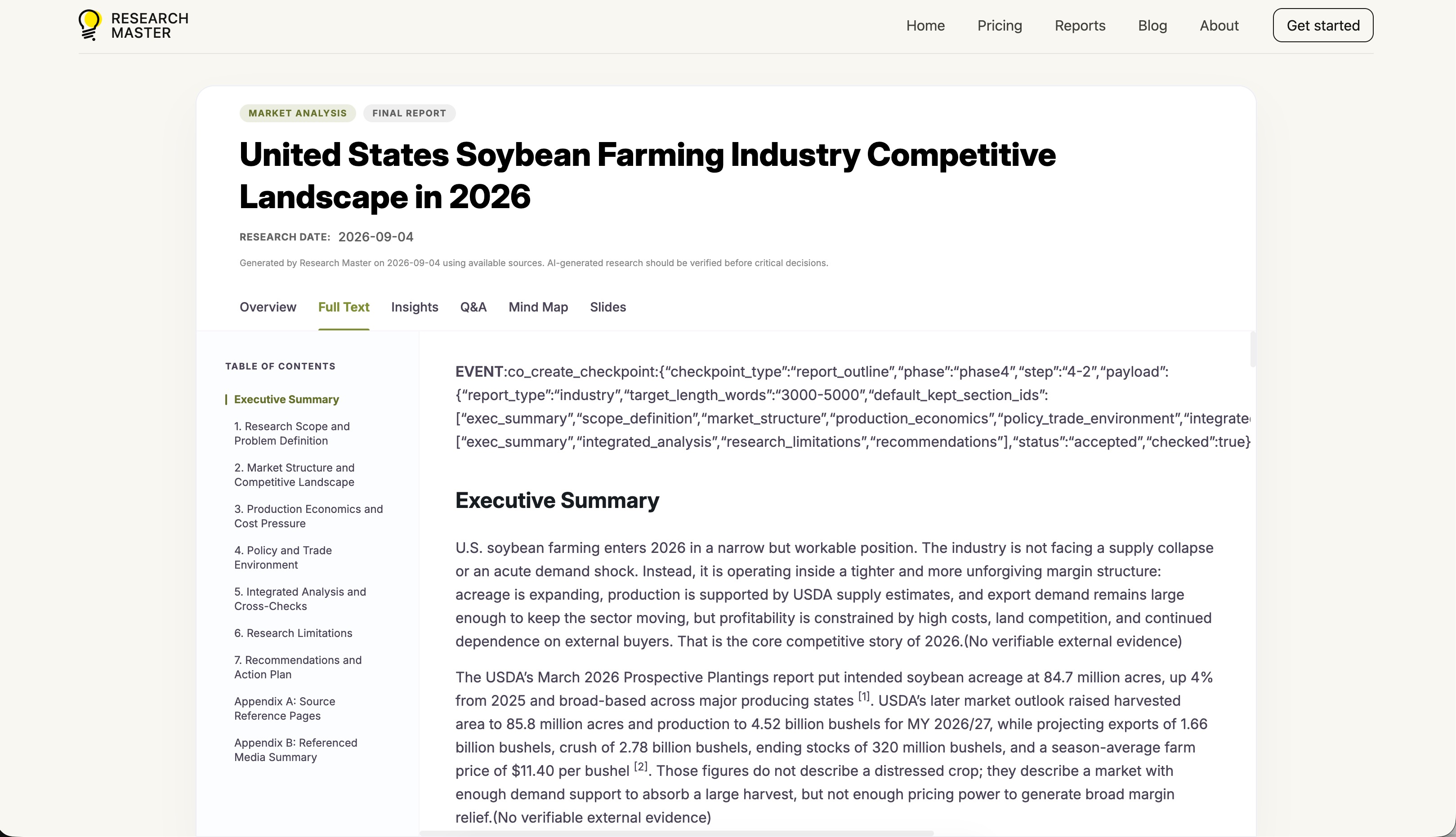
ResearchMaster starts with a research question rather than a fixed chapter template. In this report, the analysis is organized around acreage, supply and demand, farm-level breakeven economics, export competition, and policy risk.
The report draws on USDA NASS, USDA ERS, and Purdue materials. It cites 84.7 million intended soybean acres for 2026, USDA estimates for 2026/27 production, exports, crush, stocks, and farm price, and Purdue estimates for breakeven prices by soil productivity. Those figures are presented as evidence for a decision question: can U.S. soybean farming keep its place in the rotation while costs and export competition remain high?
Flexible inputs and outputs
An AI market research tool is most useful when it can work with the evidence a team already owns. ResearchMaster can begin with a topic, URL, or local PDF, then add public research and organize the result into Full Text, Insights, Q&A, Mind Map, and Slides views.
That flexibility is valuable for a product team, consultant, or operator who needs to move from an industry report to a briefing, a follow-up question, or a working presentation without manually rebuilding the document.
Faster iteration, with a visible limitation
ResearchMaster's report is explicit about its limits. It says the evidence base is narrower than a full multi-source industry dossier, and the page warns that AI-generated research should be verified before critical decisions.
That warning should be taken seriously. The report lists seven independent sources, but its source appendix mainly names institutions rather than giving a complete URL for every claim. Several paragraphs also display “No verifiable external evidence.” ResearchMaster can shorten discovery and organization time, but the user still needs to open the source, check the date and definition, and resolve conflicts.
Side-by-side comparison
| Dimension | IbisWorld | ResearchMaster | What it means in practice |
|---|---|---|---|
| Data model | Long-running industry database, standard categories, historical series, and forecasts | Question-led synthesis of available sources, including user files | Use IbisWorld for a stable baseline; use ResearchMaster to extend it |
| Sources | Curated industry research and listed reference organizations | Public web and institutional sources combined around the prompt | Check source quality and date in either workflow |
| Citations | Report sections and page references; use is limited by copyright and subscription terms | Source markers and evidence blocks, but completeness varies by report | ResearchMaster makes checking easier, not automatic |
| Industry definition | Fixed NAICS-oriented scope | Can be set or changed by the user | Freeze the definition before comparing numbers |
| Human analysis | Established editorial and analyst process | AI synthesis with user review | Traditional analysis has more consistent domain judgment |
| Update speed | Report-cycle updates | New research can be run when the question changes | ResearchMaster is better for fast refreshes |
| Collaboration | Primarily read, annotate, and share the report | Full Text, Insights, Q&A, Mind Map, and Slides views | ResearchMaster supports more iterative team work |
| Export and reuse | PDF and data tables, subject to license | Report views and presentation-ready formats | Choose based on the next deliverable |
| Price | Usually subscription or quoted access; exact pricing varies | Depends on account plan and usage; exact pricing varies | Compare total workflow cost, not an assumed list price |
| Best fit | Investors, consultants, lenders, strategists, and formal industry research | Analysts, operators, product teams, and consultants needing fast custom research | The right choice depends on decision risk and time |
Where the reports agree, and where they differ
Both reports describe a large, globally exposed industry under margin pressure. IbisWorld estimates 2026 revenue at $45.7 billion and highlights lower prices, export pressure, and rising volatility. ResearchMaster reaches a similar operational conclusion using USDA and Purdue indicators: acreage and demand are sufficient to keep the sector moving, but rent, inputs, basis, and foreign supply leave little room for weak farm economics.
The numbers should not be merged mechanically. IbisWorld's revenue is an industry measure. ResearchMaster's USDA figures describe acres, bushels, exports, stocks, and a farm-price outlook. Purdue's breakeven price is a farm-economics benchmark. They illuminate different layers of the same market.
The difference is also visible in depth. IbisWorld covers geographic breakdown, competitive forces, industry assistance, companies, external drivers, and long-run industry data. ResearchMaster is stronger at turning a defined question into a current action plan, but its own limitations section acknowledges thinner state-by-state profitability, basis differentials, and private procurement coverage.
A practical combined workflow
- Set the baseline with IbisWorld. Record the industry definition, year, units, historical period, and forecast assumptions.
- Load the PDF into ResearchMaster. Ask it to preserve the IbisWorld scope and label every added figure as confirmed, estimated, or requiring review.
- Add primary public sources. Use USDA NASS for acreage and production, USDA ERS and WASDE for supply and demand, USDA FAS for trade, Purdue for farm economics, and NOAA for weather risk.
- Ask for a conflict table. Require the report to show differences in year, market year, geography, unit, and denominator instead of hiding them in a single blended estimate.
- Review decision-critical claims manually. Open the original source for every number that could change an investment, pricing, procurement, or acreage decision.
- Export the output for the next audience. Use a concise insight brief for leadership, Q&A for working sessions, or Slides for a meeting. Keep the source register with the final deliverable.
Who should use which approach?
Choose IbisWorld first when the work needs a defensible industry baseline, a consistent history, or a report that can be reviewed by investment, finance, or consulting stakeholders.
Choose ResearchMaster first when the question is narrow, the evidence is changing, or the team needs to combine an existing report with internal notes and current public sources. It is especially useful for an early market screen, a competitor or supply-chain question, or a fast update before a decision meeting.
For consequential decisions, keep the two roles separate: IbisWorld supplies a structured reference point; ResearchMaster accelerates discovery, comparison, and communication. Human reviewers remain accountable for the conclusion.
Sources and citation notice
- IBISWorld, Soybean Farming in the US, published January 2026, user-provided PDF, pp. 1-10 and 39-41. Copyright 2026 IBISWorld. All rights reserved. This article uses limited factual summaries for commentary and comparison; it does not reproduce the report's tables or substantial text.
- ResearchMaster, United States Soybean Farming Industry Competitive Landscape in 2026, research date September 4, 2026: view the shared report. Accessed September 4, 2026.
- USDA National Agricultural Statistics Service
- USDA Economic Research Service
- USDA World Agricultural Supply and Demand Estimates
- USDA Foreign Agricultural Service
- Purdue Center for Commercial Agriculture
- NOAA National Centers for Environmental Information
Online preview of the IbisWorld source
The source PDF supplied for this comparison is available below for online preview only. The preview does not include a download button. The document remains the copyrighted property of IBISWorld; access and reuse are subject to the rights holder's terms.
Preview source: IBISWorld, Soybean Farming in the US, January 2026. Provided for reference in this comparison; not for redistribution.