Business reports are full of useful information, but they are rarely ready to present. A single report can include market data, customer feedback, product details, recommendations, meeting notes, and pages of supporting explanation. The work is valuable. The format is simply wrong for a room where people need to understand the point quickly.
For teams preparing a client proposal, sales deck, internal update, or quarterly business review, the difficult part is not choosing a slide template. It is deciding what matters, building a clear story, and making sure the final presentation is easy for its audience to follow.
AI can reduce that production work. It works best, however, when it starts with the real business material rather than a broad request to "make a presentation."
Why business reports do not become slides by themselves
Business reports and business presentations do different jobs.
A report is made for reading. It can hold detailed explanations, full tables, background context, and the reasoning behind a conclusion. A presentation is made for communication. It needs to make the main point clear in a short amount of time, then show the evidence that supports it.
That is why copying a report into slides usually fails. Long paragraphs are hard to scan. Large tables hide the important number. A useful recommendation can disappear under context that belongs in an appendix.
| What a report often contains | What goes wrong on a slide | What the audience needs instead |
|---|---|---|
| Long background sections | The main message arrives too late | A short context statement and the key implication |
| Full data tables | Too much detail to read in a meeting | A small number of decision-relevant metrics |
| Several findings with equal weight | No clear narrative or priority | A sequence from problem to evidence to action |
| Detailed methodology | The audience loses sight of the business question | Essential proof, with the rest available for follow-up |
| Recommendations at the end | The next step is easy to miss | A direct decision, owner, or action |
A useful presentation is not a shorter report. It is a new structure built for a specific audience.
Why AI works better with real business material
It is tempting to ask an AI tool for a business deck from a single sentence. That can produce tidy slides, but the result is often generic. The tool does not know which figures in your report matter, what your customer already understands, or what decision the presentation needs to support.
Real source material gives the work a business context. It may include PDF reports, meeting records, product briefs, sales reviews, customer interviews, user feedback, previous research, or internal planning documents.
For example, a customer-behavior report can become a presentation about the few insights that should change product or sales decisions. A product document can become a sales presentation that connects a buyer problem to the relevant capabilities. A quarterly review can become a structured update for leadership or a client.
The quality of the output still depends on the goal. A deck for a prospect, a leadership team, and a project review should not be organized the same way, even if all three begin with the same report.
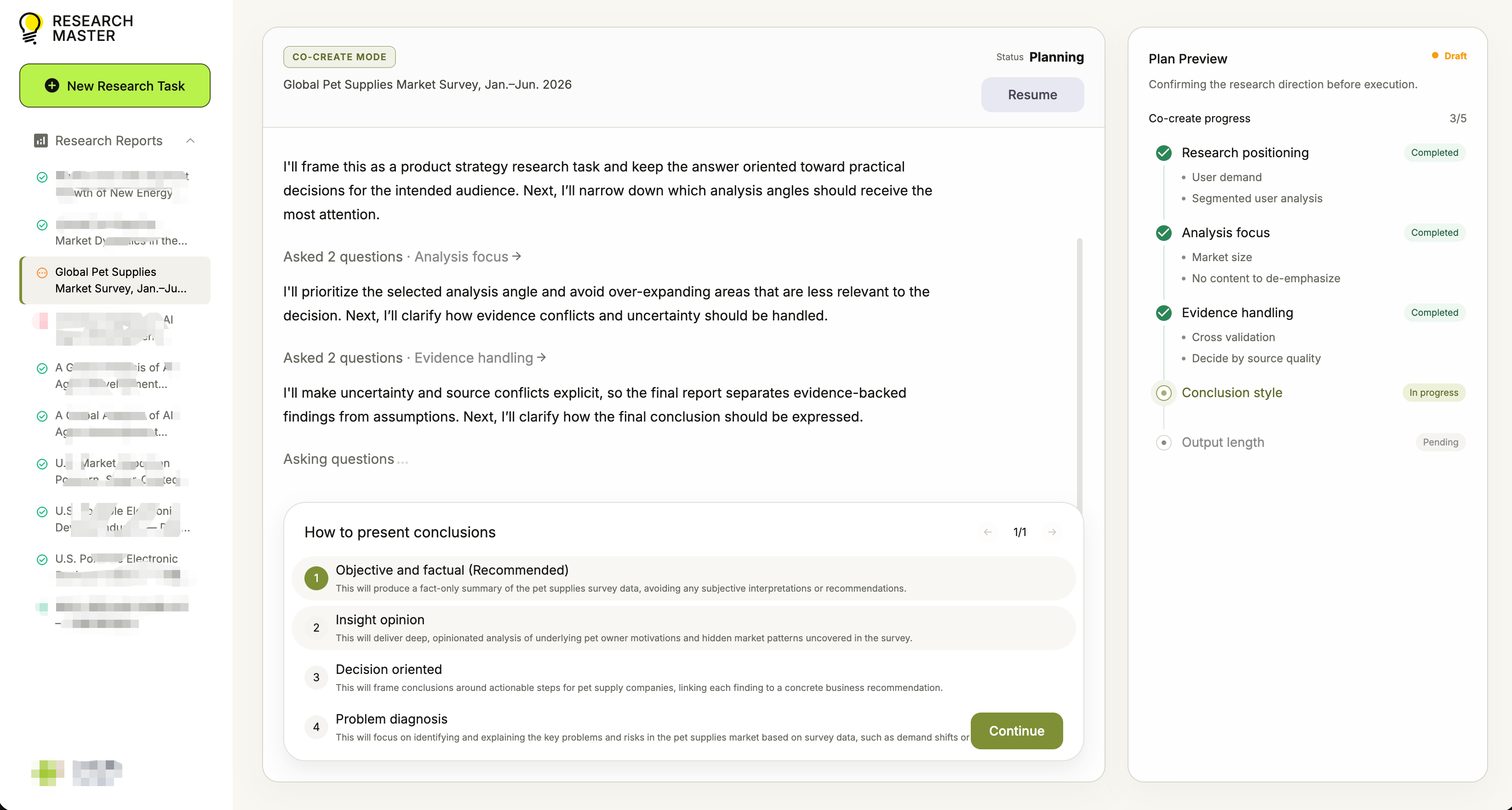
How ResearchMaster turns business material into presentation-ready content
ResearchMaster is an AI market research tool built to turn topics, URLs, and local files into structured, source-backed research. That makes it useful when a presentation needs more than a polished outline: it needs business context, relevant outside information, and a path back to the evidence behind an important claim.
1. Upload local files and set the presentation brief
Start with the material that already exists. Upload the relevant local files, then describe the region, industry, audience, and business goal.
The brief can be short, but it should answer a few practical questions:
- Who will see this presentation?
- What decision, conversation, or next step should it support?
- Which market, customer group, product, or time period is in scope?
- Which metrics, risks, or questions deserve the most attention?
This prevents a generic presentation structure from taking over a specific business task.
2. Use local context alongside external research
Local files show what the team has already learned. Public sources can add the market, industry, competitor, or regional context that an internal report does not contain.
ResearchMaster uses the supplied material as a starting point and can research related information across the web. The purpose is not to collect more links. It is to identify the information that changes the presentation: a missing market indicator, a relevant competitor signal, a current industry development, or a source that helps verify an important number.
This matters when internal and external evidence do not agree. A team may see changing customer behavior in sales records while public research shows a broader market trend. Both may be useful, but they should not be treated as interchangeable. Source verification and cited sources help the team distinguish direct evidence, context, and assumptions that still need review.
3. Organize the research for a presentation, not another report
Once the material is structured, the next job is to decide what the audience needs to understand first. A practical business presentation often follows this order:
- The decision or key conclusion
- The business or market context
- The most important data, customer insight, or competitive finding
- What the evidence means for the audience
- Recommended actions, risks, and next steps
- Sources and supporting material for follow-up
ResearchMaster can present the same work in several forms, including full text, key insights, Q&A, mind maps, slides, and shareable outputs. The presentation is therefore connected to the original research rather than rebuilt from a blank deck.
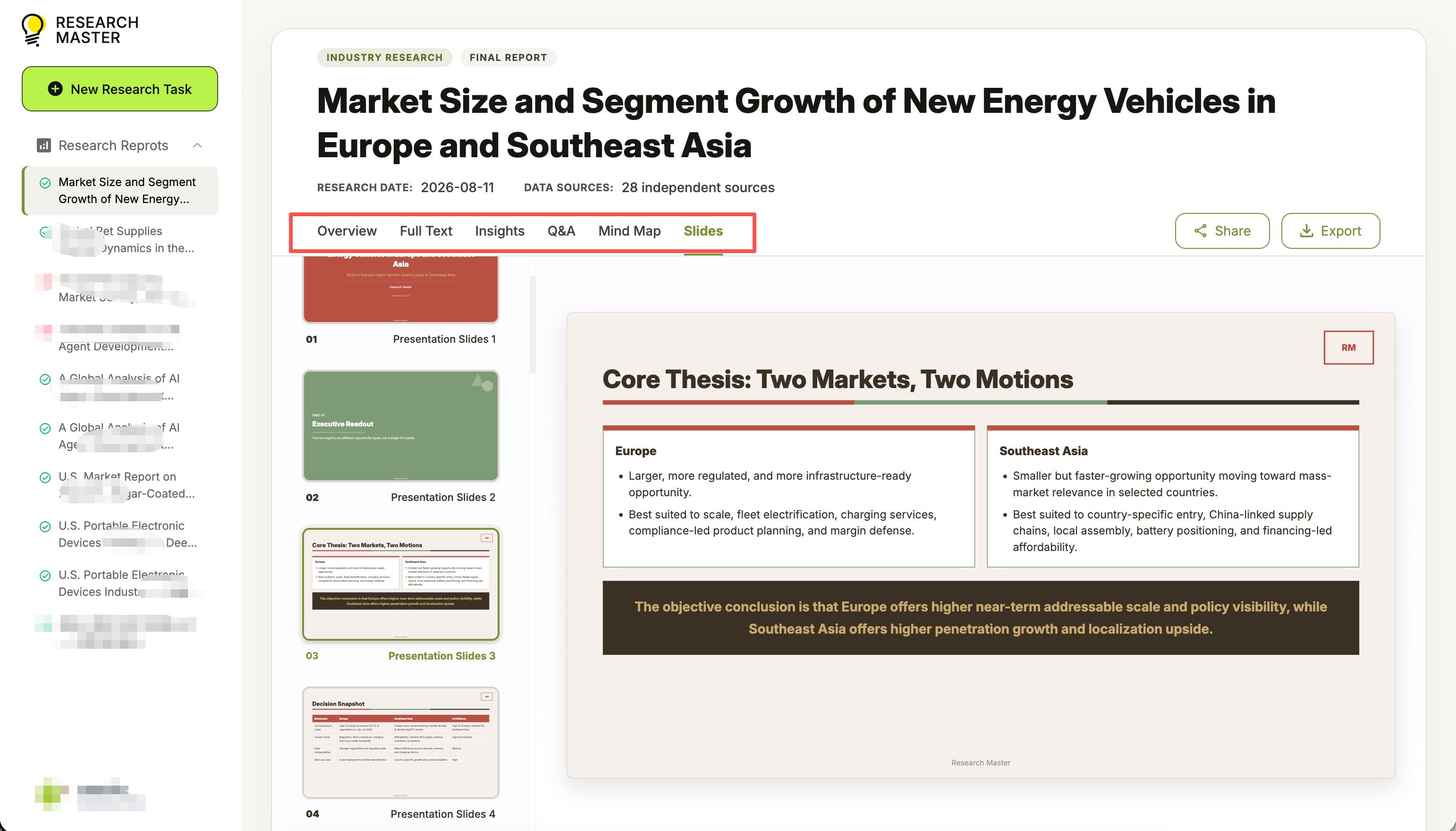
The deck may still need editing. A sales lead may need a stronger customer example; an executive may want one less detail and one clearer decision. Starting from a structured, evidence-backed presentation gives the team a better place to make those changes.
Match the deck to the job it needs to do
The same source material can lead to different presentations.
| Use case | First question to answer | Useful source material | Best presentation emphasis |
|---|---|---|---|
| Client proposal | Why should this client act now? | Customer context, market evidence, product information | Problem, value, proof, next step |
| Sales presentation | Why is this solution a fit? | Product brief, customer needs, competitive alternatives | Buyer needs, capabilities, outcomes |
| Internal update | What changed and what needs attention? | Operating data, meeting records, project updates | Progress, risks, decisions needed |
| Quarterly business review | What happened and what should happen next? | Performance data, customer insight, market signals | Results, explanation, priorities |
| Market-entry discussion | Is this market worth pursuing? | Local evidence, industry research, competitor analysis | Opportunity, constraints, evidence, recommendation |
The format should follow the decision. This is more useful than trying to make every report fit the same presentation template.
A better brief for an AI business presentation
Before starting, use a brief like this:
Turn the attached business records and market research into a presentation for audience. Focus on decision or business question in region and industry. Prioritize metrics, customer insights, risks, or competitor findings. Keep the main deck concise, include cited sources for important external claims, and reserve supporting detail for the appendix.
The more specific the decision, audience, and scope, the easier it is to decide what belongs on a slide.
For work that depends heavily on internal material, see our guide to turning local files into a verified industry report. If the research direction needs human review before the final output, Co-create Mode provides a guided workflow. For a broader view of how research output can support different stakeholders, see market research frameworks for AI-assisted decisions.
Turn business records into a discussion, not a document dump
The value in business data and records is already there. The challenge is connecting the material to a clear conclusion and a useful next step.
ResearchMaster helps teams begin with their own files, add relevant external context, check important sources, and create a structured output that can be presented, edited, or shared. That leaves less time spent moving paragraphs between documents and more time for the discussion the presentation is supposed to enable.